I am not in all cases and under all circumstances against…
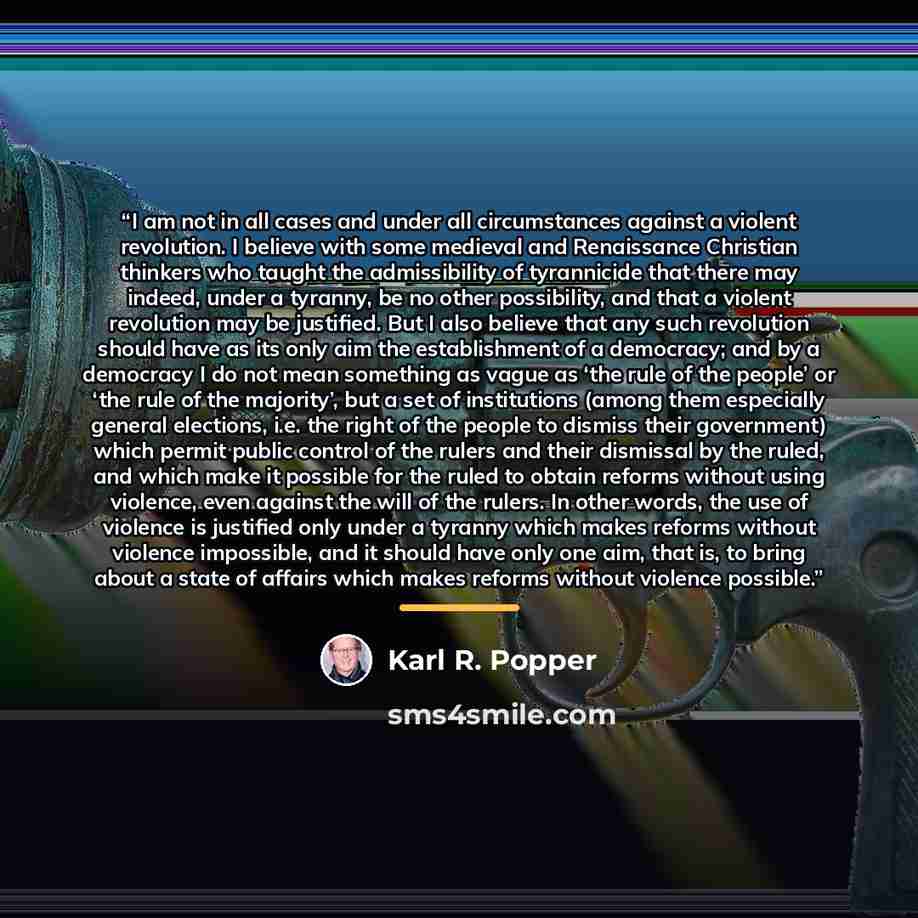
““I am not in all cases and under all circumstances against a violent revolution. I believe with some medieval and Renaissance Christian thinkers who taught the admissibility of tyrannicide that there may indeed, under a tyranny, be no other possibility, and that a violent revolution may be justified. But I also believe that any such revolution should have as its only aim the establishment of a democracy; and by a democracy I do not mean something as vague as ‘the rule of the people’ or ‘the rule of the majority’, but a set of institutions (among them especially general elections, i.e. the right of the people to dismiss their government) which permit public control of the rulers and their dismissal by the ruled, and which make it possible for the ruled to obtain reforms without using violence, even against the will of the rulers. In other words, the use of violence is justified only under a tyranny which makes reforms without violence impossible, and it should have only one aim, that is, to bring about a state of affairs which makes reforms without violence possible.””
About This Quote
This interpretation was drafted with AI assistance. It is one reading of the quote, not the author's own explanation.
Violent revolution is justified only under tyranny when peaceful reform is impossible; aim must be democratic institutions.
In simple terms: Violence may be needed to end tyranny, but only to build democracy.
Key Takeaway
Seek peaceful reform first; use force only as last resort.
Themes
politics
revolution
democracy
tyranny
ethics
Mood
critical
thoughtful
Type
philosophical
political
When to use this quote
- authoritarian regimes
- civil unrest
- transition to democracy
- human rights advocacy
- peaceful protest
Key Concepts
tyrannicide
social contract
institutional design
non‑violent change
Questions to Reflect On
- When is violence truly unavoidable?
- What safeguards ensure post‑revolution democracy?
A Different Perspective
Violence can cause unintended harm and instability.