But sympathy in novels need not be simply a matter of the…
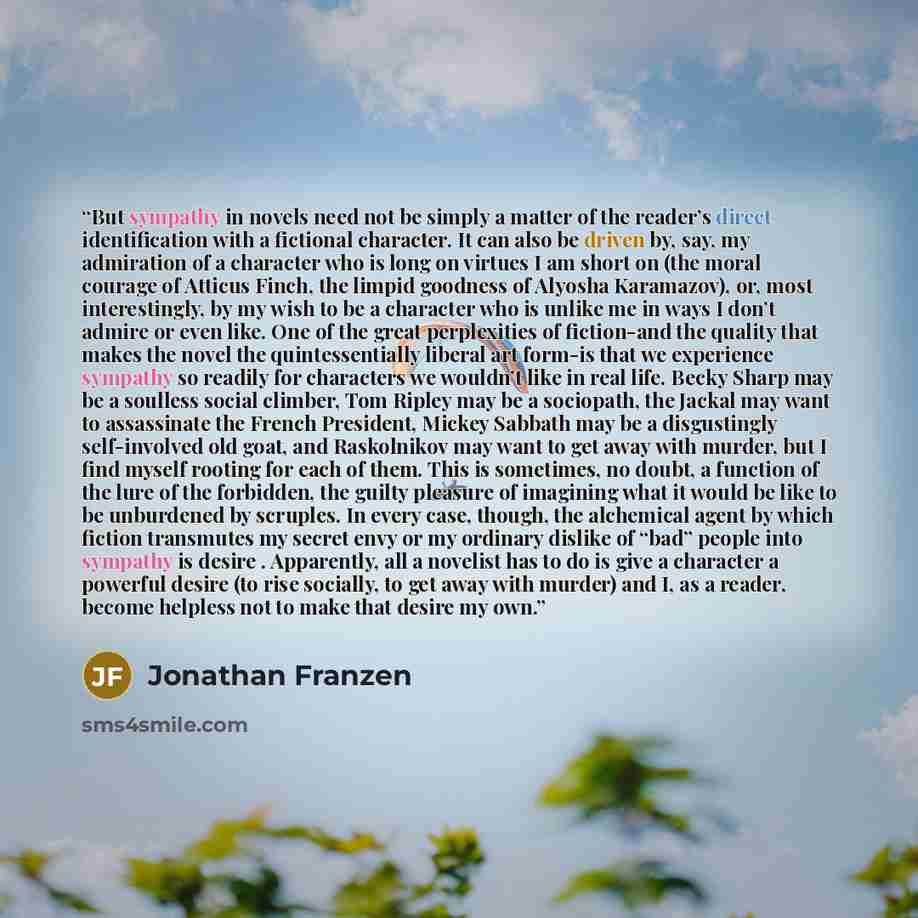
““But sympathy in novels need not be simply a matter of the reader’s direct identification with a fictional character. It can also be driven by, say, my admiration of a character who is long on virtues I am short on (the moral courage of Atticus Finch, the limpid goodness of Alyosha Karamazov), or, most interestingly, by my wish to be a character who is unlike me in ways I don’t admire or even like. One of the great perplexities of fiction-and the quality that makes the novel the quintessentially liberal art form-is that we experience sympathy so readily for characters we wouldn’t like in real life. Becky Sharp may be a soulless social climber, Tom Ripley may be a sociopath, the Jackal may want to assassinate the French President, Mickey Sabbath may be a disgustingly self-involved old goat, and Raskolnikov may want to get away with murder, but I find myself rooting for each of them. This is sometimes, no doubt, a function of the lure of the forbidden, the guilty pleasure of imagining what it would be like to be unburdened by scruples. In every case, though, the alchemical agent by which fiction transmutes my secret envy or my ordinary dislike of “bad” people into sympathy is desire . Apparently, all a novelist has to do is give a character a powerful desire (to rise socially, to get away with murder) and I, as a reader, become helpless not to make that desire my own.””
About This Quote
This interpretation was drafted with AI assistance. It is one reading of the quote, not the author's own explanation.
Readers empathize with characters through desire, even when they dislike them, turning envy or dislike into sympathy.
In simple terms: Desire in characters creates empathy, even for disliked ones.
Key Takeaway
Seek characters’ desires to understand your own feelings.
Themes
empathy
desire
fiction
identification
psychology
Mood
analytical
thoughtful
Type
literary
psychological
When to use this quote
- reading novels
- writing fiction
- film analysis
- psychotherapy
- teaching literature
Key Concepts
character motivation
moral complexity
projection
Questions to Reflect On
- What desires in characters resonate with you?
- How does identifying with a disliked character challenge your morals?
A Different Perspective
Desire alone may not bridge deep moral gaps; personal values still matter.