Long before the Gorgon Medusa constellated within the…
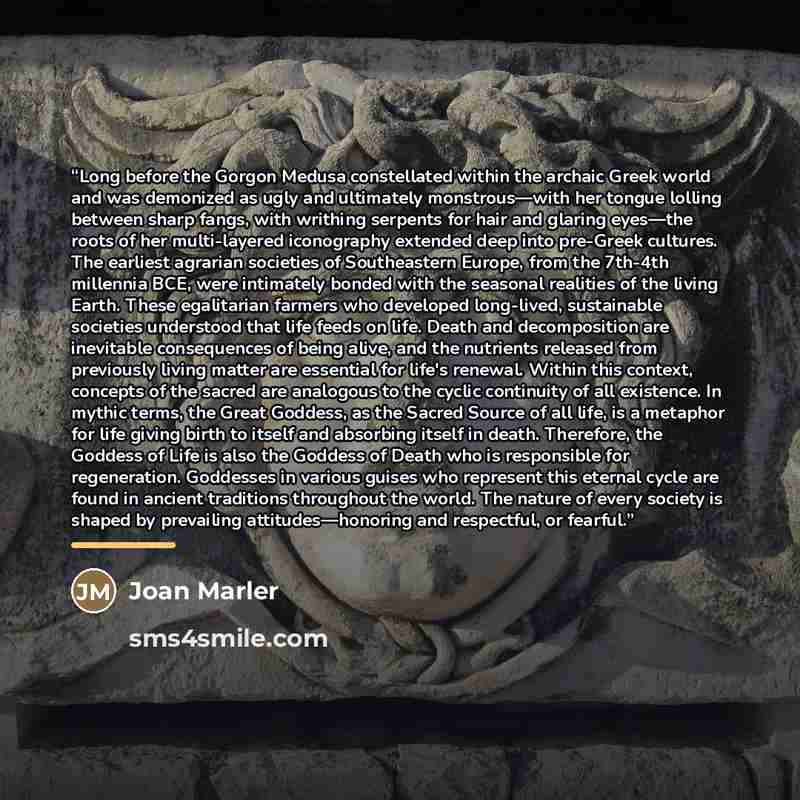
““Long before the Gorgon Medusa constellated within the archaic Greek world and was demonized as ugly and ultimately monstrous—with her tongue lolling between sharp fangs, with writhing serpents for hair and glaring eyes—the roots of her multi-layered iconography extended deep into pre-Greek cultures. The earliest agrarian societies of Southeastern Europe, from the 7th-4th millennia BCE, were intimately bonded with the seasonal realities of the living Earth. These egalitarian farmers who developed long-lived, sustainable societies understood that life feeds on life. Death and decomposition are inevitable consequences of being alive, and the nutrients released from previously living matter are essential for life's renewal. Within this context, concepts of the sacred are analogous to the cyclic continuity of all existence. In mythic terms, the Great Goddess, as the Sacred Source of all life, is a metaphor for life giving birth to itself and absorbing itself in death. Therefore, the Goddess of Life is also the Goddess of Death who is responsible for regeneration. Goddesses in various guises who represent this eternal cycle are found in ancient traditions throughout the world. The nature of every society is shaped by prevailing attitudes—honoring and respectful, or fearful.””
About This Quote
This interpretation was drafted with AI assistance. It is one reading of the quote, not the author's own explanation.
The quote explains that Medusa’s image originates from ancient agrarian cultures that saw life and death as a continuous, regenerative cycle, linking the goddess to both creation and decay.
In simple terms: Medusa’s myth reflects ancient ideas of life‑death cycles and renewal.
Key Takeaway
Recognize the balance of creation and destruction in nature.
Themes
mythology
cycle
renewal
gender
culture
Mood
reflective
inquisitive
Type
analytical
philosophical
inspirational
When to use this quote
- archaeology
- environmental education
- spiritual practice
- artistic inspiration
Key Concepts
sacredness
ecology
symbolism
Questions to Reflect On
- How do modern societies view the balance of life and death?
- What symbols in your culture reflect this cycle?
A Different Perspective
The interpretation may oversimplify diverse cultural meanings and ignore later political uses of the myth.