Bernard was to remember this moment for the rest of his…
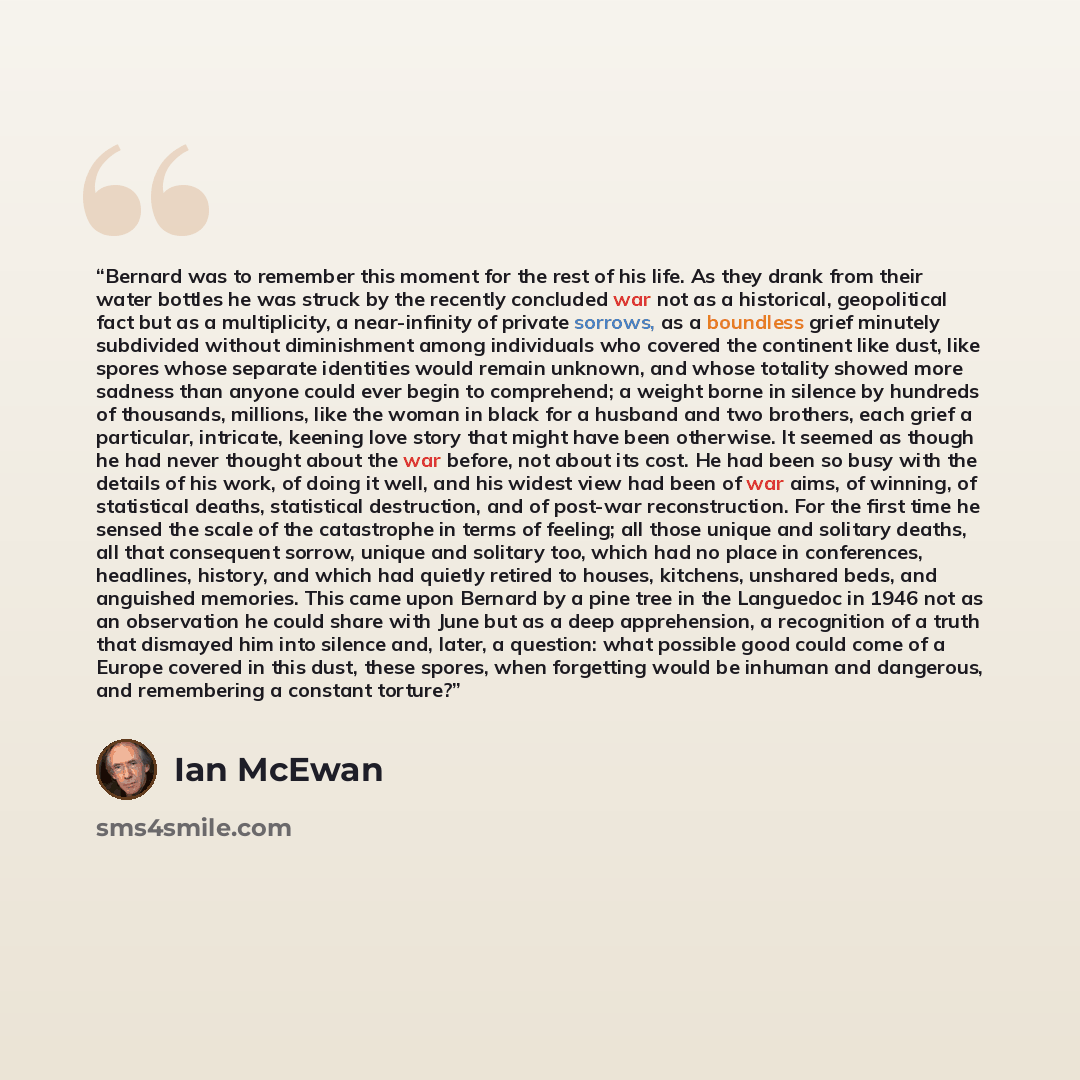
““Bernard was to remember this moment for the rest of his life. As they drank from their water bottles he was struck by the recently concluded war not as a historical, geopolitical fact but as a multiplicity, a near-infinity of private sorrows, as a boundless grief minutely subdivided without diminishment among individuals who covered the continent like dust, like spores whose separate identities would remain unknown, and whose totality showed more sadness than anyone could ever begin to comprehend; a weight borne in silence by hundreds of thousands, millions, like the woman in black for a husband and two brothers, each grief a particular, intricate, keening love story that might have been otherwise. It seemed as though he had never thought about the war before, not about its cost. He had been so busy with the details of his work, of doing it well, and his widest view had been of war aims, of winning, of statistical deaths, statistical destruction, and of post-war reconstruction. For the first time he sensed the scale of the catastrophe in terms of feeling; all those unique and solitary deaths, all that consequent sorrow, unique and solitary too, which had no place in conferences, headlines, history, and which had quietly retired to houses, kitchens, unshared beds, and anguished memories. This came upon Bernard by a pine tree in the Languedoc in 1946 not as an observation he could share with June but as a deep apprehension, a recognition of a truth that dismayed him into silence and, later, a question: what possible good could come of a Europe covered in this dust, these spores, when forgetting would be inhuman and dangerous, and remembering a constant torture?””
About This Quote
This interpretation was drafted with AI assistance. It is one reading of the quote, not the author's own explanation.
Bernard realizes war’s true cost is the countless private sorrows hidden behind statistics, revealing a collective grief that cannot be ignored.
In simple terms: War’s impact is personal suffering, not just numbers.
Key Takeaway
Recognize individual pain behind large tragedies.
Themes
war
memory
humanity
grief
history
Mood
somber
reflective
melancholic
Type
literary
philosophical
historical
When to use this quote
- post‑war reconstruction
- personal reflection
- public discourse
- education
- memorials
Key Concepts
collective trauma
empathy
historical consciousness
Questions to Reflect On
- How can societies honor individual loss while addressing systemic causes?
- What role does personal memory play in preventing future conflicts?
A Different Perspective
The quote may romanticize personal grief over structural analysis, risking emotional overwhelm.