In any disease, say smoking-induced lung or heart disease…
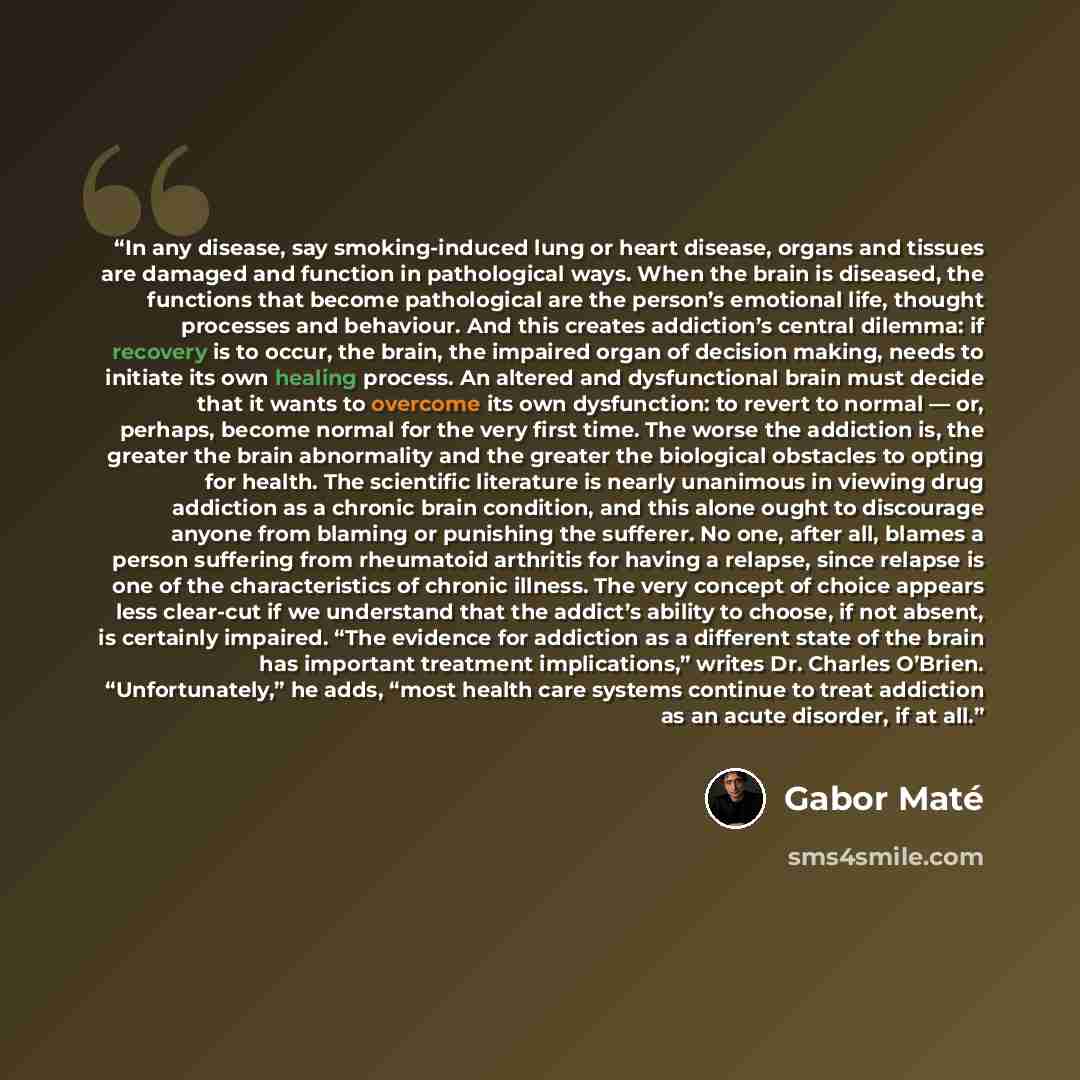
““In any disease, say smoking-induced lung or heart disease, organs and tissues are damaged and function in pathological ways. When the brain is diseased, the functions that become pathological are the person’s emotional life, thought processes and behaviour. And this creates addiction’s central dilemma: if recovery is to occur, the brain, the impaired organ of decision making, needs to initiate its own healing process. An altered and dysfunctional brain must decide that it wants to overcome its own dysfunction: to revert to normal — or, perhaps, become normal for the very first time. The worse the addiction is, the greater the brain abnormality and the greater the biological obstacles to opting for health. The scientific literature is nearly unanimous in viewing drug addiction as a chronic brain condition, and this alone ought to discourage anyone from blaming or punishing the sufferer. No one, after all, blames a person suffering from rheumatoid arthritis for having a relapse, since relapse is one of the characteristics of chronic illness. The very concept of choice appears less clear-cut if we understand that the addict’s ability to choose, if not absent, is certainly impaired. “The evidence for addiction as a different state of the brain has important treatment implications,” writes Dr. Charles O’Brien. “Unfortunately,” he adds, “most health care systems continue to treat addiction as an acute disorder, if at all.””
About This Quote
This interpretation was drafted with AI assistance. It is one reading of the quote, not the author's own explanation.
Addiction is a chronic brain disorder; recovery requires the brain to initiate its own healing, but health systems often treat it as an acute issue, hindering effective care.
In simple terms: Addiction is a brain disease needing self‑driven healing.
Key Takeaway
Support brain‑based treatment and reduce blame.
Themes
health
addiction
neuroscience
policy
Mood
empathetic
concerned
Type
educational
advocacy
When to use this quote
- clinical practice
- public health policy
- patient support
Key Concepts
chronic illness
decision making
treatment models
Questions to Reflect On
- What changes would improve addiction treatment?
- How can we reduce stigma for addicts?
A Different Perspective
Health systems often lack resources for long‑term brain‑focused care.