An imbecile habit has arisen in modern controversy of…
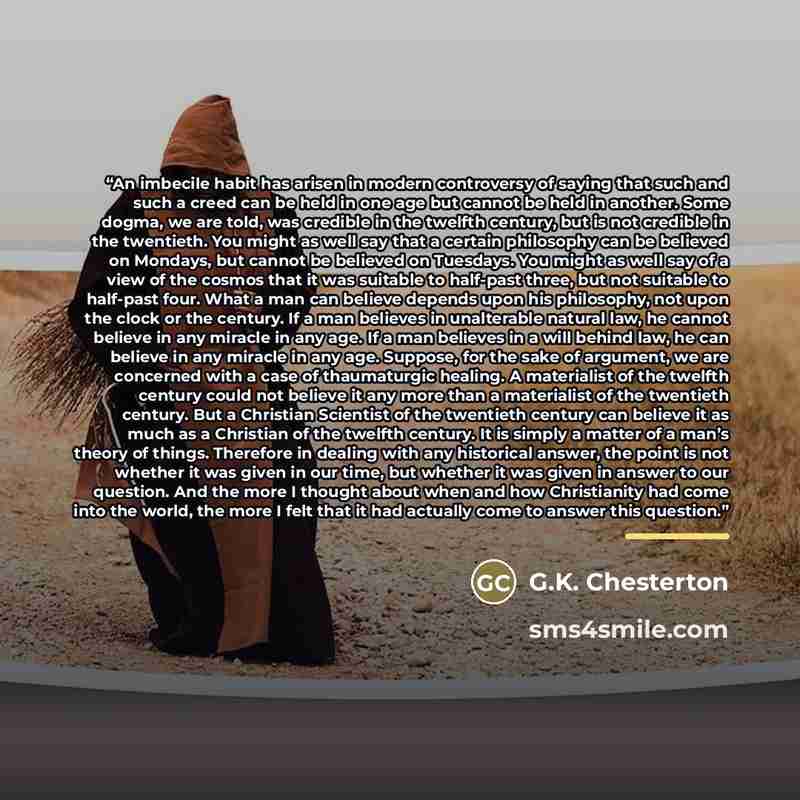
““An imbecile habit has arisen in modern controversy of saying that such and such a creed can be held in one age but cannot be held in another. Some dogma, we are told, was credible in the twelfth century, but is not credible in the twentieth. You might as well say that a certain philosophy can be believed on Mondays, but cannot be believed on Tuesdays. You might as well say of a view of the cosmos that it was suitable to half-past three, but not suitable to half-past four. What a man can believe depends upon his philosophy, not upon the clock or the century. If a man believes in unalterable natural law, he cannot believe in any miracle in any age. If a man believes in a will behind law, he can believe in any miracle in any age. Suppose, for the sake of argument, we are concerned with a case of thaumaturgic healing. A materialist of the twelfth century could not believe it any more than a materialist of the twentieth century. But a Christian Scientist of the twentieth century can believe it as much as a Christian of the twelfth century. It is simply a matter of a man’s theory of things. Therefore in dealing with any historical answer, the point is not whether it was given in our time, but whether it was given in answer to our question. And the more I thought about when and how Christianity had come into the world, the more I felt that it had actually come to answer this question.””
About This Quote
This interpretation was drafted with AI assistance. It is one reading of the quote, not the author's own explanation.
Beliefs are shaped by underlying philosophies, not by historical era or clock time.
In simple terms: What you believe depends on your worldview, not the date.
Key Takeaway
Examine your assumptions before judging ideas.
Themes
philosophy
belief
historical context
religion
science
Mood
thoughtful
analytical
inquisitive
Type
philosophical
theological
critical
When to use this quote
- debate on science vs. religion
- evaluating historical claims
- personal worldview analysis
- cross‑cultural belief comparison
- examining miracles in modern medicine
Key Concepts
relativism
faith
materialism
miracle
theology
Questions to Reflect On
- How does your worldview limit what you accept as possible?
- Can a belief be both historically rooted and universally true?
A Different Perspective
Counterpoint: Some truths may be timeless, but cultural lenses still affect interpretation.