This is apparently a little promotional ¶ where we’re…
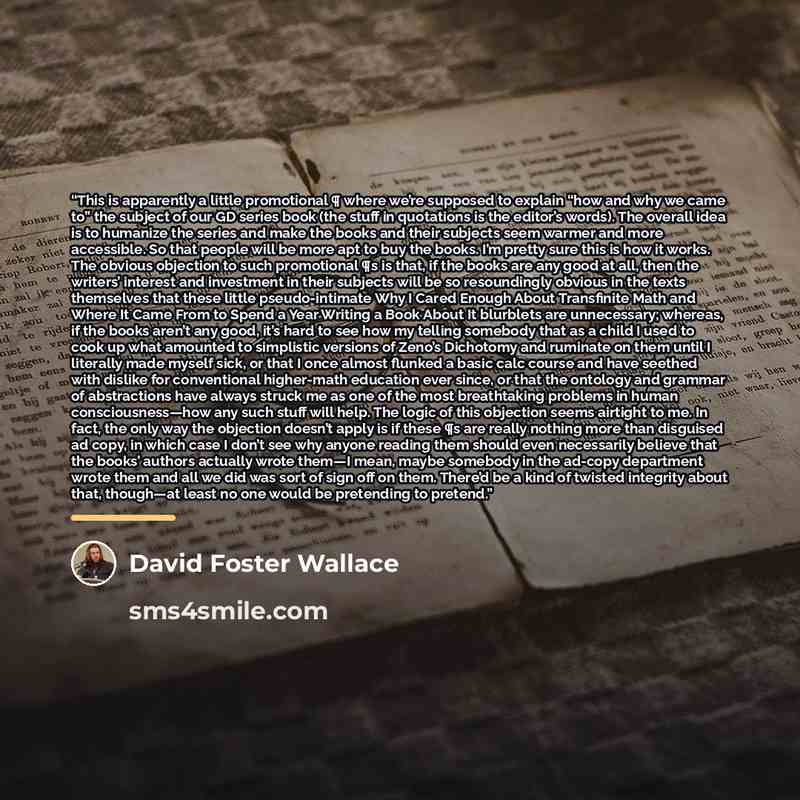
““This is apparently a little promotional ¶ where we’re supposed to explain “how and why we came to” the subject of our GD series book (the stuff in quotations is the editor’s words). The overall idea is to humanize the series and make the books and their subjects seem warmer and more accessible. So that people will be more apt to buy the books. I’m pretty sure this is how it works. The obvious objection to such promotional ¶s is that, if the books are any good at all, then the writers’ interest and investment in their subjects will be so resoundingly obvious in the texts themselves that these little pseudo-intimate Why I Cared Enough About Transfinite Math and Where It Came From to Spend a Year Writing a Book About It blurblets are unnecessary; whereas, if the books aren’t any good, it’s hard to see how my telling somebody that as a child I used to cook up what amounted to simplistic versions of Zeno’s Dichotomy and ruminate on them until I literally made myself sick, or that I once almost flunked a basic calc course and have seethed with dislike for conventional higher-math education ever since, or that the ontology and grammar of abstractions have always struck me as one of the most breathtaking problems in human consciousness—how any such stuff will help. The logic of this objection seems airtight to me. In fact, the only way the objection doesn’t apply is if these ¶s are really nothing more than disguised ad copy, in which case I don’t see why anyone reading them should even necessarily believe that the books’ authors actually wrote them—I mean, maybe somebody in the ad-copy department wrote them and all we did was sort of sign off on them. There’d be a kind of twisted integrity about that, though—at least no one would be pretending to pretend.””
About This Quote
This interpretation was drafted with AI assistance. It is one reading of the quote, not the author's own explanation.
The passage explains why the author includes personal, informal anecdotes to humanize the subject and make the book more appealing, despite potential criticism that good work should speak for itself.
In simple terms: Personal stories are used to make technical books feel warmer and more marketable.
Key Takeaway
Use relatable anecdotes to connect with readers.
Themes
marketing
authenticity
self‑promotion
writing process
Mood
reflective
critical
analytical
Type
promotional
self‑referential
meta
When to use this quote
- book launch
- academic publishing
- science communication
- marketing copy
- author introductions
Key Concepts
humanization
reader engagement
authorial voice
Questions to Reflect On
- Do personal stories always add value?
- When does authenticity become marketing?
A Different Perspective
If the book is weak, personal anecdotes may feel disingenuous and fail to persuade.