Who was the first person to go to the tomb? Was it Mary…
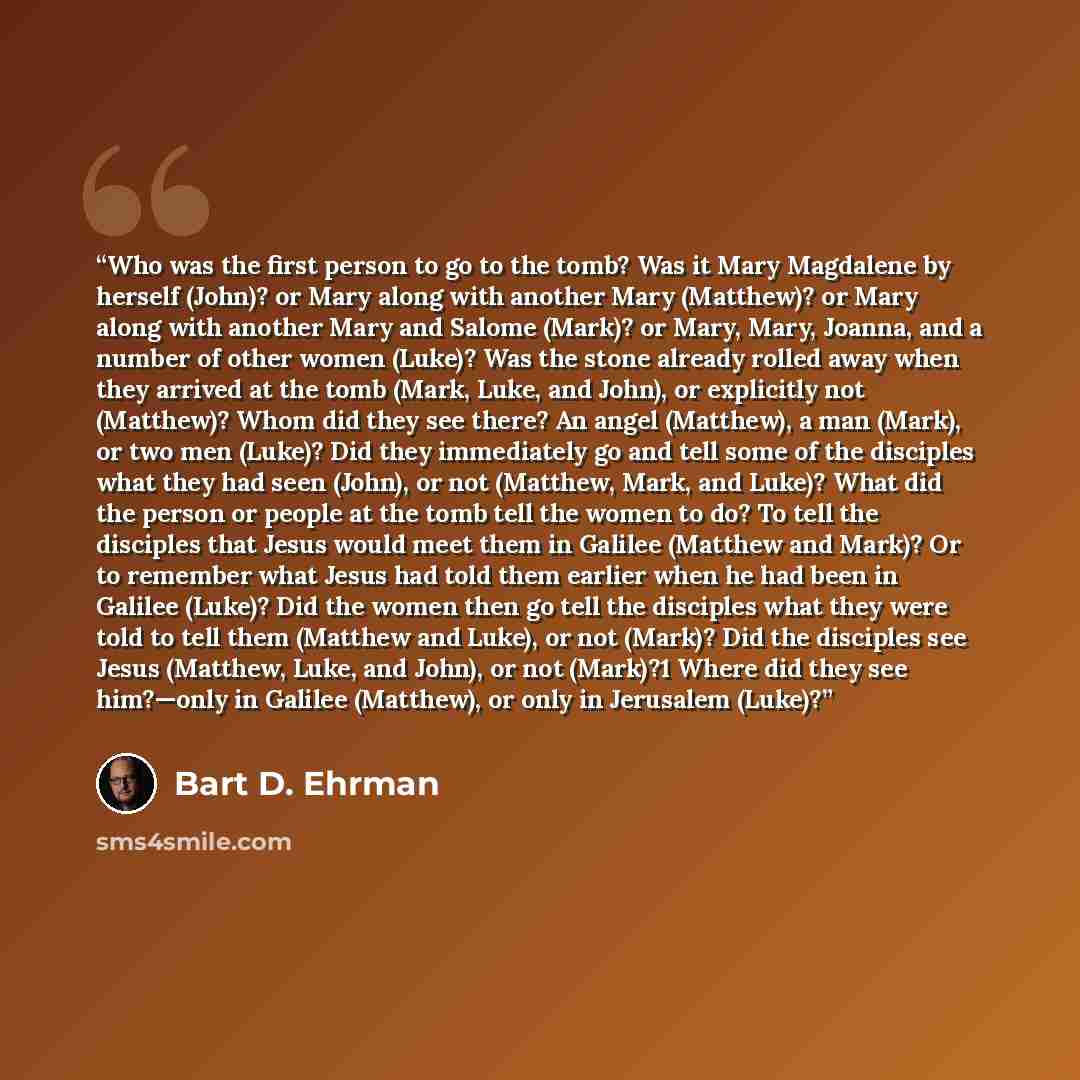
““Who was the first person to go to the tomb? Was it Mary Magdalene by herself (John)? or Mary along with another Mary (Matthew)? or Mary along with another Mary and Salome (Mark)? or Mary, Mary, Joanna, and a number of other women (Luke)? Was the stone already rolled away when they arrived at the tomb (Mark, Luke, and John), or explicitly not (Matthew)? Whom did they see there? An angel (Matthew), a man (Mark), or two men (Luke)? Did they immediately go and tell some of the disciples what they had seen (John), or not (Matthew, Mark, and Luke)? What did the person or people at the tomb tell the women to do? To tell the disciples that Jesus would meet them in Galilee (Matthew and Mark)? Or to remember what Jesus had told them earlier when he had been in Galilee (Luke)? Did the women then go tell the disciples what they were told to tell them (Matthew and Luke), or not (Mark)? Did the disciples see Jesus (Matthew, Luke, and John), or not (Mark)?1 Where did they see him?—only in Galilee (Matthew), or only in Jerusalem (Luke)?””
About This Quote
This interpretation was drafted with AI assistance. It is one reading of the quote, not the author's own explanation.
The Gospel accounts differ on details of the resurrection appearances, reflecting varied traditions and theological emphases.
In simple terms: Different Gospels give different resurrection details.
Key Takeaway
Consider multiple perspectives when studying history.
Themes
history
theology
gospel
interpretation
faith
Mood
thoughtful
inquisitive
Type
scholarly
reflective
When to use this quote
- academic research
- faith education
- interfaith dialogue
- personal study
- teaching
Key Concepts
scholarship
critical analysis
religious studies
Questions to Reflect On
- How do you reconcile conflicting accounts?
- What does this tell us about early Christian communities?
A Different Perspective
Discrepancies can challenge literalist beliefs and cause confusion.