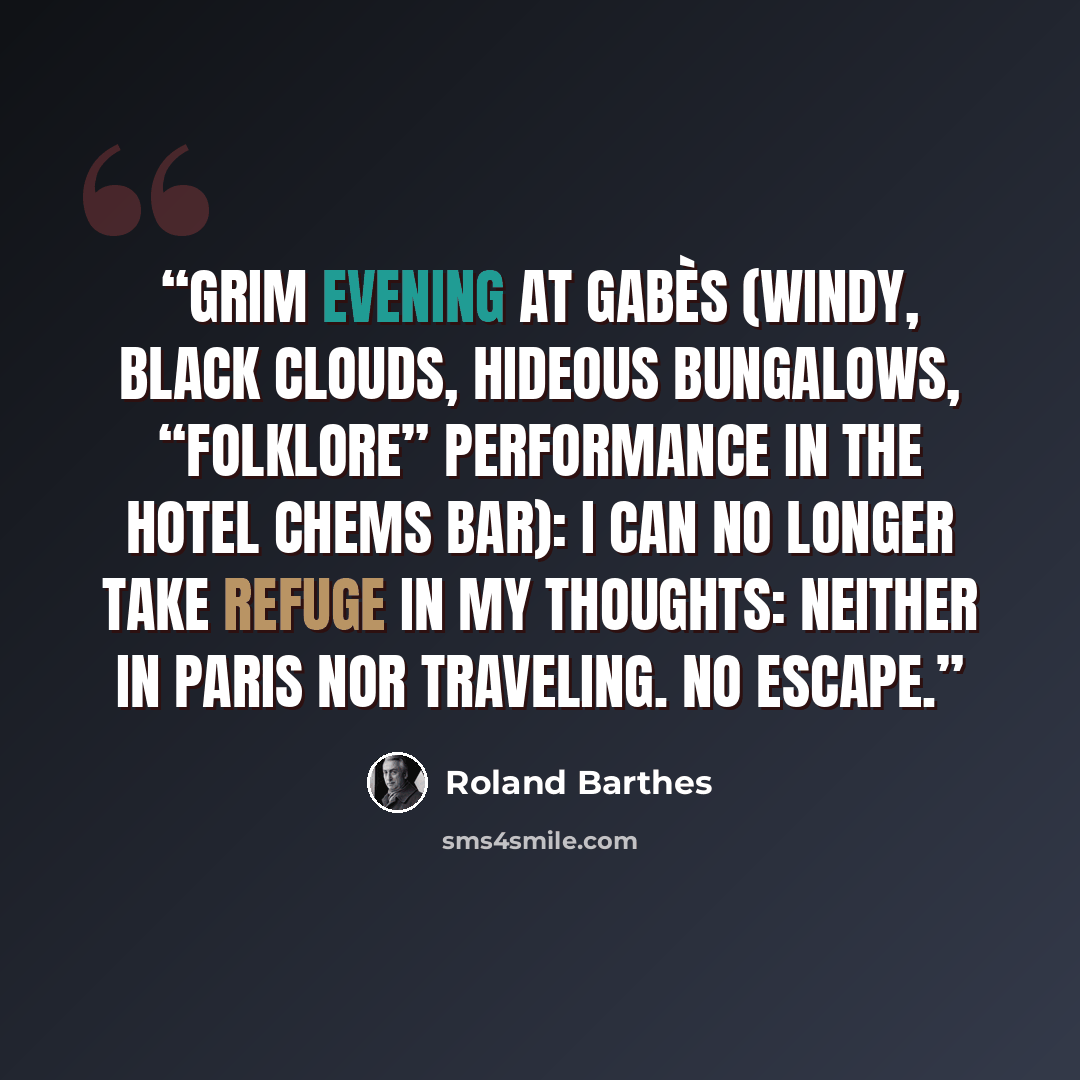
“Grim evening at Gabès (windy, black clouds, hideous bungalows, “folklore” performance in the Hotel Chems bar): I can no longer take refuge… — Roland Barthes Black clouds Copy Share Image
“The pleasure of the text is that moment when my body pursues its own ideas—for my body does not have the same… — Roland Barthes Pleasure Copy Share Image
I encounter millions of bodies in my life; of these millions, I may desire some hundreds; but of these hundreds, I love… — Roland Barthes Body Copy Share Image
The politician being interviewed clearly takes a great deal of trouble to imagine an ending to his sentence: and if he stopped… — Roland Barthes Copy Share Image
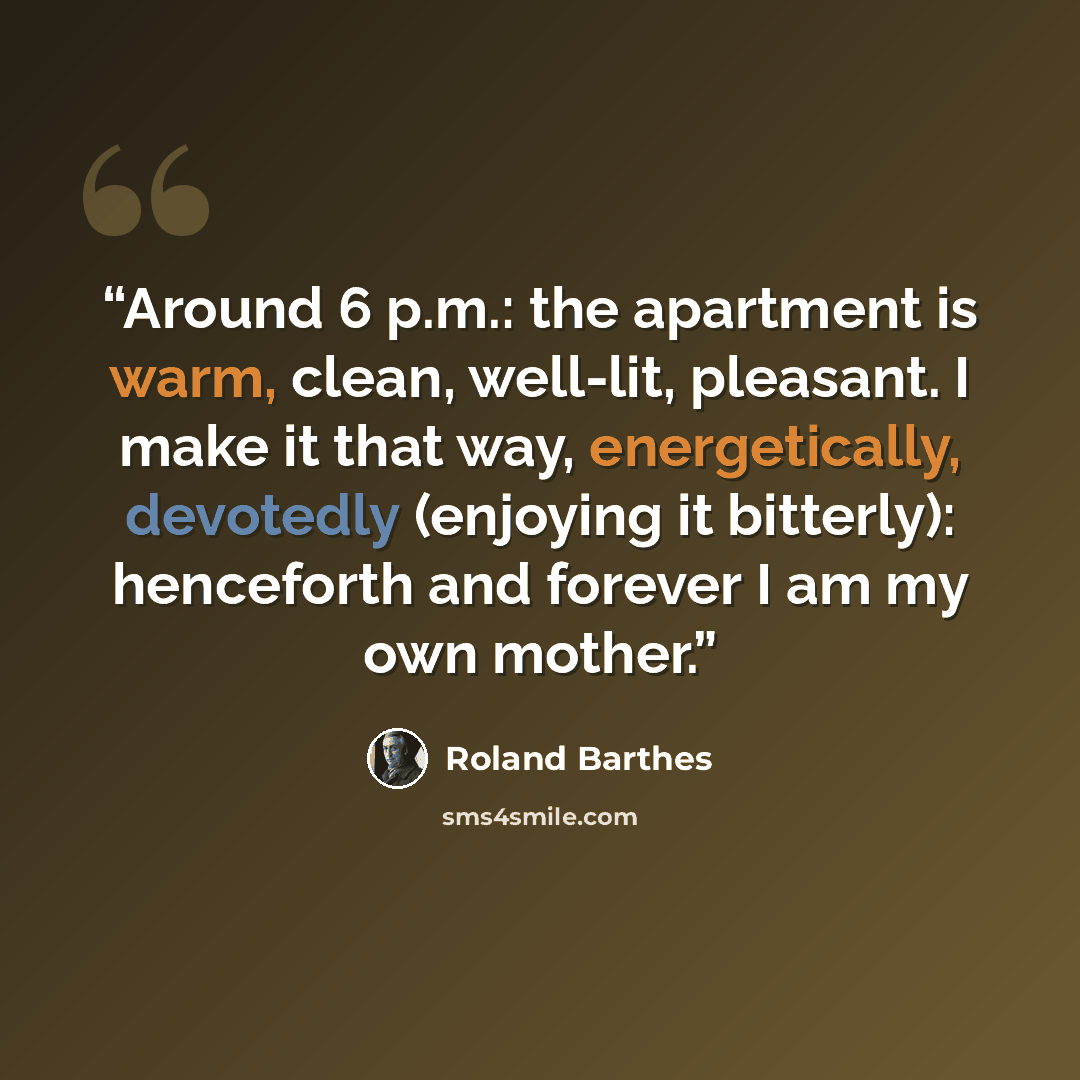
“Around 6 p.m.: the apartment is warm, clean, well-lit, pleasant. I make it that way, energetically, devotedly (enjoying it bitterly): henceforth and… — Roland Barthes Copy Share Image
“What affects me most powerfully: mourning in layers—a kind of sclerosis. [Which means: no depth. Layers of surface—or rather, each layer: a… — Roland Barthes Mourning Copy Share Image
Literature is without proofs. By which it must be understood that it cannot prove, not only what it says, but even that… — Roland Barthes Books Copy Share Image
I passed beyond the unreality of the thing represented, I entered crazily into the spectacle, into the image, taking into my arms… — Roland Barthes Copy Share Image
Ensnared in his starvation, Chaplin-man is always just below political awareness. A strike is a catastrophe for him because it threatens a… — Roland Barthes Copy Share Image
“The modern writer (scriptor) is born simultaneously with his text; he is in no way supplied with a being which precedes or… — Roland Barthes Postmodernism Copy Share Image
“I waver—in the dark—between the observation (but is it entirely accurate?) that I’m unhappy only by moments, by jerks and surges, sporadically,… — Roland Barthes Death Copy Share Image
For me the noise of Time is not sad: I love bells, clocks, watches — and I recall that at first photographic… — Roland Barthes Bells Copy Share Image
“(Love’s atopia, characteristic which causes it to escape all dissertations, would be that *ultimately* it is possible to talk about love only… — Roland Barthes Discourse Copy Share Image
Isn’t desire always the same, whether the object is present or absent? Isn’t the object always absent? —This isn’t the same languor:… — Roland Barthes Copy Share Image
There are two kinds of liberalism. A liberalism which is always, subterraneously authoritative and paternalistic, on the side of one's good conscience.… — Roland Barthes Conscience Copy Share Image
The unary Photograph has every reason to be banal, 'unity' of composition being the first rule of vulgar (and notably, of academic)… — Roland Barthes Academic Copy Share Image
“Absence is the figure of privation; simultaneously, I desire and I need. Desire is squashed against need: that is the obsessive phenomenon… — Roland Barthes Absence Copy Share Image
Inexpressible Love: To know that one does not write for the other, to know that these things I am going to write… — Roland Barthes Inexpressible Copy Share Image
“I cannot countenance the traditional belief that postulates a natural dichotomy between the objectivity of the scientist and the subjectivity of the… — Roland Barthes Contradiction Copy Share Image
The discourse on the Text should itself be nothing other than text, research, textual activity, since the Text is that social space… — Roland Barthes Copy Share Image
“I transform "Work" in its analytic meaning (the Work of Mourning, the Dream-Work) into the real "Work" - of writing.) for: the… — Roland Barthes Copy Share Image
“Everything began all over again immediately: arrival of manuscripts, requests, people’s stories, each person mercilessly pushing ahead his own little demand (for… — Roland Barthes Copy Share Image
“The Tower is not a usual spectacle; to enter the Tower, to scale it, to run around its courses, is, in a… — Roland Barthes Copy Share Image
“There is no sadness and no cruelty in that gaze; it is a gaze without adjectives, it is only, completely, a gaze… — Roland Barthes Copy Share Image
It is as if the Photograph always carries its referent with itself, both affected by the same amorous or funereal immobility, at… — Roland Barthes Copy Share Image
For the photograph's immobility is somehow the result of a perverse confusion between two concepts: the Real and the Live: by attesting… — Roland Barthes Alive Copy Share Image
“This book has two determinants: on the one hand, an ideological critique of the language of so-called mass culture; on the other,… — Roland Barthes Books Copy Share Image
“...The editors of (i)Life(i) rejected Kerész'a photographs when he arrived in the United States in 1937 because, they said, his images 'spoke… — Roland Barthes Copy Share Image
Literature can no longer be either Mimesis or Mathesis but merely Semiosis, the adventure of what is impossible to language, in a… — Roland Barthes Adventure Copy Share Image
Ultimately — or at the limit — in order to see a photograph well, it is best to look away or close… — Roland Barthes Copy Share Image
If I acknowledge my dependency, I do so because for me it is a means of signifying my demand: in the realm… — Roland Barthes Absurdity Copy Share Image
“I can do everything with my language but not with my body. What I hide by my language, my body utters. I… — Roland Barthes Body language Copy Share Image
Each photograph is read as the private appearance of its referent: the age of Photography corresponds precisely to the explosion of the… — Roland Barthes Age Copy Share Image
“Man does not exist prior to language, either as a species or as an individual. We never encounter a state where man… — Roland Barthes Language Copy Share Image
The Winter Photograph was my Ariadne, not because it would help me discover a secret thing (monster or treasure), but because it… — Roland Barthes Copy Share Image
“What pricks me is the discovery of this equivalence. In front of the photograph of my mother as a child, I tell… — Roland Barthes Children Copy Share Image
Is the scene always visual? It can be aural, the frame can be linguistic: I can fall in love with a sentence… — Roland Barthes Desire Copy Share Image
The Photograph is an extended, loaded evidence — as if it caricatured not the figure of what it represents (quite the converse)… — Roland Barthes Bizarre Copy Share Image
Other countries drink to get drunk, and this is accepted by everyone; in France, drunkenness is a consequence, never an intention. A… — Roland Barthes Copy Share Image
“It is by studium that I am interested in so many photographs, whether I receive them as political testimony or enjoy them… — Roland Barthes Photographs Copy Share Image



![“What affects me most powerfully: mourning in layers—a kind of sclerosis. [Which means: no depth. Layers of surface—or rather, each layer: a totality. Units]” quote by Roland Barthes](https://sms4smile.com/q/img-quotes/ac5/roland-barthes-1062_mourning_what-affects-me-most-powerfully-mourning_1556153.png)