Average person Quote by William Rosen
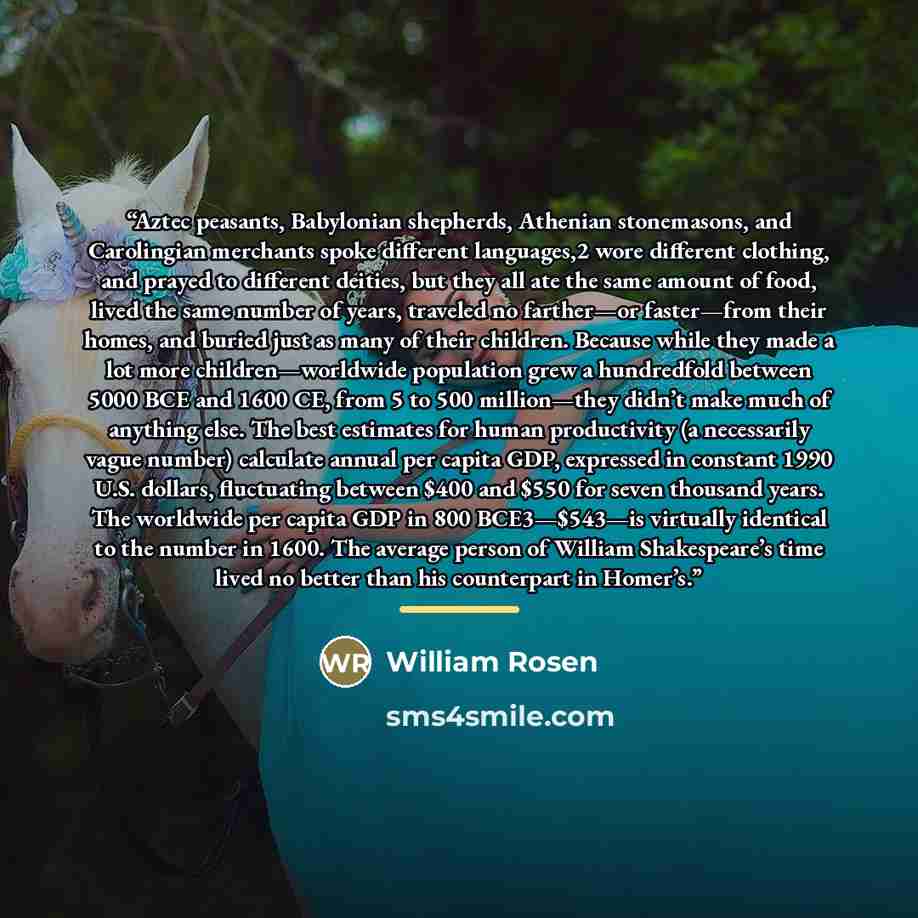
““Aztec peasants, Babylonian shepherds, Athenian stonemasons, and Carolingian merchants spoke different languages,2 wore different clothing, and prayed to different deities, but they all ate the same amount of food, lived the same number of years, traveled no farther—or faster—from their homes, and buried just as many of their children. Because while they made a lot more children—worldwide population grew a hundredfold between 5000 BCE and 1600 CE, from 5 to 500 million—they didn’t make much of anything else. The best estimates for human productivity (a necessarily vague number) calculate annual per capita GDP, expressed in constant 1990 U.S. dollars, fluctuating between $400 and $550 for seven thousand years. The worldwide per capita GDP in 800 BCE3—$543—is virtually identical to the number in 1600. The average person of William Shakespeare’s time lived no better than his counterpart in Homer’s.””
About This Quote
Source Book: The Story of Economics, William Rosen, 2011
Human productivity has barely changed over millennia despite population growth and cultural differences.
In simple terms: People’s output per person stayed almost the same for 7,000 years.
Key Takeaway
Recognize that economic growth is a recent phenomenon.
Themes
history
economics
productivity
population
inequality
Mood
analytical
thoughtful
Type
historical
economic
When to use this quote
- policy analysis
- educational curricula
- development economics
- comparative history
Key Concepts
GDP per capita
technological stagnation
cultural convergence
Questions to Reflect On
- What factors enabled the recent surge in productivity?
- How can we sustain growth without harming the environment?
A Different Perspective
Modern economies benefit from institutions, not just human effort.



![“My dad is a big extrovert - he's a doctor - but he always loved [William] Shakespeare and he took us to tons of theater.” quote by Vanessa Kirby](https://sms4smile.com/quotes/img-quotes/b3f/vanessa-kirby-7869_bigs_my-dad-is-a-big-extrovert-he-s-a-doctor_160313.jpg)





![“[Thine] face is not worth sunburning. William Shakespeare, Henry V” quote by William Shakespear](https://sms4smile.com/quotes/img-quotes/e10/william-shakespear-25254_being-awesome_thine-face-is-not-worth-sunburning-willi_94563.jpg)