Deadly sins Quote by W.H. Auden
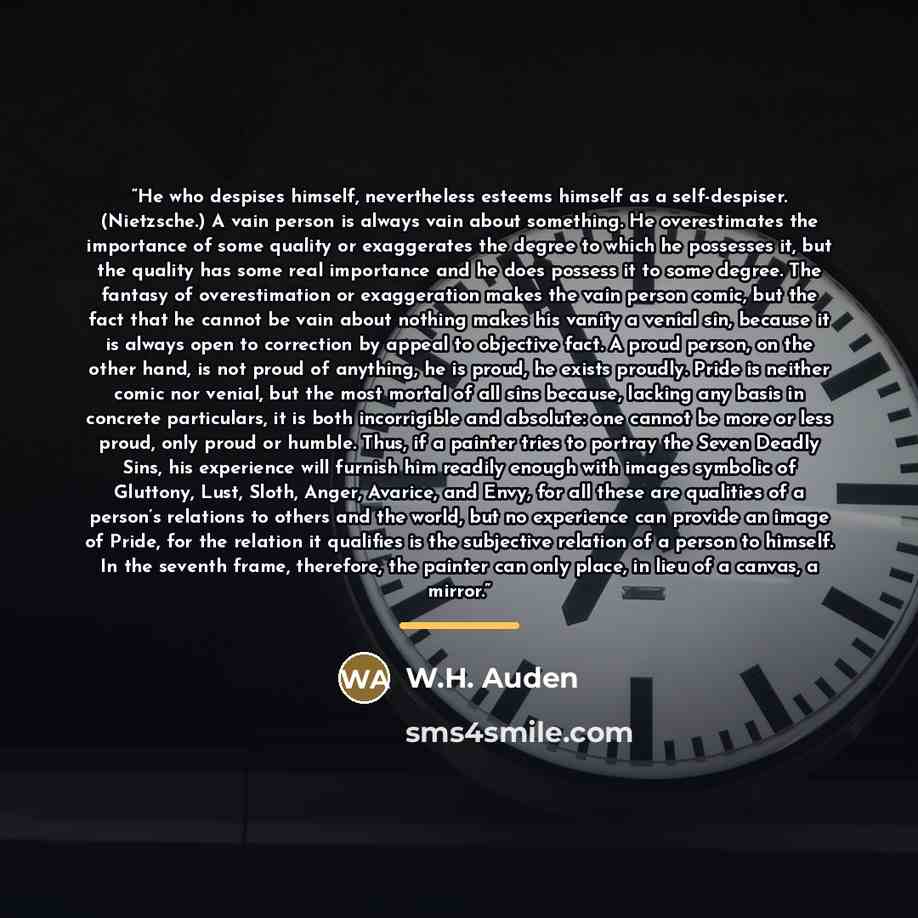
““He who despises himself, nevertheless esteems himself as a self-despiser. (Nietzsche.) A vain person is always vain about something. He overestimates the importance of some quality or exaggerates the degree to which he possesses it, but the quality has some real importance and he does possess it to some degree. The fantasy of overestimation or exaggeration makes the vain person comic, but the fact that he cannot be vain about nothing makes his vanity a venial sin, because it is always open to correction by appeal to objective fact. A proud person, on the other hand, is not proud of anything, he is proud, he exists proudly. Pride is neither comic nor venial, but the most mortal of all sins because, lacking any basis in concrete particulars, it is both incorrigible and absolute: one cannot be more or less proud, only proud or humble. Thus, if a painter tries to portray the Seven Deadly Sins, his experience will furnish him readily enough with images symbolic of Gluttony, Lust, Sloth, Anger, Avarice, and Envy, for all these are qualities of a person’s relations to others and the world, but no experience can provide an image of Pride, for the relation it qualifies is the subjective relation of a person to himself. In the seventh frame, therefore, the painter can only place, in lieu of a canvas, a mirror.””
About This Quote
Source Essay: "The Mirror of Pride" (1939)
Explores vanity versus pride, arguing pride is a unique, unrepresentable sin that can only be reflected, not depicted.
In simple terms: Pride is a self‑focused sin that cannot be shown, only mirrored.
Key Takeaway
Understand the limits of self‑assessment.
Themes
philosophy
psychology
ethics
Mood
analytical
thoughtful
Type
philosophical
critical
When to use this quote
- art criticism
- self‑reflection
- psychotherapy
- ethical debates
Key Concepts
vanity
pride
self‑perception
Questions to Reflect On
- How do you differentiate vanity from pride?
- Can self‑reflection reveal hidden pride?
A Different Perspective
Pride may be difficult to recognize in oneself.













![“Cassio is a ladies’ man, that is to say, a man who feels most at home in feminine company where his looks and good manners make him popular, but is ill at ease in the company of his own sex because he is unsure of his own masculinity. […] Cassio is a ladies’ man, not a seducer. With women of his…” quote by W.H. Auden](https://sms4smile.com/quotes/img-quotes/cb5/w-h-auden-2-7412_business_cassio-is-a-ladies-man-that-is-to-say-a_87978.jpg)