Berlin wall Quote by Tony Judt
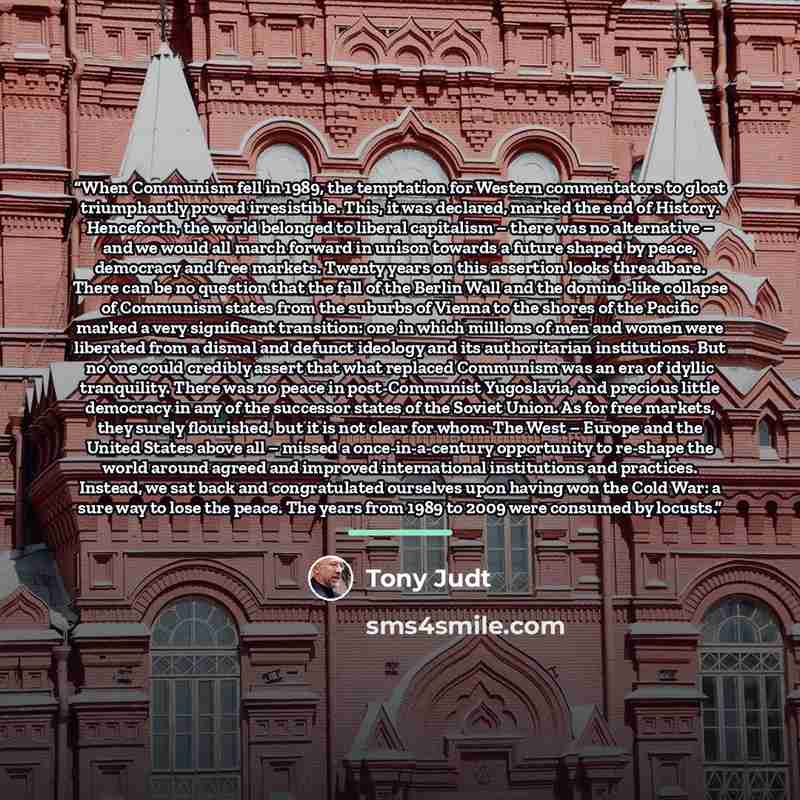
““When Communism fell in 1989, the temptation for Western commentators to gloat triumphantly proved irresistible. This, it was declared, marked the end of History. Henceforth, the world belonged to liberal capitalism – there was no alternative – and we would all march forward in unison towards a future shaped by peace, democracy and free markets. Twenty years on this assertion looks threadbare. There can be no question that the fall of the Berlin Wall and the domino-like collapse of Communism states from the suburbs of Vienna to the shores of the Pacific marked a very significant transition: one in which millions of men and women were liberated from a dismal and defunct ideology and its authoritarian institutions. But no one could credibly assert that what replaced Communism was an era of idyllic tranquility. There was no peace in post-Communist Yugoslavia, and precious little democracy in any of the successor states of the Soviet Union. As for free markets, they surely flourished, but it is not clear for whom. The West – Europe and the United States above all – missed a once-in-a-century opportunity to re-shape the world around agreed and improved international institutions and practices. Instead, we sat back and congratulated ourselves upon having won the Cold War: a sure way to lose the peace. The years from 1989 to 2009 were consumed by locusts.””
About This Quote
Source Book: Postwar: A History of Europe Since 1945, Tony Judt, 2005
The optimism after communism’s fall ignored ongoing conflicts and inequities, revealing a missed chance for better global governance.
In simple terms: Post‑communist optimism overlooked real problems and lost reform chances.
Key Takeaway
Question narratives of inevitable progress.
Themes
history
politics
economics
Mood
critical
thought‑provoking
Type
historical
analytical
When to use this quote
- policy making
- academic research
- public discourse
- international relations
Key Concepts
ideology critique
global governance
post‑cold war analysis
Questions to Reflect On
- What alternative paths could have been pursued?
- Who benefited most from the post‑1989 order?
A Different Perspective
Optimism can blind societies to new challenges and inequities.
![“Terrorism has replaced Communism as the rationale for the militarization of the country [America], for military adventures abroad, and for the suppression of civil liberties at home. It serves the same purpose, serving to create hysteria.” quote by Howard Zinn](https://sms4smile.com/quotes/img-quotes/45f/howard-zinn-576_adventure_terrorism-has-replaced-communism-as-the_706007.jpg)



![“Lieux de memoire . . . 'exist because there are no longer any milieux de memoire , settings in which memory is a real part of everyday experience.' And what are lieux de memoire ? [They] are . . . vestiges . . . the rituals of a ritual-less society.” quote by Tony Judt](https://sms4smile.com/quotes/img-quotes/e56/tony-judt-1730_memory_lieux-de-memoire-exist-because-there-are_21586.jpg)