Israel Quote by Timothy Snyder
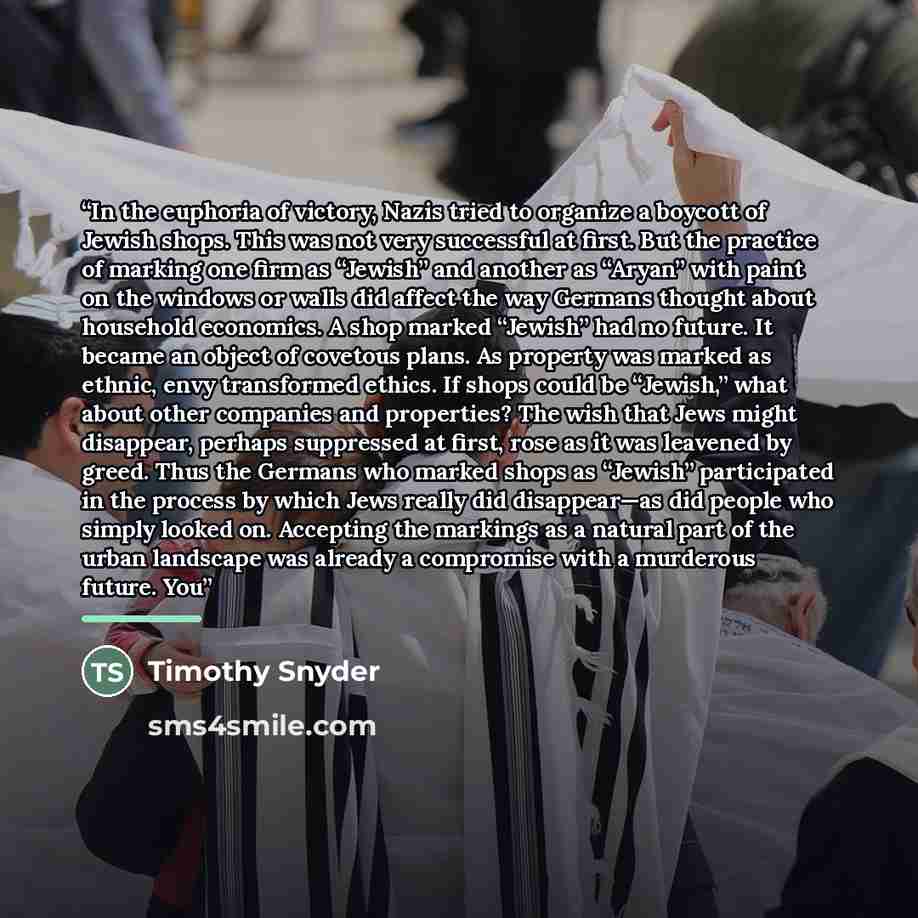
““In the euphoria of victory, Nazis tried to organize a boycott of Jewish shops. This was not very successful at first. But the practice of marking one firm as “Jewish” and another as “Aryan” with paint on the windows or walls did affect the way Germans thought about household economics. A shop marked “Jewish” had no future. It became an object of covetous plans. As property was marked as ethnic, envy transformed ethics. If shops could be “Jewish,” what about other companies and properties? The wish that Jews might disappear, perhaps suppressed at first, rose as it was leavened by greed. Thus the Germans who marked shops as “Jewish” participated in the process by which Jews really did disappear—as did people who simply looked on. Accepting the markings as a natural part of the urban landscape was already a compromise with a murderous future. You””
About This Quote
Source Book: Bloodlands: Europe Between Hitler and Stalin, 1933‑1945, 2010
Marking property by ethnicity normalizes exclusion, turning prejudice into economic competition and facilitating genocide.
In simple terms: Labeling people as “Jewish” made them targets and justified their removal.
Key Takeaway
Recognize how dehumanizing labels enable violence.
Themes
prejudice
economics
genocide
social psychology
Mood
somber
reflective
Type
historical
analytical
When to use this quote
- urban policy
- consumer behavior
- historical analysis
- propaganda campaigns
Key Concepts
ethnic labeling
moral disengagement
group dynamics
Questions to Reflect On
- How do modern economic practices echo these historic patterns?
- What safeguards can prevent labeling from leading to exclusion?
A Different Perspective
Such labeling can be resisted through legal protections and public awareness, but may persist covertly.
![“So he [Sigmund Freud] called this "the uncanny" and he also referred to cities as well, like the idea of walking through the city and the way the urban landscape could lead you to a sense of disorientation and to a kind of, you know, sense of repetition. And the way a city can unfold as you walk.” quote by DJ Spooky](https://sms4smile.com/quotes/img-quotes/711/dj-spooky-8230_cities_so-he-sigmund-freud-called-this-the-unca_1409290.jpg)







![“[Islam] Leaves no room of human legislation in an Islamic state, because herein all legislative functions vest in God and the only function left for Muslims lies in their observance of the God-made law.” quote by Abul A'la Maududi](https://sms4smile.com/quotes/img-quotes/704/abul-a-la-maududi-51903_function_islam-leaves-no-room-of-human-legislatio_886.jpg)