Blankness Quote by Thomas Pynchon
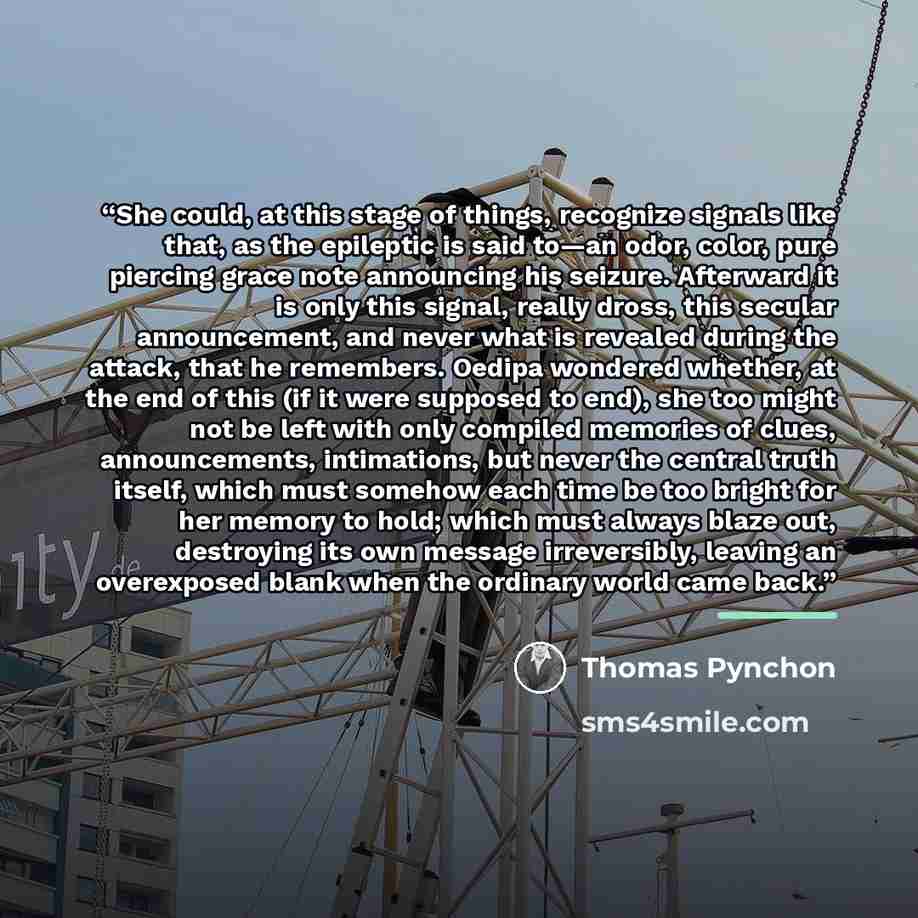
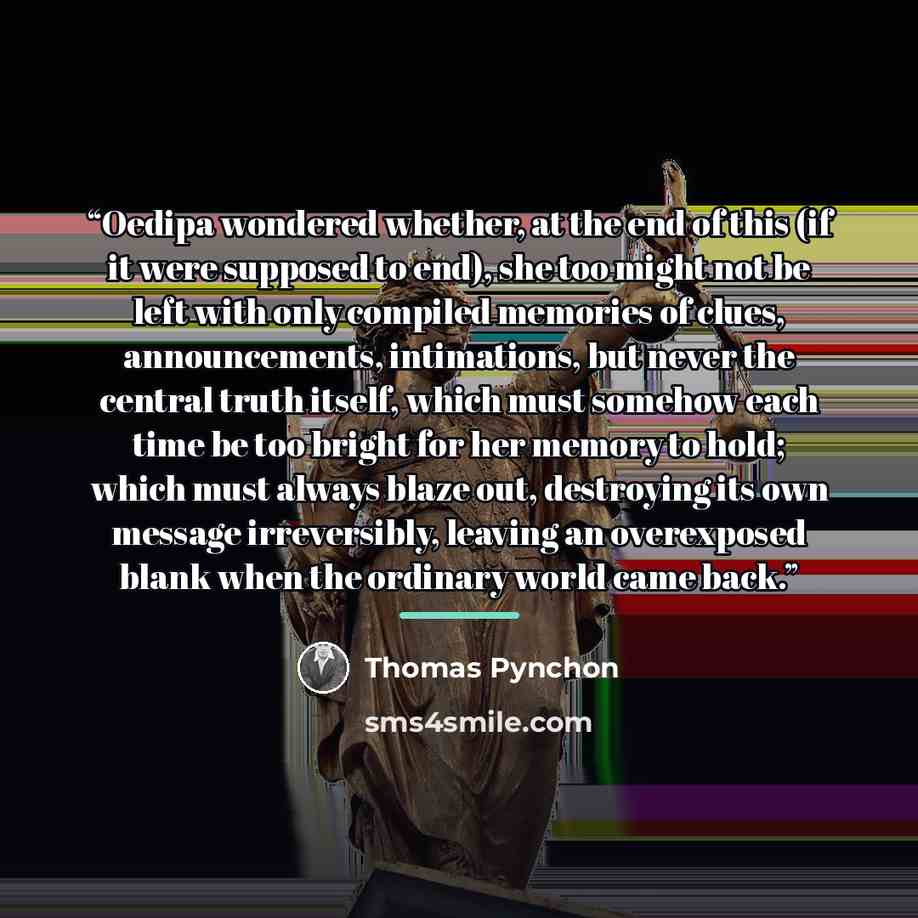
““She could, at this stage of things, recognize signals like that, as the epileptic is said to—an odor, color, pure piercing grace note announcing his seizure. Afterward it is only this signal, really dross, this secular announcement, and never what is revealed during the attack, that he remembers. Oedipa wondered whether, at the end of this (if it were supposed to end), she too might not be left with only compiled memories of clues, announcements, intimations, but never the central truth itself, which must somehow each time be too bright for her memory to hold; which must always blaze out, destroying its own message irreversibly, leaving an overexposed blank when the ordinary world came back.””
About This Quote
Source Novel: The Crying of Lot 49 by Thomas Pynchon, 1966
The narrator reflects on how intense experiences can be reduced to fleeting hints, leaving the core truth elusive and overwhelming to memory.
In simple terms: Intense moments become vague clues, not full truths.
Key Takeaway
Accept that some truths may remain beyond full comprehension.
Themes
memory
perception
truth
overwhelm
Mood
reflective
melancholic
introspective
Type
literary
philosophical
psychological
When to use this quote
- reading literature
- analyzing complex narratives
- personal introspection
- psychological study
- artistic criticism
Key Concepts
epilepsy metaphor
subjective reality
limits of cognition
Questions to Reflect On
- How do we cope with truths that exceed our mental capacity?
- What role do sensory cues play in shaping memory?
A Different Perspective
The metaphor may obscure rather than clarify the intended meaning.
![“[He] told me more than once that being with me is like an epileptic with a pacemaker being married to a strobe light artist.” quote by Maggie Nelson](https://sms4smile.com/quotes/img-quotes/4e3/maggie-nelson-4294_art_he-told-me-more-than-once-that-being-wit_935533.jpg)