Agnostic Quote by Thomas Henry Huxley
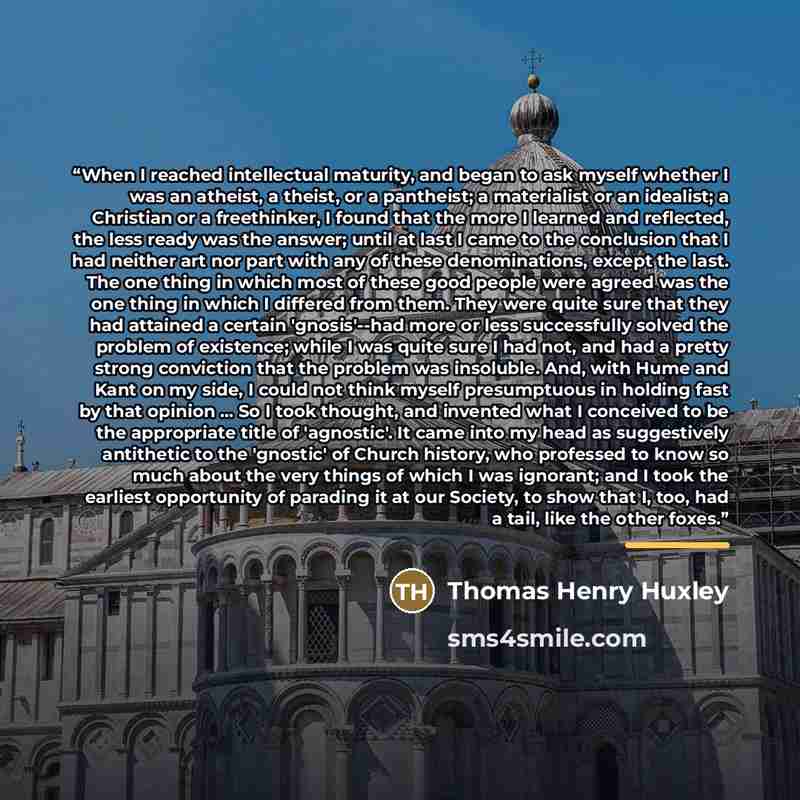
““When I reached intellectual maturity, and began to ask myself whether I was an atheist, a theist, or a pantheist; a materialist or an idealist; a Christian or a freethinker, I found that the more I learned and reflected, the less ready was the answer; until at last I came to the conclusion that I had neither art nor part with any of these denominations, except the last. The one thing in which most of these good people were agreed was the one thing in which I differed from them. They were quite sure that they had attained a certain 'gnosis'--had more or less successfully solved the problem of existence; while I was quite sure I had not, and had a pretty strong conviction that the problem was insoluble. And, with Hume and Kant on my side, I could not think myself presumptuous in holding fast by that opinion ... So I took thought, and invented what I conceived to be the appropriate title of 'agnostic'. It came into my head as suggestively antithetic to the 'gnostic' of Church history, who professed to know so much about the very things of which I was ignorant; and I took the earliest opportunity of parading it at our Society, to show that I, too, had a tail, like the other foxes.””
About This Quote
Source Speech: Address to the Metaphysical Society, London, 1869
Huxley coined “agnostic” to express that knowledge about divine matters is unattainable, contrasting with claimed certainty of others.
In simple terms: He argued we cannot know ultimate truths about God.
Key Takeaway
Accept uncertainty and avoid dogma.
Themes
philosophy
religion
epistemology
skepticism
Mood
thoughtful
introspective
Type
philosophical
skeptical
reflective
When to use this quote
- academic debate
- personal belief formation
- public lectures
- interfaith dialogue
Key Concepts
gnosis
agnosticism
knowledge limits
faith vs reason
Questions to Reflect On
- What evidence would change your stance on ultimate questions?
- How do you balance humility with curiosity?
A Different Perspective
Some may view agnosticism as indecisive rather than thoughtful.