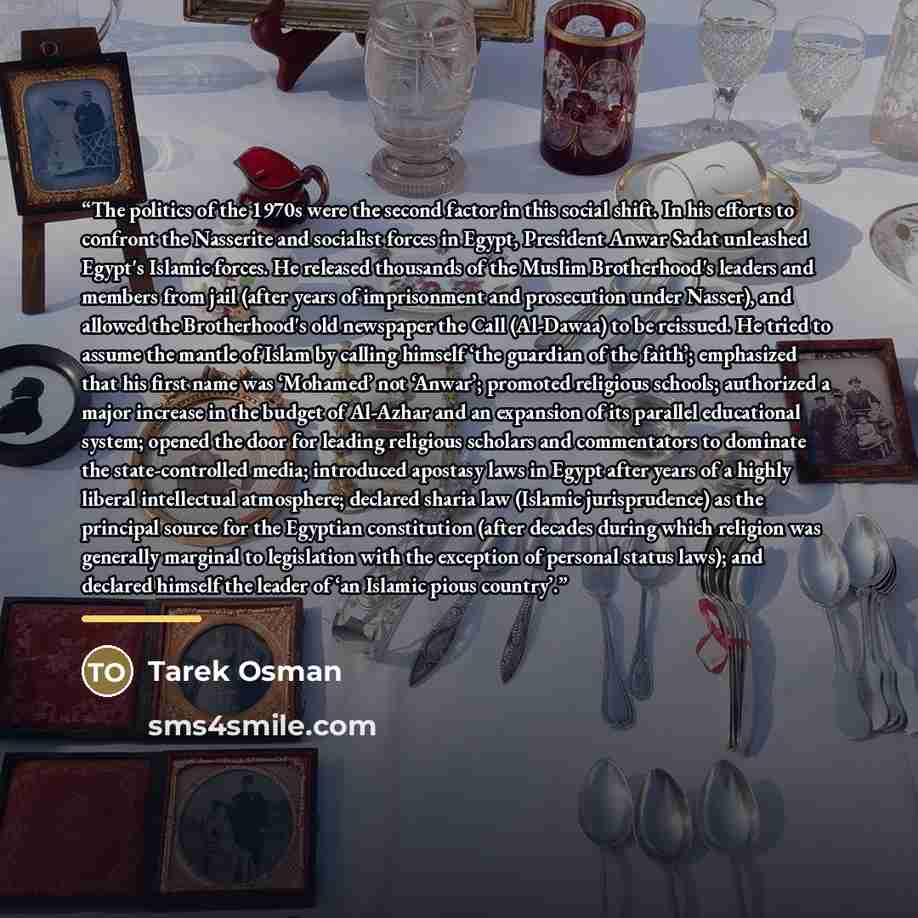
““The politics of the 1970s were the second factor in this social shift. In his efforts to confront the Nasserite and socialist forces in Egypt, President Anwar Sadat unleashed Egypt's Islamic forces. He released thousands of the Muslim Brotherhood's leaders and members from jail (after years of imprisonment and prosecution under Nasser), and allowed the Brotherhood's old newspaper the Call (Al-Dawaa) to be reissued. He tried to assume the mantle of Islam by calling himself ‘the guardian of the faith’; emphasized that his first name was ‘Mohamed’ not ‘Anwar’; promoted religious schools; authorized a major increase in the budget of Al-Azhar and an expansion of its parallel educational system; opened the door for leading religious scholars and commentators to dominate the state-controlled media; introduced apostasy laws in Egypt after years of a highly liberal intellectual atmosphere; declared sharia law (Islamic jurisprudence) as the principal source for the Egyptian constitution (after decades during which religion was generally marginal to legislation with the exception of personal status laws); and declared himself the leader of ‘an Islamic pious country’.””
![“Move over to Egypt. Once again, the [Barack] Obama administration, encouraged by Republicans, toppled [Hosni] Mubarak who had been a reliable ally of the United States, of Israel, and in its place, [Mohamed] Morsi and the Muslim Brotherhood came in, a terrorist organization.” quote by Ted Cruz](https://sms4smile.com/quotes/img-quotes/43d/ted-cruz-487_administration_move-over-to-egypt-once-again-the-barack_924371.jpg)
![“There was not a single Islamic slogan [in Egypt]. It was secular men and women, and in fact, they were unified. Now they want to divide the revolution, and religion is a very strong weapon.” quote by Nawal El Saadawi](https://sms4smile.com/quotes/img-quotes/f75/nawal-el-saadawi-4167_divides_there-was-not-a-single-islamic-slogan-in_1259271.jpg)

![“Ben Carson also denounced [Donald] Trump's ban all Muslims proposal saying we do not and would not advocate being selective on one's religion.” quote by Rachel Maddow](https://sms4smile.com/quotes/img-quotes/0d7/rachel-maddow-1240_bans_ben-carson-also-denounced-donald-trump-s_674.jpg)
![“[Islam] Leaves no room of human legislation in an Islamic state, because herein all legislative functions vest in God and the only function left for Muslims lies in their observance of the God-made law.” quote by Abul A'la Maududi](https://sms4smile.com/quotes/img-quotes/704/abul-a-la-maududi-51903_function_islam-leaves-no-room-of-human-legislatio_886.jpg)

![“[T]he people who are close to Allah worry so much about wasting time that they call themselves to account for every breath they spend - how many of us wonder about how we spend our day, let alone each breath?” quote by Ethar El- Katatney](https://sms4smile.com/quotes/img-quotes/a43/ethar-el-katatney-236694_allah_t-he-people-who-are-close-to-allah-worry_3003.jpg)