Writing Quote by Sylvain Reynard
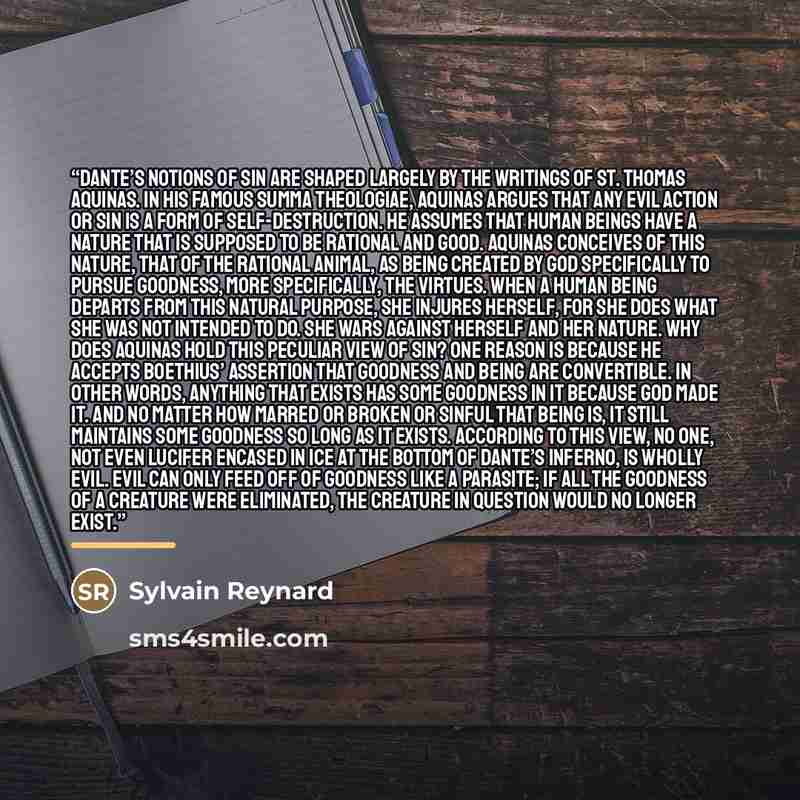
““Dante’s notions of sin are shaped largely by the writings of St. Thomas Aquinas. In his famous Summa Theologiae, Aquinas argues that any evil action or sin is a form of self-destruction. He assumes that human beings have a nature that is supposed to be rational and good. Aquinas conceives of this nature, that of the rational animal, as being created by God specifically to pursue goodness, more specifically, the virtues. When a human being departs from this natural purpose, she injures herself, for she does what she was not intended to do. She wars against herself and her nature. Why does Aquinas hold this peculiar view of sin? One reason is because he accepts Boethius’ assertion that goodness and being are convertible. In other words, anything that exists has some goodness in it because God made it. And no matter how marred or broken or sinful that being is, it still maintains some goodness so long as it exists. According to this view, no one, not even Lucifer encased in ice at the bottom of Dante’s Inferno, is wholly evil. Evil can only feed off of goodness like a parasite; if all the goodness of a creature were eliminated, the creature in question would no longer exist.””
About This Quote
Aquinas views sin as self‑destruction because he links evil to a deviation from the rational, God‑given nature intended for goodness.
In simple terms: Sin is harming yourself by acting against your true nature.
Key Takeaway
Recognize actions that betray your rational nature.
Themes
theology
philosophy
morality
human nature
Mood
reflective
thoughtful
Type
analytical
philosophical
When to use this quote
- personal decision‑making
- ethical counseling
- spiritual reflection
- literary analysis
Key Concepts
self‑destruction
goodness
evil asparasite
Boethius
Aquinas
Questions to Reflect On
- How do you identify when you act against your rational nature?
- Can evil exist without any goodness?
A Different Perspective
Aquinas’ view may overlook systemic or external causes of wrongdoing.
![“As Christians, if sin were the reason for our afflictions, then we should all be in ICU" ~ R. Alan Woods [2012]” quote by R. Alan Woods](https://sms4smile.com/quotes/img-quotes/b9d/r-alan-woods-1455_afflictions_as-christians-if-sin-were-the-reason-for_343184.jpg)

![“Saint Thomas Aquinas says, wisely, that the only way to drive out a bad passion is by a stronger good passion. The same is true of thoughts as of passions. When your mind wanders, like a child, your will must bring it back, like a mother. [. . .] The will-parent must discipline the mind-child…” quote by Peter Kreeft](https://sms4smile.com/quotes/img-quotes/726/peter-kreeft-820_discipline_saint-thomas-aquinas-says-wisely-that-th_537121.jpg)