Repulsed Quote by Sue Monk Kidd
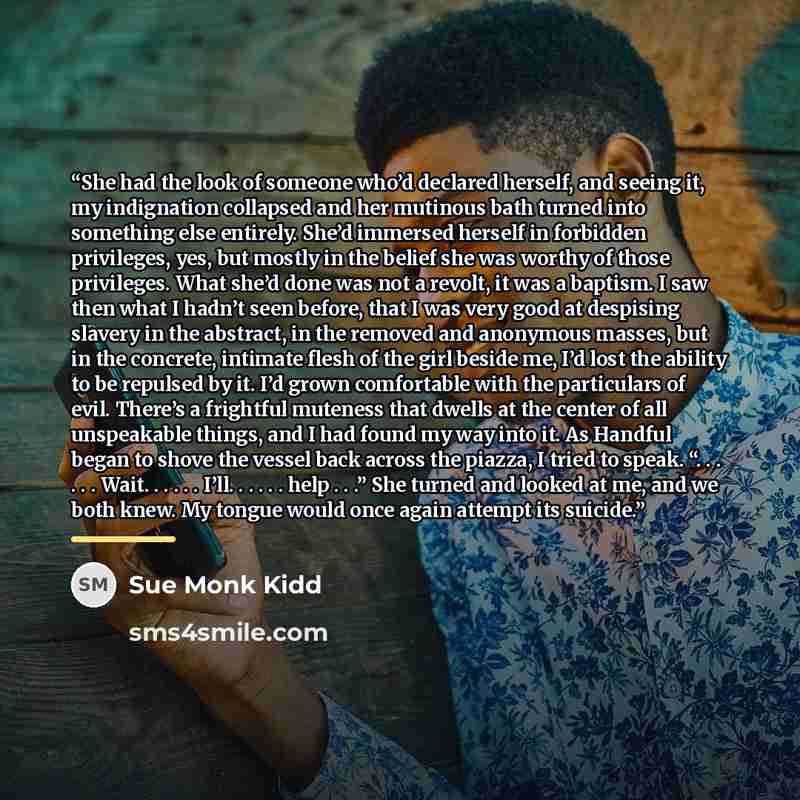
““She had the look of someone who’d declared herself, and seeing it, my indignation collapsed and her mutinous bath turned into something else entirely. She’d immersed herself in forbidden privileges, yes, but mostly in the belief she was worthy of those privileges. What she’d done was not a revolt, it was a baptism. I saw then what I hadn’t seen before, that I was very good at despising slavery in the abstract, in the removed and anonymous masses, but in the concrete, intimate flesh of the girl beside me, I’d lost the ability to be repulsed by it. I’d grown comfortable with the particulars of evil. There’s a frightful muteness that dwells at the center of all unspeakable things, and I had found my way into it. As Handful began to shove the vessel back across the piazza, I tried to speak. “. . . . . . Wait. . . . . . I’ll. . . . . . help . . .” She turned and looked at me, and we both knew. My tongue would once again attempt its suicide.””
About This Quote
She pretended to be worthy of forbidden privileges, turning rebellion into a personal rite, which made the narrator confront his own complacency toward abstract evil versus concrete suffering.
In simple terms: She claimed privilege, turning defiance into a personal rite, exposing the narrator’s moral blindness.
Key Takeaway
Recognize how personal privilege can mask deeper moral failings.
Themes
morality
privilege
identity
empathy
Mood
thoughtful
introspective
Type
literary
philosophical
When to use this quote
- social justice work
- ethical training
- personal reflection
- literary analysis
- psychotherapy
Key Concepts
self‑deception
ethical blindness
personal transformation
Questions to Reflect On
- How does personal privilege affect our view of injustice?
- Can recognizing personal complicity lead to real change?
A Different Perspective
The narrator’s introspection may be self‑serving, not fully addressing systemic injustice.