Cognition Quote by Steven Pinker
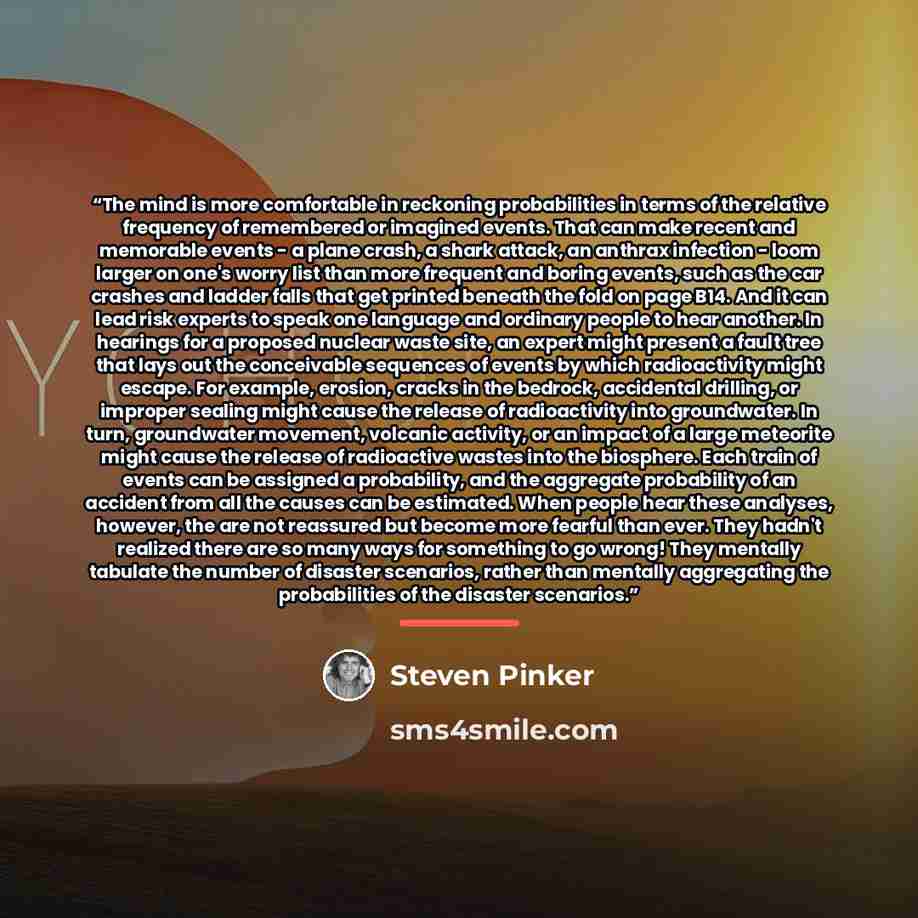
““The mind is more comfortable in reckoning probabilities in terms of the relative frequency of remembered or imagined events. That can make recent and memorable events - a plane crash, a shark attack, an anthrax infection - loom larger on one's worry list than more frequent and boring events, such as the car crashes and ladder falls that get printed beneath the fold on page B14. And it can lead risk experts to speak one language and ordinary people to hear another. In hearings for a proposed nuclear waste site, an expert might present a fault tree that lays out the conceivable sequences of events by which radioactivity might escape. For example, erosion, cracks in the bedrock, accidental drilling, or improper sealing might cause the release of radioactivity into groundwater. In turn, groundwater movement, volcanic activity, or an impact of a large meteorite might cause the release of radioactive wastes into the biosphere. Each train of events can be assigned a probability, and the aggregate probability of an accident from all the causes can be estimated. When people hear these analyses, however, the are not reassured but become more fearful than ever. They hadn't realized there are so many ways for something to go wrong! They mentally tabulate the number of disaster scenarios, rather than mentally aggregating the probabilities of the disaster scenarios.””
About This Quote
Source Book: The Better Angels of Our Nature, Steven Pinker, 2011
People overestimate rare, vivid events and underestimate common, mundane risks, leading to distorted fear and communication gaps between experts and the public.
In simple terms: We focus on dramatic events, ignoring everyday risks.
Key Takeaway
Recognize and balance vivid and routine risks.
Themes
cognition
risk perception
communication
psychology
decision making
Mood
anxious
thoughtful
inquisitive
Type
analytical
educational
When to use this quote
- public policy debates
- health risk communication
- environmental safety planning
- personal risk assessment
Key Concepts
availability heuristic
probability weighting
risk communication
expert‑public gap
Questions to Reflect On
- How can experts present risk without amplifying fear?
- What habits help balance vivid and routine risk awareness?
A Different Perspective
Rare events dominate fear, but statistical reality may be opposite.






![“[Mood allocates] investments of time, effort, resources, and risk taking to maximize Darwinian fitness in situations of varying propitiousness. High and low moods adjust cognition and behavior to cope with propitious and unpropitious situations.” quote by Randolph M. Nesse](https://sms4smile.com/quotes/img-quotes/6d0/randolph-m-nesse-24802_behavior_mood-allocates-investments-of-time-effor_87538.jpg)