Beauty Quote by Simone Weil

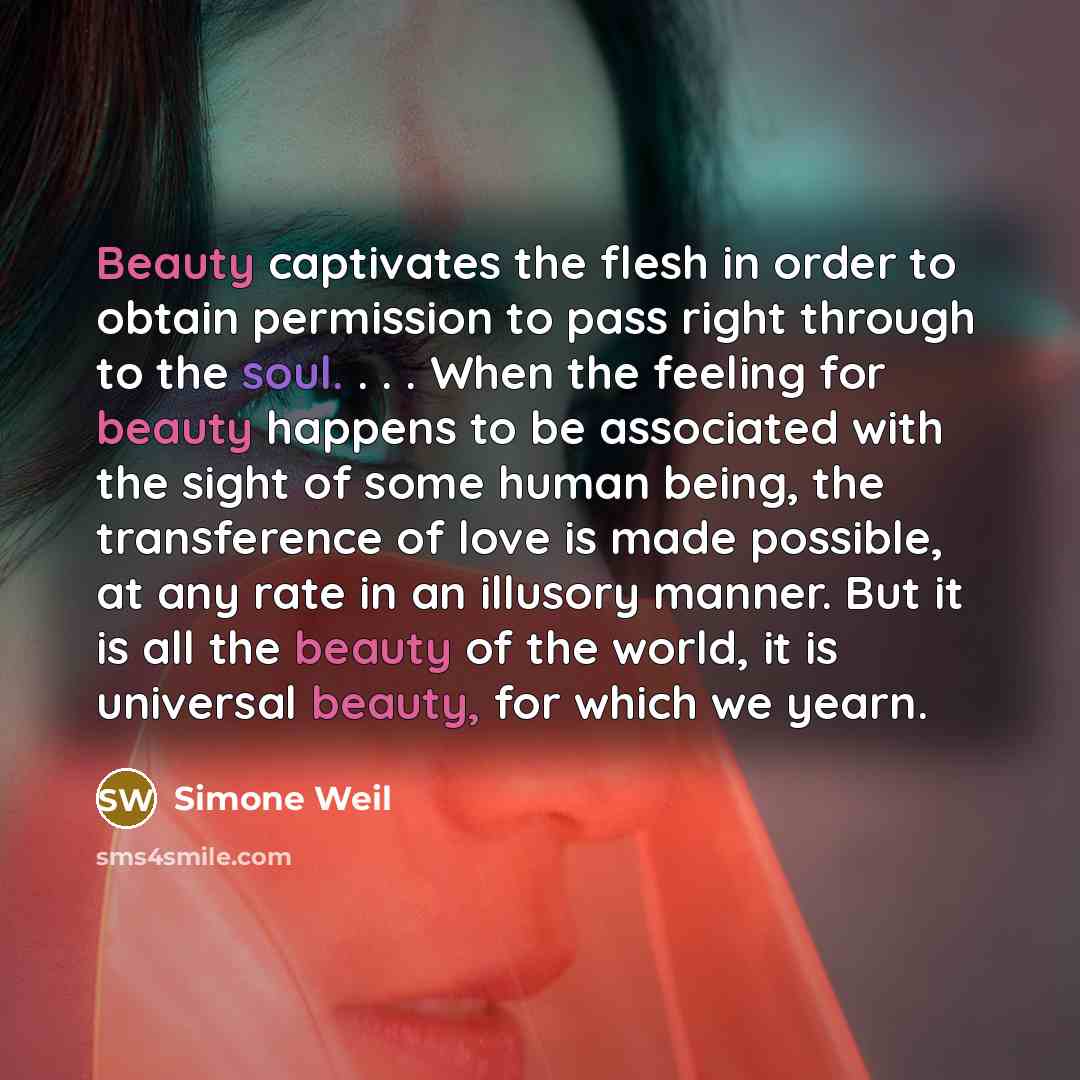
““Carnal love in all its forms, from the highest — true marriage or platonic love — to the most base, down to debauchery, has the beauty of the world for its object. Love that gives itself to the spectacle of the heavens, the plains, the sea, the mountains or the silence of nature senses this love in a thousand faint sounds, breaths of wind and the warmth of the sun. Every human being feels it vaguely for at least a moment. It is an incomplete love, sorrowful, because it gives itself to something incapable of response, which is matter. People desire to transfer this love onto a being that is like it, capable of responding to love, of saying ‘yes,’ of yielding to it. The feeling of beauty sometimes linked to the appearance of a human being makes this transfer possible at least in an illusory way. But it is the beauty of the world — the universal beauty — toward which our desire leads. This kind of transfer is expressed in all literature that encompasses love, from the most ancient and most used metaphors and similes of poetry to the subtle analysis of Proust. The desire to love the beauty of the world in a human being is essentially the desire for the Incarnation. If we think it is something else, we are mistaken. The Incarnation alone can satisfy it.””
About This Quote
Source Essay: “The Love of God and the Incarnation” by Simone Weil, 1940s
Human love seeks to unite with a responsive being, but ultimately longs for the universal beauty of the world, fulfilled only in the Incarnation.
In simple terms: Love wants a responsive partner but truly craves the world’s beauty, found in the Incarnation.
Key Takeaway
Seek the divine through love of beauty.
Themes
love
beauty
spiritual longing
incarnation
philosophy
Mood
contemplative
hopeful
melancholic
Type
philosophical
theological
poetic
When to use this quote
- personal relationships
- art appreciation
- religious practice
- philosophical study
Key Concepts
theology
existentialism
aesthetics
Questions to Reflect On
- How does love for beauty differ from love for a person?
- Can the Incarnation be understood as the ultimate answer to love?
A Different Perspective
Human love cannot fully satisfy the yearning for universal beauty.



![“In turning away from beauty, we turn away from all that is wholesome and true, and deliver ourselves into an exile where the vulgar and artificial dull and deaden the human spirit [] In contrast, the Beautiful offers us an invitation to order, coherence, and unity. When these needs are met, the…” quote by John O'Donohue](https://sms4smile.com/quotes/img-quotes/d37/john-o-donohue-1919_beautiful_in-turning-away-from-beauty-we-turn-away_625329.jpg)