First class Quote by Samuel Noah Kramer
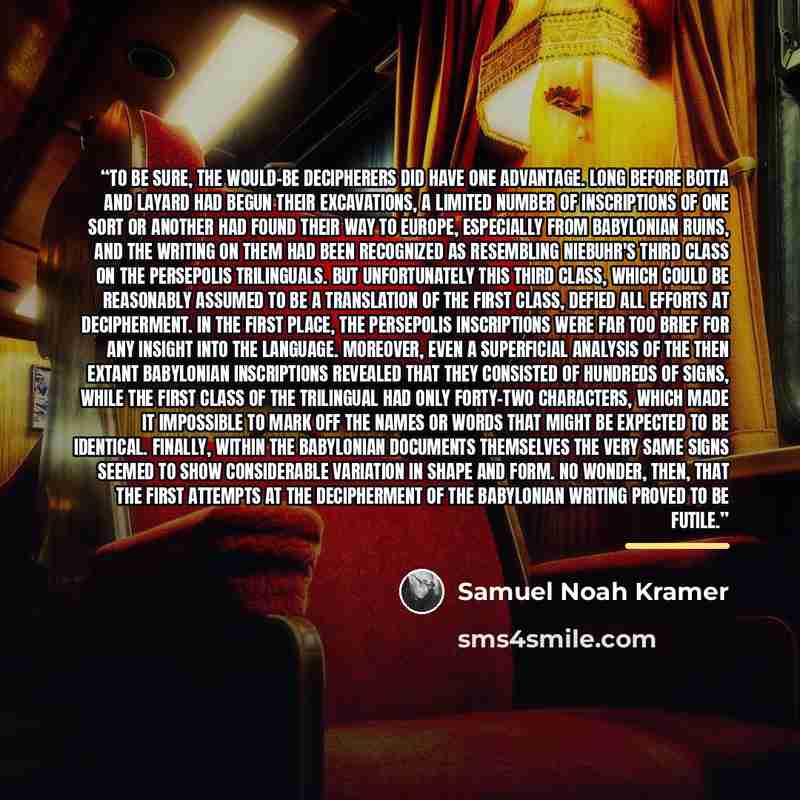
““To be sure, the would-be decipherers did have one advantage. Long before Botta and Layard had begun their excavations, a limited number of inscriptions of one sort or another had found their way to Europe, especially from Babylonian ruins, and the writing on them had been recognized as resembling Niebuhr's third class on the Persepolis trilinguals. But unfortunately this third class, which could be reasonably assumed to be a translation of the first class, defied all efforts at decipherment. In the first place, the Persepolis inscriptions were far too brief for any insight into the language. Moreover, even a superficial analysis of the then extant Babylonian inscriptions revealed that they consisted of hundreds of signs, while the first class of the trilingual had only forty-two characters, which made it impossible to mark off the names or words that might be expected to be identical. Finally, within the Babylonian documents themselves the very same signs seemed to show considerable variation in shape and form. No wonder, then, that the first attempts at the decipherment of the Babylonian writing proved to be futile.””
About This Quote
Source Book: History of Babylonian Writing, Samuel Noah Kramer, 1963
Early attempts to decode Babylonian script failed due to brief inscriptions, many signs, and variable shapes, making identification impossible.
In simple terms: Early decoding attempts failed because the texts were too short and inconsistent.
Key Takeaway
Recognize limits of data before attempting interpretation.
Themes
history
archaeology
language
decipherment
Mood
analytical
reflective
Type
academic
historical
When to use this quote
- archaeological research
- academic study
- historical analysis
Key Concepts
epigraphy
sign variation
translation challenges
Questions to Reflect On
- How can modern technology overcome sparse ancient data?
- What alternative methods could aid decipherment?
A Different Perspective
Limited data can hinder progress despite expertise.