Cognition Quote by Sam Harris
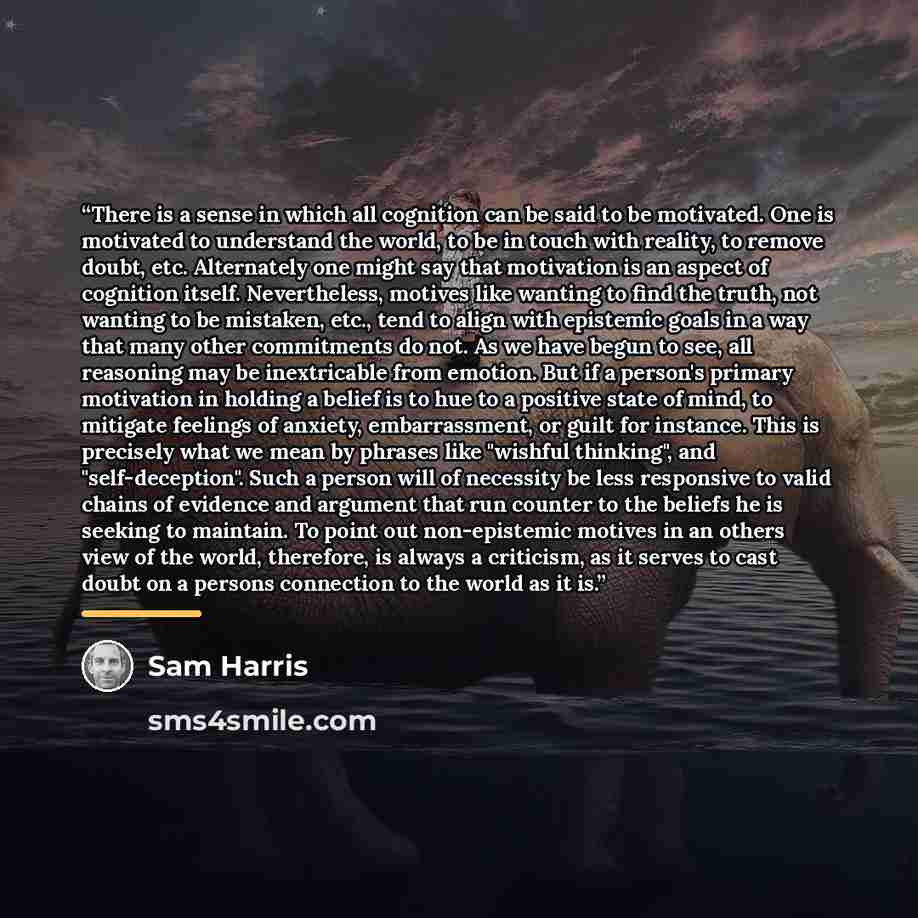
““There is a sense in which all cognition can be said to be motivated. One is motivated to understand the world, to be in touch with reality, to remove doubt, etc. Alternately one might say that motivation is an aspect of cognition itself. Nevertheless, motives like wanting to find the truth, not wanting to be mistaken, etc., tend to align with epistemic goals in a way that many other commitments do not. As we have begun to see, all reasoning may be inextricable from emotion. But if a person's primary motivation in holding a belief is to hue to a positive state of mind, to mitigate feelings of anxiety, embarrassment, or guilt for instance. This is precisely what we mean by phrases like "wishful thinking", and "self-deception". Such a person will of necessity be less responsive to valid chains of evidence and argument that run counter to the beliefs he is seeking to maintain. To point out non-epistemic motives in an others view of the world, therefore, is always a criticism, as it serves to cast doubt on a persons connection to the world as it is.””
About This Quote
Source Book: The Moral Landscape by Sam Harris, 2010
Cognition is driven by motives, often aligning with truth‑seeking, but non‑epistemic motives like wishful thinking can bias reasoning and reduce openness to evidence.
In simple terms: Our motives shape how we think, sometimes clouding truth.
Key Takeaway
Recognize and question non‑epistemic motives.
Themes
cognition
motivation
epistemic goals
bias
emotion
Mood
reflective
critical
Type
philosophical
analytical
When to use this quote
- academic research
- personal decision‑making
- debate
- critical thinking
Key Concepts
epistemology
psychology
self‑deception
Questions to Reflect On
- How do your personal goals affect your judgments?
- Can you identify when wishful thinking is influencing you?
A Different Perspective
Non‑epistemic motives can dominate even when evidence is strong.

![“[Mood allocates] investments of time, effort, resources, and risk taking to maximize Darwinian fitness in situations of varying propitiousness. High and low moods adjust cognition and behavior to cope with propitious and unpropitious situations.” quote by Randolph M. Nesse](https://sms4smile.com/quotes/img-quotes/6d0/randolph-m-nesse-24802_behavior_mood-allocates-investments-of-time-effor_87538.jpg)
![“Moderates in every faith are obliged to loosely interpret (or simply ignore) much of their canons in the interests of living in the modern world. [...] The first thing to observe about the moderate’s retreat from scriptural literalism is that it draws its inspiration not from scripture but from…” quote by Sam Harris](https://sms4smile.com/quotes/img-quotes/b44/sam-harris-457_bible_moderates-in-every-faith-are-obliged-to_6967.jpg)