Poetry Quote by Søren Kierkegaard
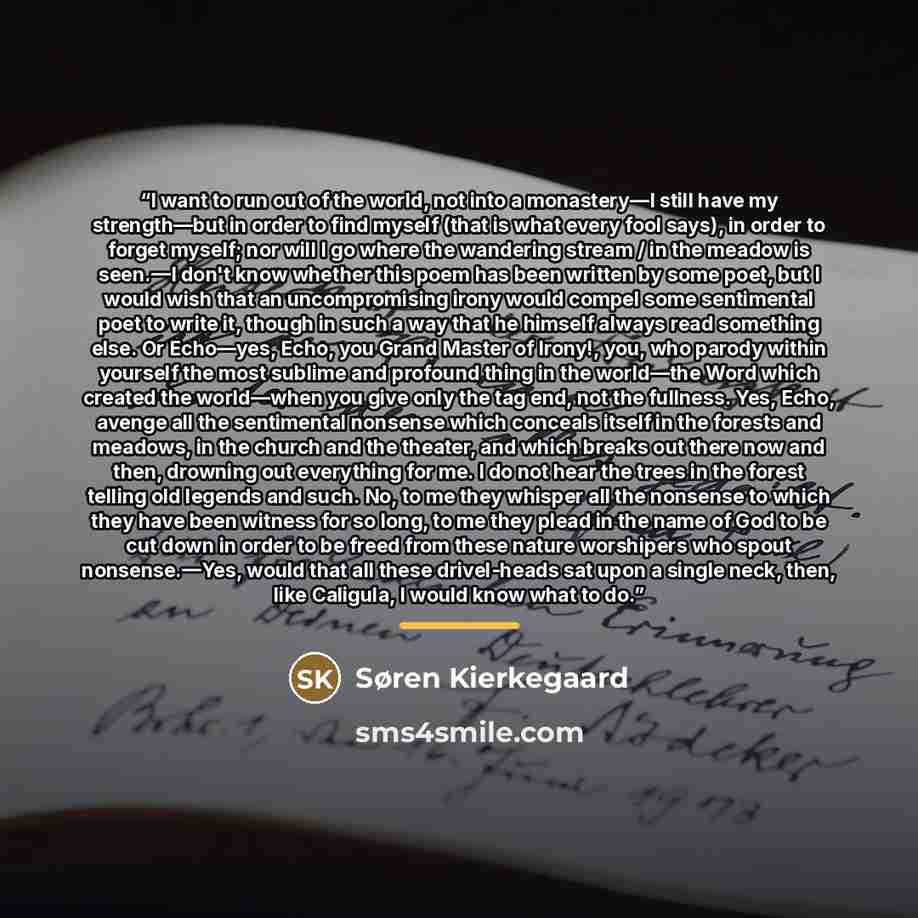
““I want to run out of the world, not into a monastery—I still have my strength—but in order to find myself (that is what every fool says), in order to forget myself; nor will I go where the wandering stream / in the meadow is seen.—I don't know whether this poem has been written by some poet, but I would wish that an uncompromising irony would compel some sentimental poet to write it, though in such a way that he himself always read something else. Or Echo—yes, Echo, you Grand Master of Irony!, you, who parody within yourself the most sublime and profound thing in the world—the Word which created the world—when you give only the tag end, not the fullness. Yes, Echo, avenge all the sentimental nonsense which conceals itself in the forests and meadows, in the church and the theater, and which breaks out there now and then, drowning out everything for me. I do not hear the trees in the forest telling old legends and such. No, to me they whisper all the nonsense to which they have been witness for so long, to me they plead in the name of God to be cut down in order to be freed from these nature worshipers who spout nonsense.—Yes, would that all these drivel-heads sat upon a single neck, then, like Caligula, I would know what to do.””
About This Quote
Source Book: Either/Or, Part I, 1843
The speaker rejects conventional spiritual retreats, seeking self‑discovery through irony and critique of sentimentalism, urging a radical break from complacent reverence.
In simple terms: Reject easy spirituality; embrace ironic self‑search.
Key Takeaway
Question norms; seek authentic self.
Themes
existentialism
irony
critique
individualism
Mood
reflective
defiant
critical
Type
philosophical
literary
provocative
When to use this quote
- personal crisis
- artistic creation
- philosophical debate
- cultural criticism
Key Concepts
self‑identity
authenticity
religious critique
Questions to Reflect On
- What does authentic self‑discovery look like?
- How can critique become constructive?
A Different Perspective
Irony can obscure truth and alienate community.