Common life Quote by Rowan Williams
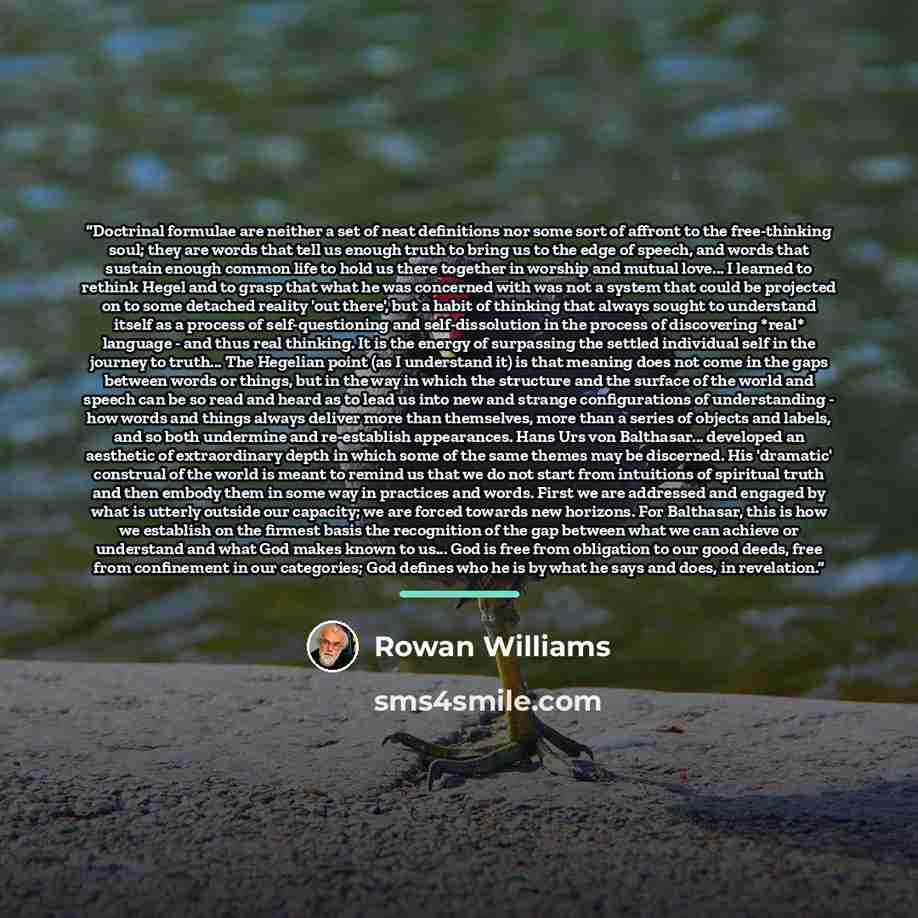
““Doctrinal formulae are neither a set of neat definitions nor some sort of affront to the free-thinking soul; they are words that tell us enough truth to bring us to the edge of speech, and words that sustain enough common life to hold us there together in worship and mutual love... I learned to rethink Hegel and to grasp that what he was concerned with was not a system that could be projected on to some detached reality 'out there', but a habit of thinking that always sought to understand itself as a process of self-questioning and self-dissolution in the process of discovering *real* language - and thus real thinking. It is the energy of surpassing the settled individual self in the journey to truth... The Hegelian point (as I understand it) is that meaning does not come in the gaps between words or things, but in the way in which the structure and the surface of the world and speech can be so read and heard as to lead us into new and strange configurations of understanding - how words and things always deliver more than themselves, more than a series of objects and labels, and so both undermine and re-establish appearances. Hans Urs von Balthasar... developed an aesthetic of extraordinary depth in which some of the same themes may be discerned. His 'dramatic' construal of the world is meant to remind us that we do not start from intuitions of spiritual truth and then embody them in some way in practices and words. First we are addressed and engaged by what is utterly outside our capacity; we are forced towards new horizons. For Balthasar, this is how we establish on the firmest basis the recognition of the gap between what we can achieve or understand and what God makes known to us... God is free from obligation to our good deeds, free from confinement in our categories; God defines who he is by what he says and does, in revelation.””
About This Quote
Source Book: Theology of Language, Rowan Williams, 2005
The quote argues that doctrinal statements are not rigid definitions but living words that guide us toward deeper understanding, emphasizing self‑questioning and the transformative power of language in theology.
In simple terms: Doctrine is living language that pushes us toward deeper truth.
Key Takeaway
Embrace language as a tool for self‑questioning.
Themes
theology
philosophy
language
self‑questioning
spirituality
Mood
contemplative
inquisitive
Type
theoretical
inspirational
When to use this quote
- academic lecture
- personal study
- spiritual reflection
- interfaith dialogue
Key Concepts
Hegelian dialectic
Balthasar aesthetic
self‑dissolution
revelation
gap theory
Questions to Reflect On
- How can we apply self‑questioning in daily worship?
- What role does language play in shaping spiritual experience?
A Different Perspective
The approach may be too abstract for practical faith practice.