Depression Quote by Robert Whitaker
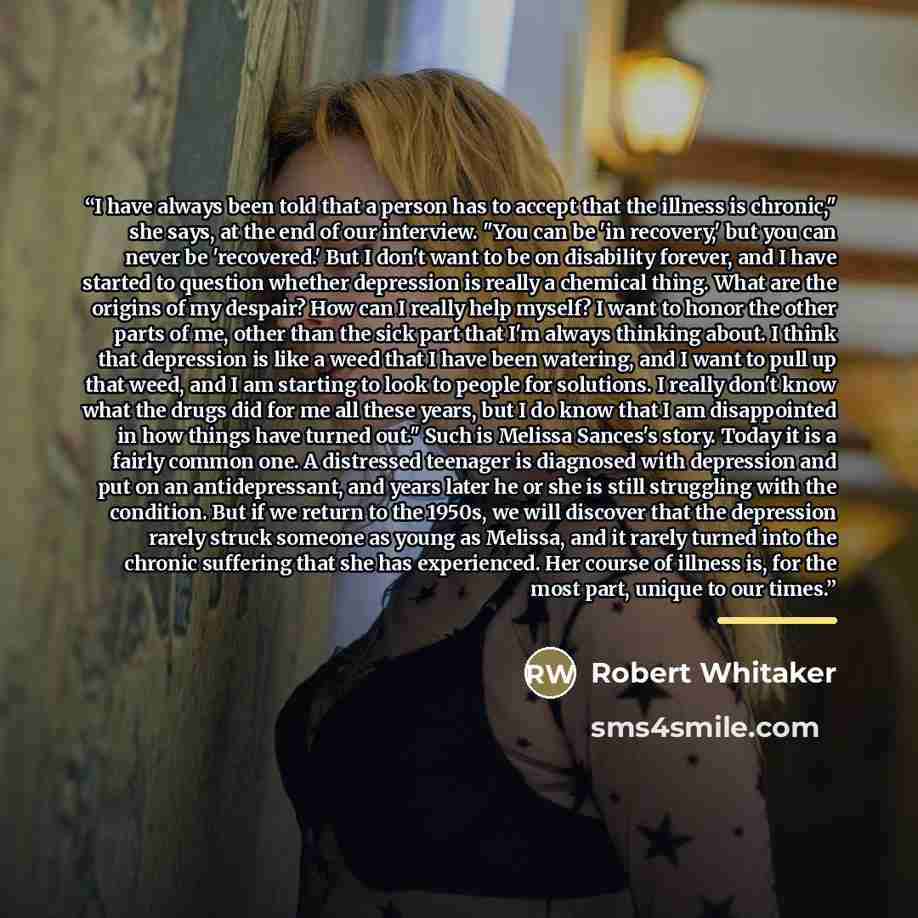
““I have always been told that a person has to accept that the illness is chronic," she says, at the end of our interview. "You can be 'in recovery,' but you can never be 'recovered.' But I don't want to be on disability forever, and I have started to question whether depression is really a chemical thing. What are the origins of my despair? How can I really help myself? I want to honor the other parts of me, other than the sick part that I'm always thinking about. I think that depression is like a weed that I have been watering, and I want to pull up that weed, and I am starting to look to people for solutions. I really don't know what the drugs did for me all these years, but I do know that I am disappointed in how things have turned out." Such is Melissa Sances's story. Today it is a fairly common one. A distressed teenager is diagnosed with depression and put on an antidepressant, and years later he or she is still struggling with the condition. But if we return to the 1950s, we will discover that the depression rarely struck someone as young as Melissa, and it rarely turned into the chronic suffering that she has experienced. Her course of illness is, for the most part, unique to our times.””
About This Quote
Source Book: Anatomy of an Epidemic by Robert Whitaker, 2010
The quote highlights the chronic labeling of depression, questioning its chemical basis and the reliance on medication, urging personal agency and alternative solutions.
In simple terms: Depression is often treated as a permanent condition, but the speaker seeks other ways to heal.
Key Takeaway
Seek holistic approaches beyond medication.
Themes
mental health
chronic illness
agency
skepticism
Mood
reflective
hopeful
determined
Type
personal narrative
motivational
critical.
When to use this quote
- therapy
- peer support
- mindfulness practices
- lifestyle changes
- self‑education
Key Concepts
biopsychosocial model
patient empowerment
pharmacology critique
Questions to Reflect On
- What personal actions can you take to manage your mood?
- How might you explore non‑pharmacological support?
A Different Perspective
Medication may not address underlying causes and can lead to dependency.