Journey Quote by Robert Macfarlane
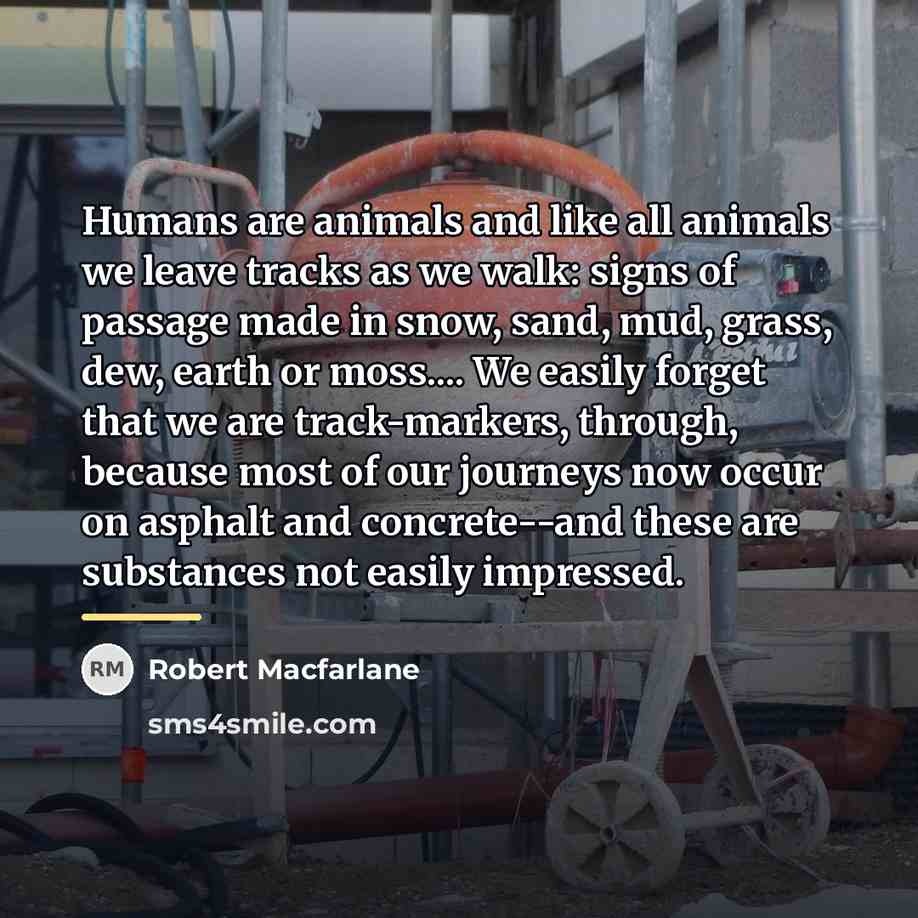
““Humans are animals and like all animals we leave tracks as we walk: signs of passage made in snow, sand, mud, grass, dew, earth or moss. The language of hunting has a luminous word for such mark-making: 'foil'. A creature's 'foil' is its track. We easily forget that we are track-makers, though, because most of our journeys now occur on asphalt and concrete - and these are substances not easily impressed. 'Always, everywhere, people have walked, veining the earth with paths visible and invisible, symmetrical or meandering,' writes Thomas Clark in his enduring prose-poem 'In Praise of Walking'. It's true that, once you begin to notice them, you see that the landscape is still webbed with paths and footways - shadowing the modern-day road network, or meeting it at a slant or perpendicular. Pilgrim paths, green roads, drove roads, corpse roads, trods, leys, dykes, drongs, sarns, snickets - say the name of paths out loud and at speed and they become a poem or rite - holloways, bostles, shutes, driftways, lichways, ridings, halterpaths, cartways, carneys, causeways, herepaths.””
About This Quote
Source Essay: In Praise of Walking by Robert Macfarlane, 2015
Human movement leaves physical traces, but modern surfaces obscure them, reminding us we are part of a larger network of paths.
In simple terms: We leave marks as we move, though cities hide them.
Key Takeaway
Notice and honor the paths you tread.
Themes
nature
movement
history
perception
poetry
Mood
reflective
contemplative
poetic
Type
philosophical
inspirational
When to use this quote
- urban planning
- hiking
- environmental education
- historical research
Key Concepts
track-making
environmental awareness
human continuity
Questions to Reflect On
- How do you recognize your own footprints in daily life?
- What can hidden paths teach us about history?
A Different Perspective
Modern infrastructure can erase trace evidence, making reflection harder.