Allegory Quote by Philip Pullman
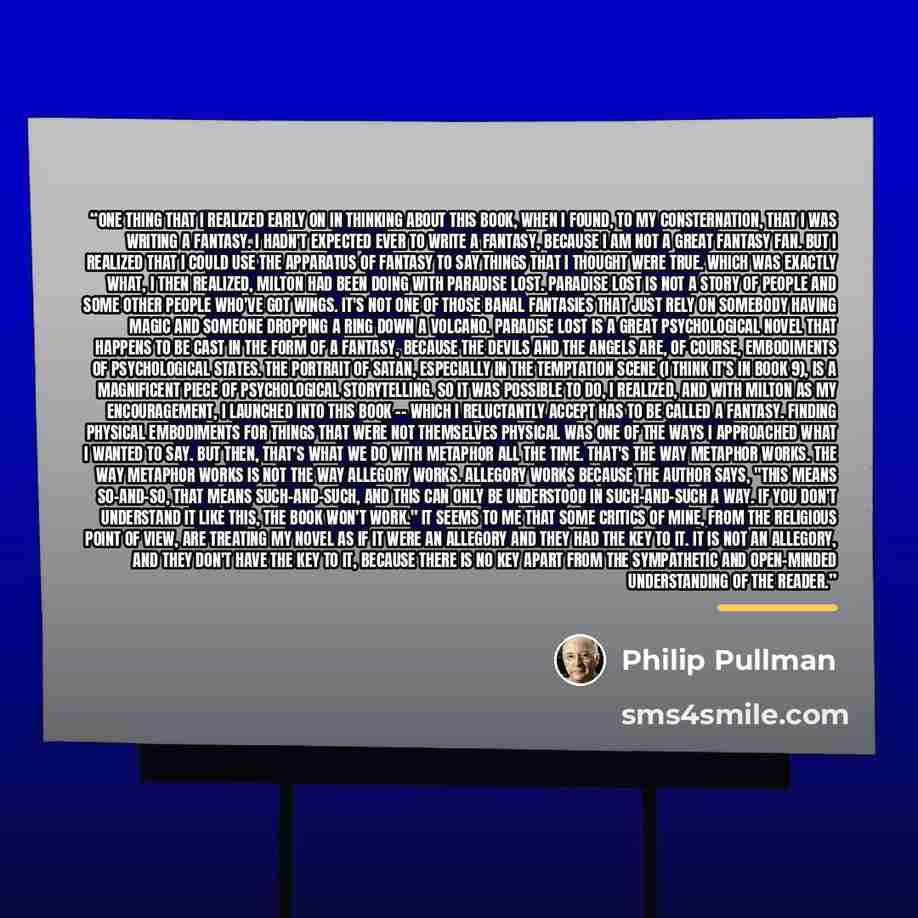
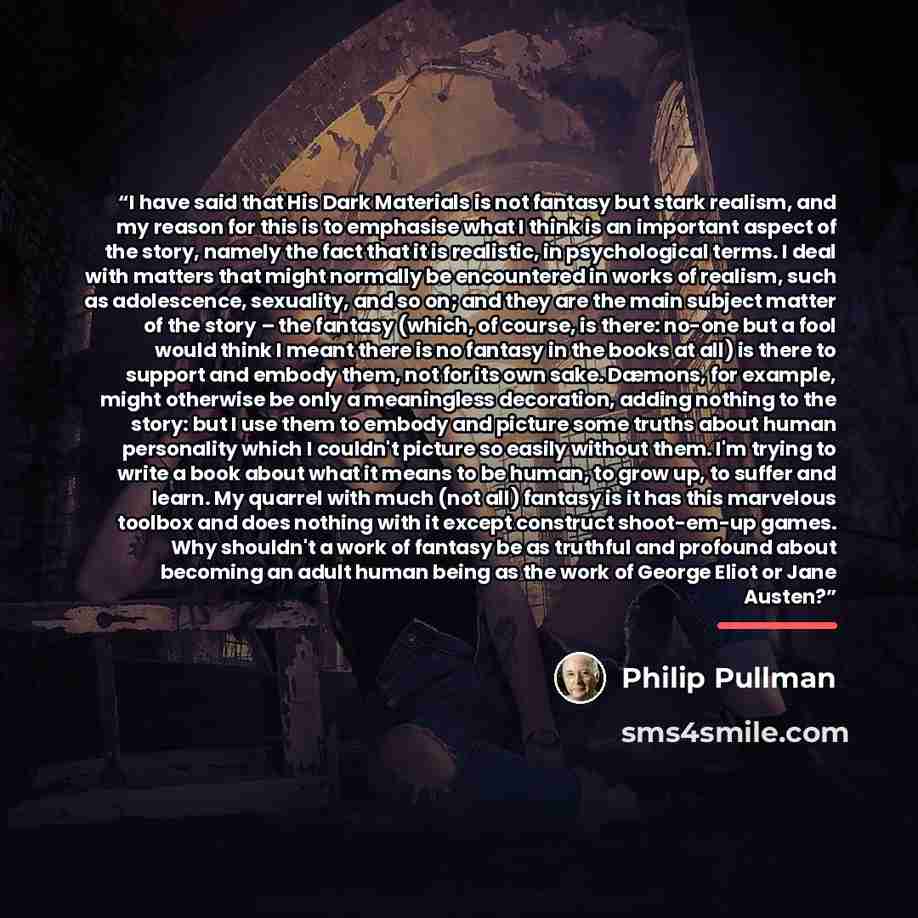
““one thing that I realized early on in thinking about this book, when I found, to my consternation, that I was writing a fantasy. I hadn't expected ever to write a fantasy, because I am not a great fantasy fan. But I realized that I could use the apparatus of fantasy to say things that I thought were true. Which was exactly what, I then realized, Milton had been doing with Paradise Lost. Paradise Lost is not a story of people and some other people who've got wings. It's not one of those banal fantasies that just rely on somebody having magic and someone dropping a ring down a volcano. Paradise Lost is a great psychological novel that happens to be cast in the form of a fantasy, because the devils and the angels are, of course, embodiments of psychological states. The portrait of Satan, especially in the Temptation scene (I think it's in Book 9), is a magnificent piece of psychological storytelling. So it was possible to do, I realized, and with Milton as my encouragement, I launched into this book -- which I reluctantly accept has to be called a fantasy. Finding physical embodiments for things that were not themselves physical was one of the ways I approached what I wanted to say. But then, that's what we do with metaphor all the time. That's the way metaphor works. The way metaphor works is not the way allegory works. Allegory works because the author says, "This means so-and-so, that means such-and-such, and this can only be understood in such-and-such a way. If you don't understand it like this, the book won't work." It seems to me that some critics of mine, from the religious point of view, are treating my novel as if it were an allegory and they had the key to it. It is not an allegory, and they don't have the key to it, because there is no key apart from the sympathetic and open-minded understanding of the reader.””
About This Quote
Source Interview: The Guardian, 2009
The author uses fantasy as a metaphorical tool to explore psychological truths, distinct from allegory, emphasizing open interpretation.
In simple terms: Fantasy serves as metaphor for inner states, not literal allegory.
Key Takeaway
Embrace metaphorical storytelling for deeper insight.
Themes
literature
creativity
psychology
Mood
reflective
inquisitive
Type
literary
philosophical
When to use this quote
- creative writing
- literary analysis
- teaching metaphor
- book clubs
Key Concepts
metaphor vs allegory
narrative technique
reader interpretation
Questions to Reflect On
- How does metaphor differ from allegory in your reading?
- What psychological ideas emerge from fantasy narratives?
A Different Perspective
Readers may misinterpret metaphor as literal, missing nuanced meaning.