Human existence Quote by Peter L. Berger
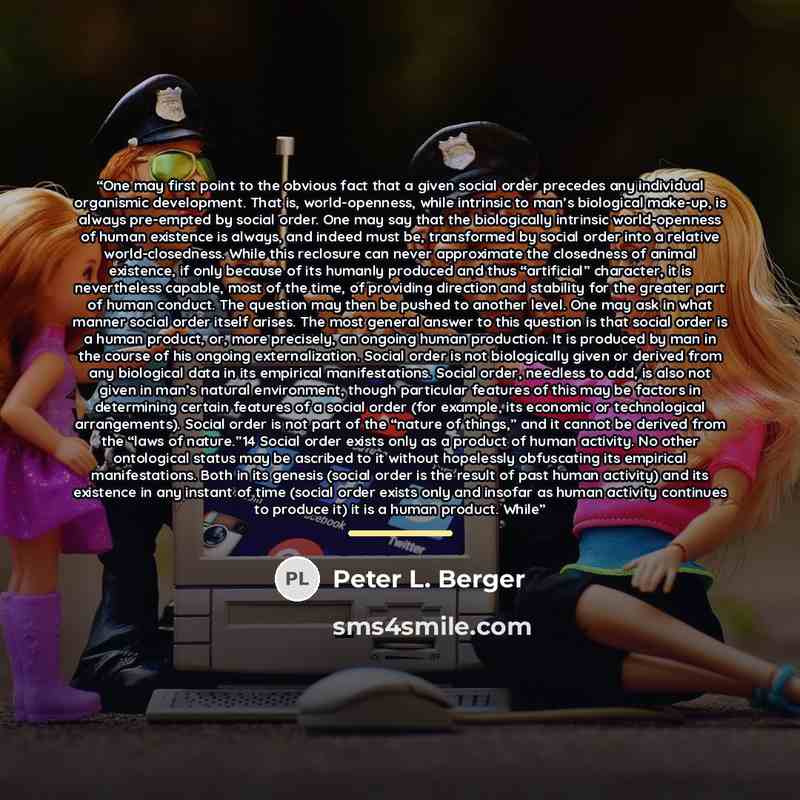
““One may first point to the obvious fact that a given social order precedes any individual organismic development. That is, world-openness, while intrinsic to man’s biological make-up, is always pre-empted by social order. One may say that the biologically intrinsic world-openness of human existence is always, and indeed must be, transformed by social order into a relative world-closedness. While this reclosure can never approximate the closedness of animal existence, if only because of its humanly produced and thus “artificial” character, it is nevertheless capable, most of the time, of providing direction and stability for the greater part of human conduct. The question may then be pushed to another level. One may ask in what manner social order itself arises. The most general answer to this question is that social order is a human product, or, more precisely, an ongoing human production. It is produced by man in the course of his ongoing externalization. Social order is not biologically given or derived from any biological data in its empirical manifestations. Social order, needless to add, is also not given in man’s natural environment, though particular features of this may be factors in determining certain features of a social order (for example, its economic or technological arrangements). Social order is not part of the “nature of things,” and it cannot be derived from the “laws of nature.”14 Social order exists only as a product of human activity. No other ontological status may be ascribed to it without hopelessly obfuscating its empirical manifestations. Both in its genesis (social order is the result of past human activity) and its existence in any instant of time (social order exists only and insofar as human activity continues to produce it) it is a human product. While””
About This Quote
Source Book: The Social Construction of Reality, Peter L. Berger & Thomas Luckmann, 1966
Human societies create the structures that shape individual lives, rather than biology alone determining behavior.
In simple terms: Society shapes us more than biology.
Key Takeaway
Recognize the role of social institutions in shaping actions.
Themes
social order
human agency
structure
culture
ontology
Mood
analytical
critical
thoughtful
Type
philosophical
sociological
theoretical
When to use this quote
- policy making
- education reform
- community organizing
- media analysis
- organizational design
Key Concepts
constructionism
structuralism
ontological status
Questions to Reflect On
- How do institutions influence personal choices?
- Can social structures be deliberately reshaped?
A Different Perspective
Social order can be reinforced by power dynamics that limit individual freedom.


![“The order of nature [is] that individual happiness shall be inseparable from the practice of virtue.” quote by Thomas Jefferson](https://sms4smile.com/quotes/img-quotes/b81/thomas-jefferson-43_character_the-order-of-nature-is-that-individual-h_1022487.jpg)