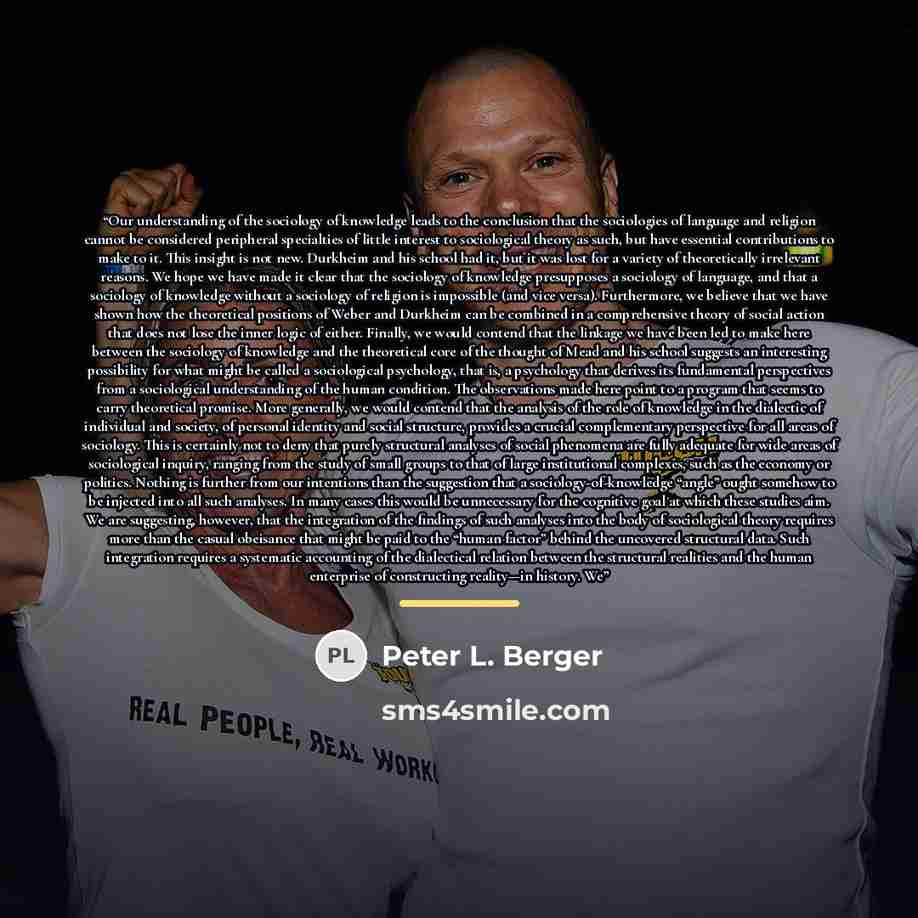
Different perspective Quote by Peter L. Berger

““Mannheim believed that ideologizing influences, while they could not be eradicated completely, could be mitigated by the systematic analysis of as many as possible of the varying socially grounded positions. In other words, the object of thought becomes progressively clearer with this accumulation of different perspectives on it. This is to be the task of the sociology of knowledge, which thus is to become an important aid in the quest for any correct understanding of human events. Mannheim believed that different social groups vary greatly in their capacity thus to transcend their own narrow position. He placed his major hope in the “socially unattached intelligentsia” (freischwebende Intelligenz, a term derived from Alfred Weber), a sort of interstitial stratum that he believed to be relatively free of class interests. Mannheim also stressed the power of “utopian” thought, which (like ideology) produces a distorted image of social reality, but which (unlike ideology) has the dynamism to transform that reality into its image of it. Needless””
About This Quote
Source Book: The Social Construction of Reality, Peter L. Berger & Thomas Luckmann, 1966
Mannheim argues that analyzing many social perspectives reduces ideological bias, making thought clearer and aiding true understanding of human events.
In simple terms: Studying many viewpoints lessens bias and clarifies understanding.
Key Takeaway
Seek diverse perspectives to improve insight.
Themes
knowledge
ideology
perspective
analysis
Mood
reflective
analytical
Type
philosophical
academic
When to use this quote
- academic research
- policy analysis
- media critique
- education curriculum design
Key Concepts
sociology of knowledge
critical theory
utopian thought
Questions to Reflect On
- How can we ensure diverse perspectives are truly represented?
- What limits the “socially unattached intelligentsia”?
A Different Perspective
Ideological influence cannot be fully eliminated, only mitigated.



![“[...] intellectualism (as understood by Fascists) divocers thought from action, science from life, the brain from the heart, and theory from practice. It is the posture of the talker and the skeptic, of the person who entrenches himself behind the maxim that it is one thing to say something and…” quote by Giovanni Gentile](https://sms4smile.com/quotes/img-quotes/692/giovanni-gentile-182419_intelligence_intellectualism-as-understood-by-fascist_722633.jpg)



















![“I [read] "The Book of Unknown Americans," which is by a friend of mine, Cristina Henriquez, and is about two Latino, immigrant families who live in Delaware. I'm interested in reading things from different perspectives.” quote by Laila Lalami](https://sms4smile.com/quotes/img-quotes/e50/laila-lalami-25030_book_i-read-the-book-of-unknown-americans-whi_138706.jpg)