Bigotry Quote by Peter Gay
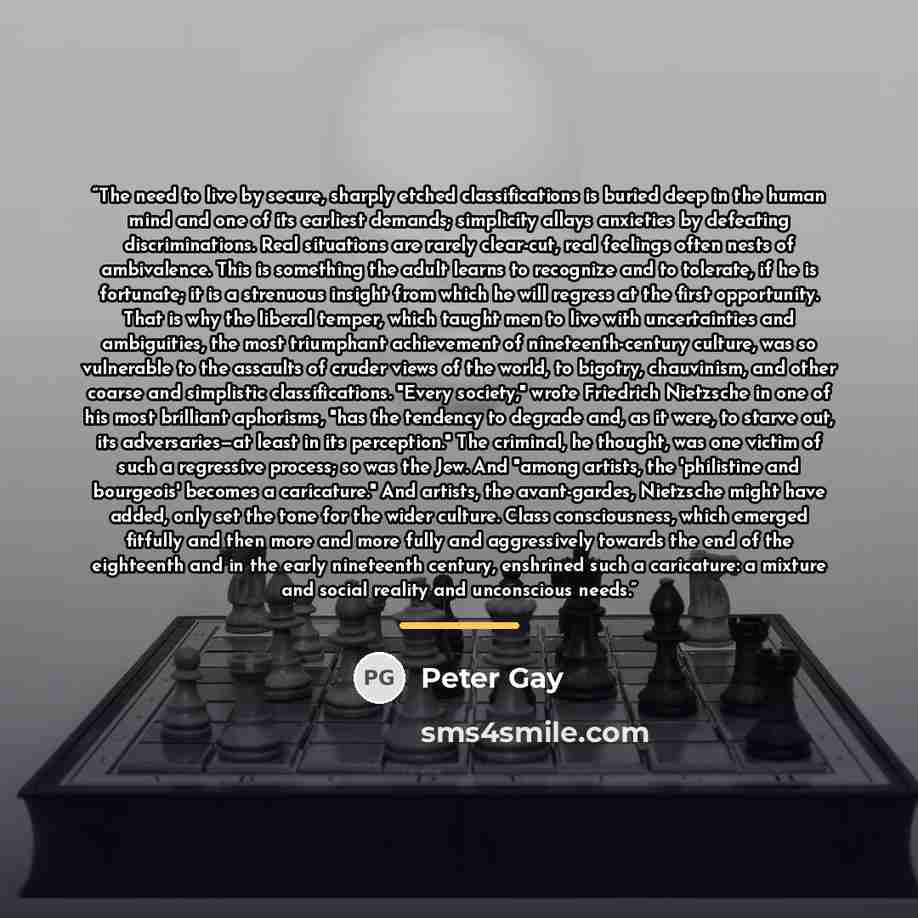
““The need to live by secure, sharply etched classifications is buried deep in the human mind and one of its earliest demands; simplicity allays anxieties by defeating discriminations. Real situations are rarely clear-cut, real feelings often nests of ambivalence. This is something the adult learns to recognize and to tolerate, if he is fortunate; it is a strenuous insight from which he will regress at the first opportunity. That is why the liberal temper, which taught men to live with uncertainties and ambiguities, the most triumphant achievement of nineteenth-century culture, was so vulnerable to the assaults of cruder views of the world, to bigotry, chauvinism, and other coarse and simplistic classifications. "Every society," wrote Friedrich Nietzsche in one of his most brilliant aphorisms, "has the tendency to degrade and, as it were, to starve out, its adversaries—at least in its perception." The criminal, he thought, was one victim of such a regressive process; so was the Jew. And "among artists, the 'philistine and bourgeois' becomes a caricature." And artists, the avant-gardes, Nietzsche might have added, only set the tone for the wider culture. Class consciousness, which emerged fitfully and then more and more fully and aggressively towards the end of the eighteenth and in the early nineteenth century, enshrined such a caricature: a mixture and social reality and unconscious needs.””
About This Quote
Source Book: The Rise of Modern Mythology by Peter Gay, 1994
Humans crave simple categories to ease anxiety, but reality is ambiguous; embracing uncertainty is a liberal achievement vulnerable to simplistic ideologies.
In simple terms: People like clear labels but life is complex; tolerance of ambiguity is hard.
Key Takeaway
Accept ambiguity, resist oversimplification.
Themes
liberalism
uncertainty
classification
bigotry
culture
Mood
reflective
critical
introspective
Type
philosophical
political
analytical
When to use this quote
- education
- political discourse
- art criticism
- personal growth
Key Concepts
psychology
social theory
philosophy
Questions to Reflect On
- How can we foster tolerance for ambiguity?
- What structures help resist oversimplification?
A Different Perspective
Simplification can ignore nuance and fuel prejudice.




![“What are you for? It may be, to a degree, consoling that white brothers and sisters did not vote for [Donald] Trump, and do not participate in that brand of animus, that gas-bagging of enormous bigotry.” quote by Michael Eric Dyson](https://sms4smile.com/quotes/img-quotes/01d/michael-eric-dyson-1424_animus_what-are-you-for-it-may-be-to-a-degree-c_14940.jpg)