Memory Quote by Paul Auster
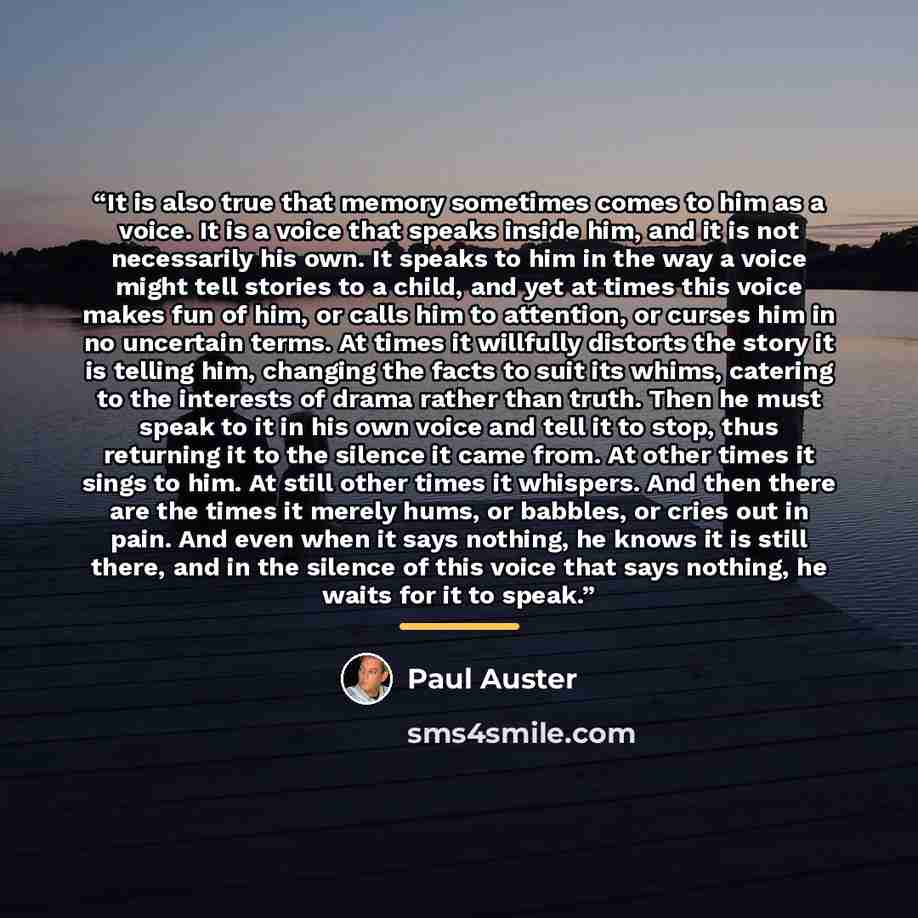
““It is also true that memory sometimes comes to him as a voice. It is a voice that speaks inside him, and it is not necessarily his own. It speaks to him in the way a voice might tell stories to a child, and yet at times this voice makes fun of him, or calls him to attention, or curses him in no uncertain terms. At times it willfully distorts the story it is telling him, changing the facts to suit its whims, catering to the interests of drama rather than truth. Then he must speak to it in his own voice and tell it to stop, thus returning it to the silence it came from. At other times it sings to him. At still other times it whispers. And then there are the times it merely hums, or babbles, or cries out in pain. And even when it says nothing, he knows it is still there, and in the silence of this voice that says nothing, he waits for it to speak.””
About This Quote
Source Novel: The New York Trilogy, Paul Auster, 1985
The inner voice can be deceptive, shifting between guidance and distortion; confronting it with personal truth restores silence.
In simple terms: Inner voice may mislead; confronting it restores peace.
Key Takeaway
Listen, discern, and speak your own truth to quiet the inner voice.
Themes
self‑awareness
inner dialogue
truth
psychology
creativity
Mood
introspective
analytical
serene
Type
literary
psychological
motivational
When to use this quote
- writing
- therapy
- decision making
- creative work
- stress management
Key Concepts
narrative voice
cognitive bias
mindfulness
Questions to Reflect On
- How do you differentiate your voice from inner chatter?
- What strategies help you stay grounded?
A Different Perspective
The voice may be a symptom of deeper issues needing professional help.