Art world Quote by Oliver Markus
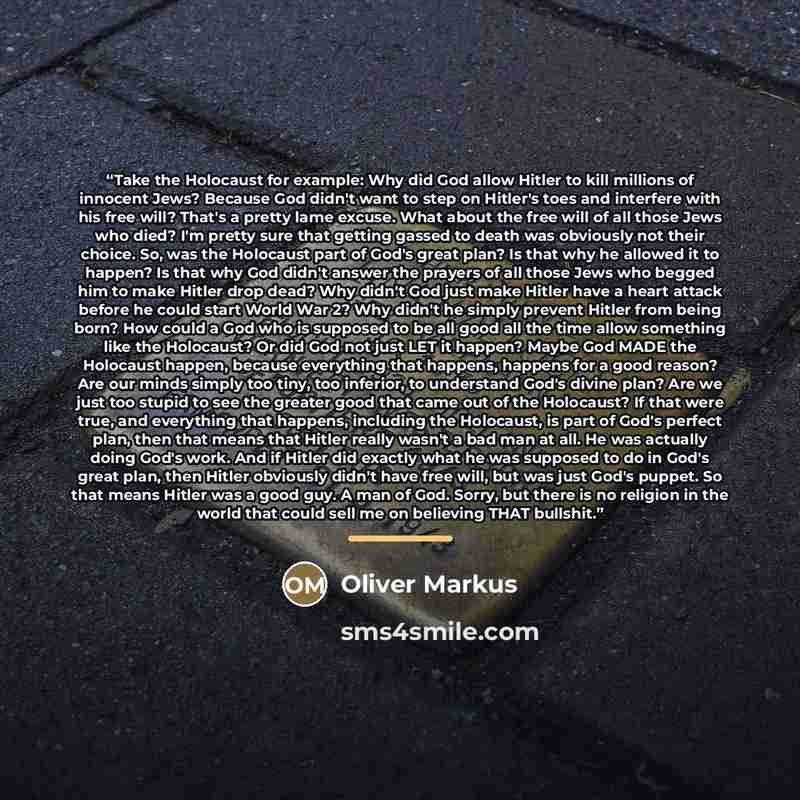
““Take the Holocaust for example: Why did God allow Hitler to kill millions of innocent Jews? Because God didn't want to step on Hitler's toes and interfere with his free will? That's a pretty lame excuse. What about the free will of all those Jews who died? I'm pretty sure that getting gassed to death was obviously not their choice. So, was the Holocaust part of God's great plan? Is that why he allowed it to happen? Is that why God didn't answer the prayers of all those Jews who begged him to make Hitler drop dead? Why didn't God just make Hitler have a heart attack before he could start World War 2? Why didn't he simply prevent Hitler from being born? How could a God who is supposed to be all good all the time allow something like the Holocaust? Or did God not just LET it happen? Maybe God MADE the Holocaust happen, because everything that happens, happens for a good reason? Are our minds simply too tiny, too inferior, to understand God's divine plan? Are we just too stupid to see the greater good that came out of the Holocaust? If that were true, and everything that happens, including the Holocaust, is part of God's perfect plan, then that means that Hitler really wasn't a bad man at all. He was actually doing God's work. And if Hitler did exactly what he was supposed to do in God's great plan, then Hitler obviously didn't have free will, but was just God's puppet. So that means Hitler was a good guy. A man of God. Sorry, but there is no religion in the world that could sell me on believing THAT bullshit.””
About This Quote
The quote questions the problem of reconciling a benevolent, omnipotent deity with the existence of extreme evil, suggesting that attributing such atrocities to divine will is a flawed and morally untenable explanation.
In simple terms: It questions how a good, all-powerful God could allow the Holocaust.
Key Takeaway
Consider the limits of human understanding of divine intent.
Themes
theodicy
free will
evil
faith
philosophy
Mood
conflicted
skeptical
thoughtful
Type
philosophical
critical
theological
When to use this quote
- personal reflection
- theological debate
- ethical discussion
- historical analysis
- moral philosophy
Key Concepts
theodicy
free will
problem of evil
divine sovereignty
Questions to Reflect On
- What does it mean to hold a deity responsible for human actions?
- How can we address suffering without resorting to simplistic divine explanations?
A Different Perspective
The argument oversimplifies complex theological and historical issues, ignoring human agency and systemic factors.
![“Have you ever thought what a God would be like who actually ordained and executed the cruelty that is in [the biblical Book of Revelation]? A holocaust of mankind. Yet so many of these Bible-men accept the idea without a second thought.” quote by C.J. Sansom](https://sms4smile.com/quotes/img-quotes/799/c-j-sansom-22985_accepting_have-you-ever-thought-what-a-god-would-b_2533547.jpg)