Simulacra Quote by McKenzie Wark
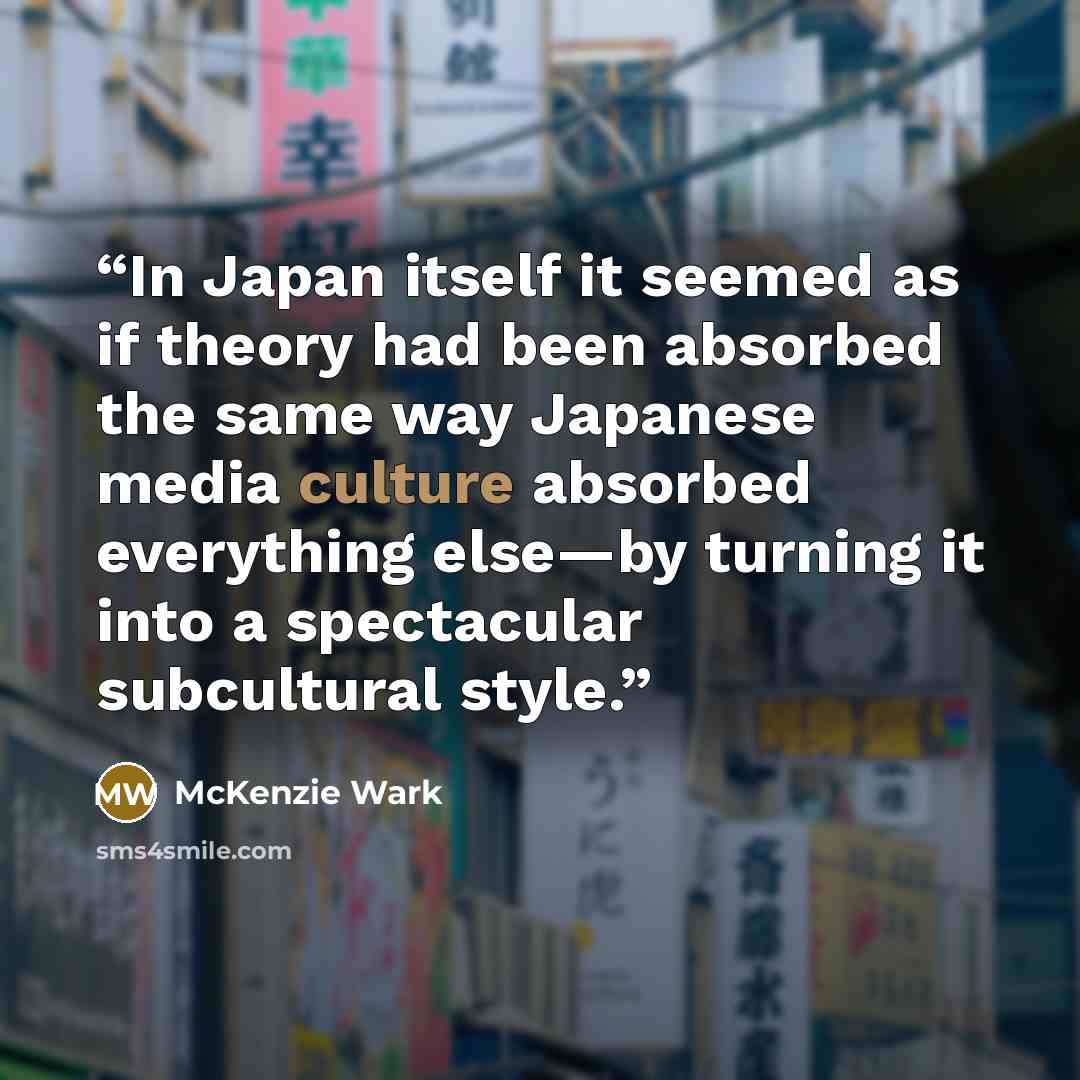
““The preferred worlds to simulate were either sci-fi or Edo-period Japan, as if the two breaks of the Meiji restoration (1868) and the occupation (1945) had not happened. Azuma links simulation to the practice of détournement or the fan-based making of derivative works, which “official” products then borrow from in turn: “the products of otaku culture are born into a chain of infinite imitations and piracy” (O26). Simulacra thus float free from both the notion of an historical time and from the authoring of original works.””
About This Quote
Source Article: “The Simulacra of Otaku Culture”, 2015
The quote argues that popular simulations favor fantasy over historical reality, creating endless cycles of imitation detached from original authorship and time.
In simple terms: Simulations ignore history, endlessly copying without originality.
Key Takeaway
Recognize and break cycles of unoriginal imitation.
Themes
culture
history
originality
simulation
media
intellectual property
Mood
critical
analytical
reflective
Type
theoretical
critical
When to use this quote
- video game design
- anime production
- fan fiction
- academic research
- cultural criticism
Key Concepts
postmodernism
détournement
simulation theory
media studies
Questions to Reflect On
- How does endless imitation affect cultural innovation?
- Can imitation coexist with originality?
A Different Perspective
It may overlook the value of homage and collaborative creativity.
![“They [Otaku] despise physical contact and love media, technical communication, and the realm of reproduction and simulation in general. They are enthusiastic collectors and manipulators of useless artifacts and information. They are an underground, but they are not opposed to the system. They…” quote by Volker Grassmuck](https://sms4smile.com/quotes/img-quotes/870/volker-grassmuck-68605_communication_they-otaku-despise-physical-contact-and_110267.jpg)



![“[T]he present age, which prefers the sign to the thing signified, the copy to the original[.]” quote by Ludwig Feuerbach](https://sms4smile.com/quotes/img-quotes/314/ludwig-feuerbach-3406_agnosticism_t-he-present-age-which-prefers-the-sign_596713.jpg)
![“Whence the possibility of an ideological analysis of Disneyland (L. Marin did it very well in Utopiques, jeux d'espace [Utopias, play of space]): digest of the American way of life, panegyric of American values, idealized transposition of a contradictory reality. Certainly. But this masks…” quote by Jean Baudrillard](https://sms4smile.com/quotes/img-quotes/e95/jean-baudrillard-1500_america_whence-the-possibility-of-an-ideological_3153887.jpg)