Mathematics Quote by Matt Parker
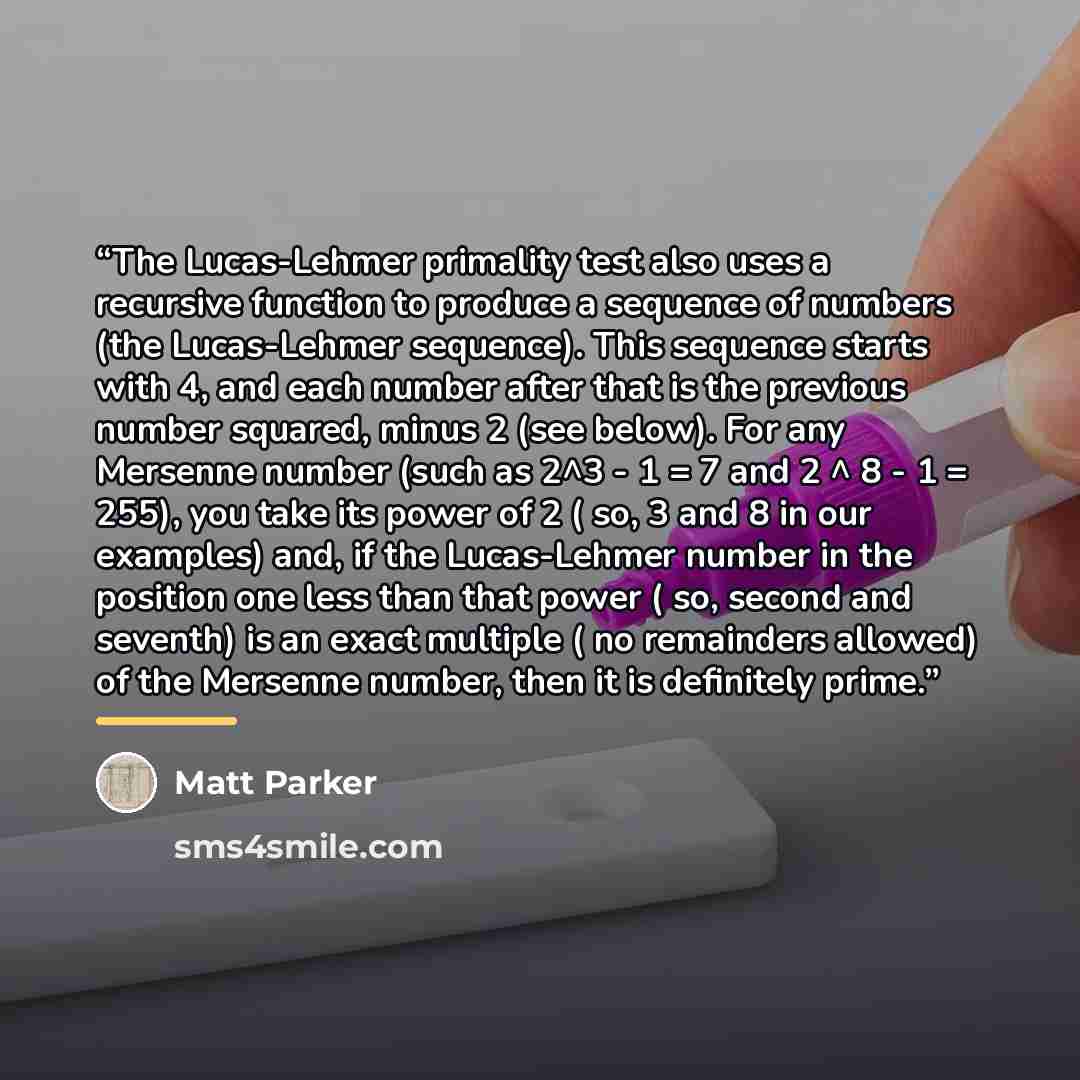
““The Lucas-Lehmer primality test also uses a recursive function to produce a sequence of numbers (the Lucas-Lehmer sequence). This sequence starts with 4, and each number after that is the previous number squared, minus 2 (see below). For any Mersenne number (such as 2^3 - 1 = 7 and 2 ^ 8 - 1 = 255), you take its power of 2 ( so, 3 and 8 in our examples) and, if the Lucas-Lehmer number in the position one less than that power ( so, second and seventh) is an exact multiple ( no remainders allowed) of the Mersenne number, then it is definitely prime.””
About This Quote
Source Video: Numberphile episode on Lucas‑Lehmer test, 2018
The test checks Mersenne numbers for primality by iterating a specific recurrence; if the final term is divisible by the original number, it is prime.
In simple terms: A method to prove certain numbers are prime.
Key Takeaway
Use the test to verify large primes.
Themes
mathematics
number theory
algorithm
primality testing
Mood
analytical
curious
Type
educational
technical
When to use this quote
- research
- cryptography
- education
- software development
Key Concepts
recursion
modular arithmetic
Mersenne primes
Questions to Reflect On
- Can you explain the recurrence in simple terms?
- Why are Mersenne primes important?
A Different Perspective
Complexity grows quickly for very large exponents.
![“The rule for working out prime numbers is very simple, but no one has ever worked out a simple formula for telling you whether a very big number is a prime number or what the next one will be. […] Prime numbers is what is left when you have taken all the patterns away. I think prime numbers are…” quote by Mark Haddon](https://sms4smile.com/quotes/img-quotes/b7f/mark-haddon-1056_life_the-rule-for-working-out-prime-numbers-i_2825727.jpg)



![“Geometry, which should only obey Physics, when united with it sometimes commands it. If it happens that the question which we wish to examine is too complicated for all the elements to be able to enter into the analytical comparison we wish to make, we separate the more inconvenient [elements], we…” quote by Jean le Rond d'Alembert](https://sms4smile.com/quotes/img-quotes/0d9/jean-le-rond-d-alembert-26487_able_geometry-which-should-only-obey-physics_6945.jpg)