1960s Quote by Luis J. Rodríguez
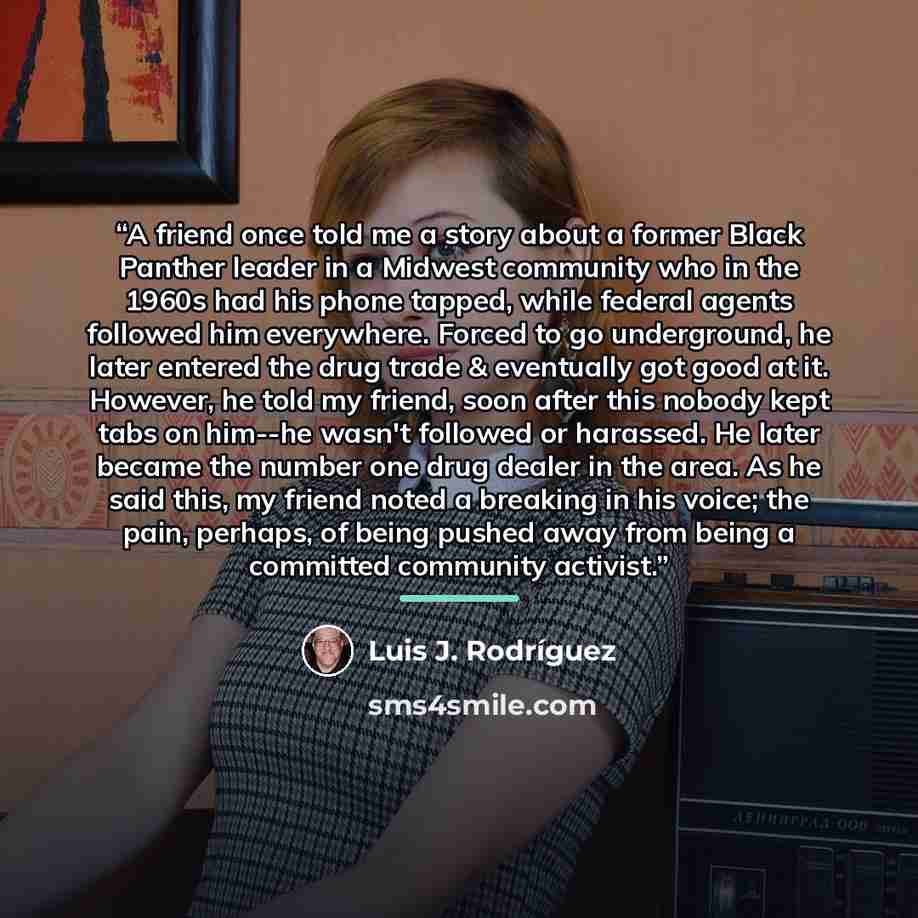
““A friend once told me a story about a former Black Panther leader in a Midwest community who in the 1960s had his phone tapped, while federal agents followed him everywhere. Forced to go underground, he later entered the drug trade & eventually got good at it. However, he told my friend, soon after this nobody kept tabs on him--he wasn't followed or harassed. He later became the number one drug dealer in the area. As he said this, my friend noted a breaking in his voice; the pain, perhaps, of being pushed away from being a committed community activist.””
About This Quote
The story illustrates how state surveillance can push activists into illicit economies, highlighting the personal cost of political repression and the loss of community leadership.
In simple terms: Surveillance can drive activists into crime.
Key Takeaway
Repression can corrupt noble intentions.
Themes
surveillance
activism
crime
psychological trauma
political repression
Mood
somber
reflective
Type
anecdotal
political
cautionary
When to use this quote
- former activist under FBI monitoring
- underground life after being targeted
- transition to drug trade
- loss of community trust
Key Concepts
state power
community impact
identity loss
Practical Applications
- studying effects of surveillance on social movements
- policy analysis on civil liberties
Questions to Reflect On
- What mechanisms can protect activists from state overreach?
- How does loss of community support affect personal identity?
A Different Perspective
While surveillance can force some into illicit paths, many activists remain resilient and continue lawful advocacy despite pressure.












![“We [people] all need each other. Gangs do try to fill that void - but they can't do what healthy, balanced, and coherent families and communities can do. Let's strengthen our core relationships from the start - and all the way through a young person's life. This is the best way to avoid the growth…” quote by Luis J. Rodriguez](https://sms4smile.com/quotes/img-quotes/5f3/luis-j-rodr-guez-15197_balanced_we-people-all-need-each-other-gangs-do-t_933688.jpg)


![“Nearly all the writing of our time is likely to disappear in a hundred years. Certainly most readers - and nearly all critics - feel that [Kurt] Vonnegut started to repeat himself, to grow increasingly self-indulgent and meandering, and to sometimes just blather in his later work. But his books up…” quote by Michael Dirda](https://sms4smile.com/quotes/img-quotes/ed7/michael-dirda-3414_1960s_nearly-all-the-writing-of-our-time-is-li_13506.jpg)

![“[In the 1960s]...you could take LSD but you couldn't wear a pantsuit.” quote by Betsey Johnson](https://sms4smile.com/quotes/img-quotes/29a/betsey-johnson-11907_1960s_in-the-1960s-you-could-take-lsd-but-you_14174.jpg)