Cambridge Quote by Lord Chesterfield
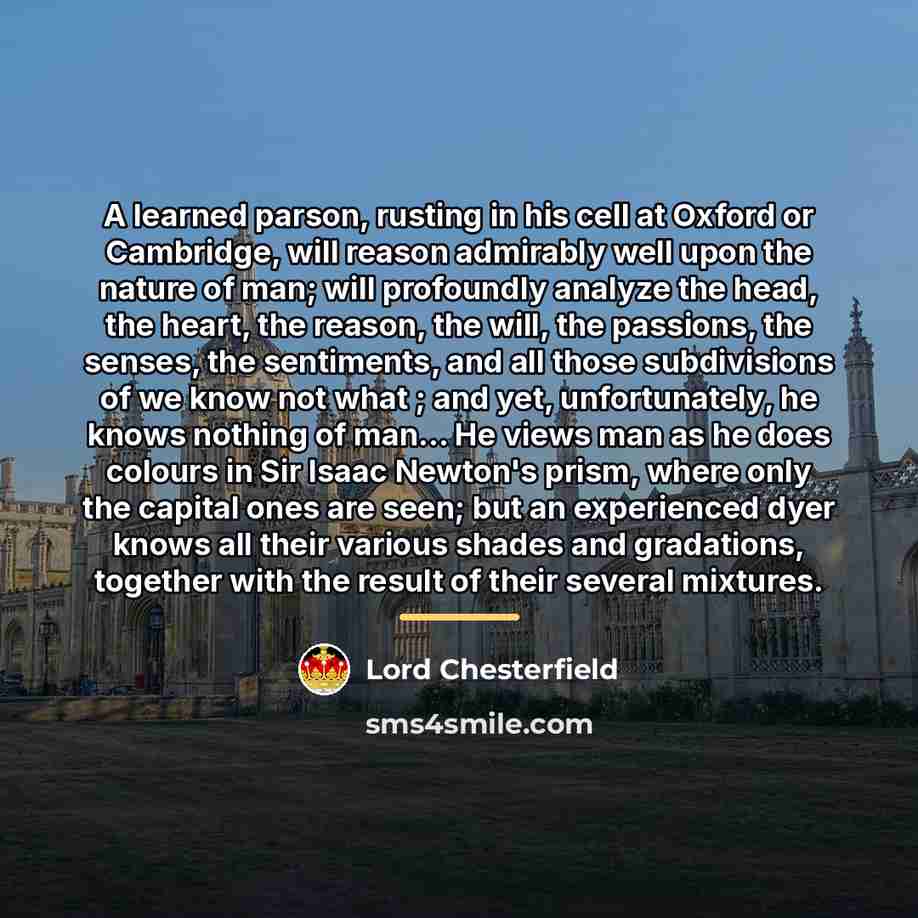
“A learned parson, rusting in his cell at Oxford or Cambridge, will reason admirably well upon the nature of man; will profoundly analyze the head, the heart, the reason, the will, the passions, the senses, the sentiments, and all those subdivisions of we know not what ; and yet, unfortunately, he knows nothing of man... He views man as he does colours in Sir Isaac Newton's prism, where only the capital ones are seen; but an experienced dyer knows all their various shades and gradations, together with the result of their several mixtures.”
About This Quote
Source Essay: Thoughts on Education, 1748
A scholar may master abstract theory but lack practical understanding of human complexity and nuance.
In simple terms: Intellectual knowledge can miss real‑world human depth.
Key Takeaway
Seek experiential insight into people.
Themes
knowledge
human nature
education
Mood
reflective
critical
Type
philosophical
educational
When to use this quote
- teaching
- psychology
- leadership
- clinical practice
Key Concepts
theory vs experience
empathy
holistic understanding
Questions to Reflect On
- How can scholars bridge theory and lived human?
- What experiences deepen understanding of human nature?
A Different Perspective
Academic focus may ignore lived experience.