Book Quote by Lev Shestov
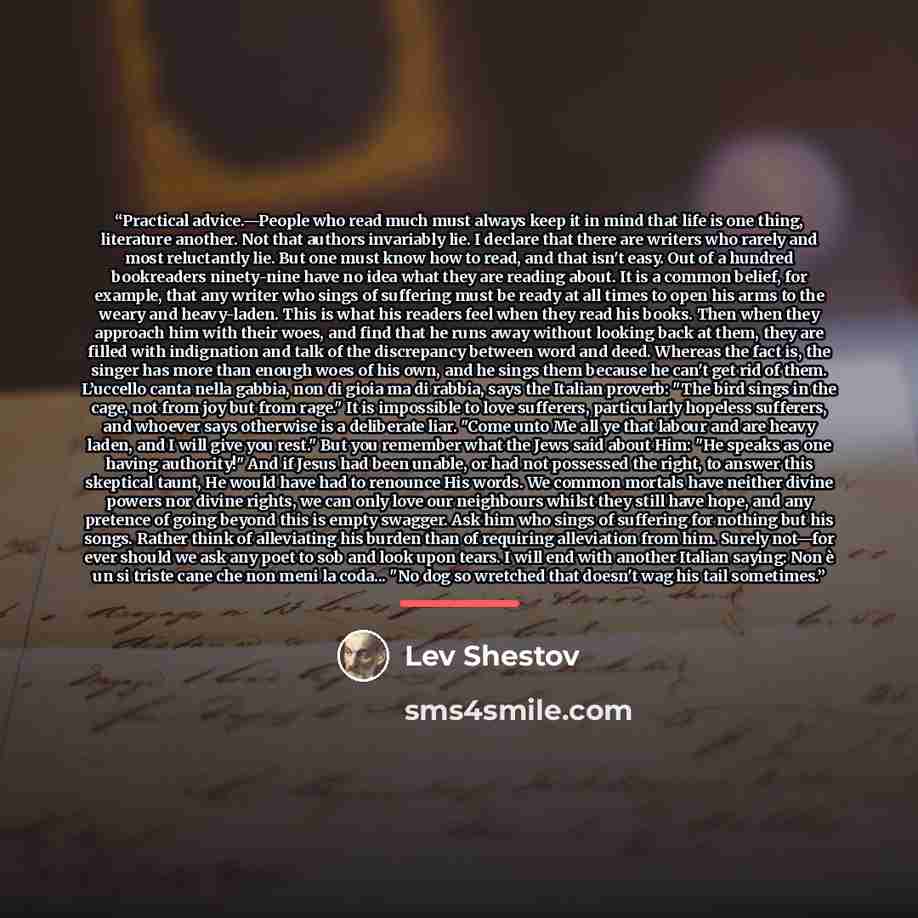
““Practical advice.—People who read much must always keep it in mind that life is one thing, literature another. Not that authors invariably lie. I declare that there are writers who rarely and most reluctantly lie. But one must know how to read, and that isn't easy. Out of a hundred bookreaders ninety-nine have no idea what they are reading about. It is a common belief, for example, that any writer who sings of suffering must be ready at all times to open his arms to the weary and heavy-laden. This is what his readers feel when they read his books. Then when they approach him with their woes, and find that he runs away without looking back at them, they are filled with indignation and talk of the discrepancy between word and deed. Whereas the fact is, the singer has more than enough woes of his own, and he sings them because he can't get rid of them. L’uccello canta nella gabbia, non di gioia ma di rabbia, says the Italian proverb: "The bird sings in the cage, not from joy but from rage." It is impossible to love sufferers, particularly hopeless sufferers, and whoever says otherwise is a deliberate liar. "Come unto Me all ye that labour and are heavy laden, and I will give you rest." But you remember what the Jews said about Him: "He speaks as one having authority!" And if Jesus had been unable, or had not possessed the right, to answer this skeptical taunt, He would have had to renounce His words. We common mortals have neither divine powers nor divine rights, we can only love our neighbours whilst they still have hope, and any pretence of going beyond this is empty swagger. Ask him who sings of suffering for nothing but his songs. Rather think of alleviating his burden than of requiring alleviation from him. Surely not—for ever should we ask any poet to sob and look upon tears. I will end with another Italian saying: Non è un si triste cane che non meni la coda... "No dog so wretched that doesn't wag his tail sometimes.””
About This Quote
Source Essay: Reflections on Literature and Suffering, 1920s
Reading requires active engagement; authors often express personal pain, not universal solutions.
In simple terms: Reading is hard; authors share their own woes.
Key Takeaway
Read critically and empathize with authors' struggles.
Themes
literature
empathy
critical reading
authenticity
Mood
thoughtful
serious
Type
analytical
philosophical
When to use this quote
- book clubs
- academic courses
- personal study
- therapy sessions
Key Concepts
interpretation
authorial intent
ethical reading
Questions to Reflect On
- Do you expect authors to solve readers' problems?
- How do you balance empathy with realism?
A Different Perspective
Not all suffering can be solved by reading; expectations may cause disappointment.