Beyond the horizon Quote by Lawrence Vogel
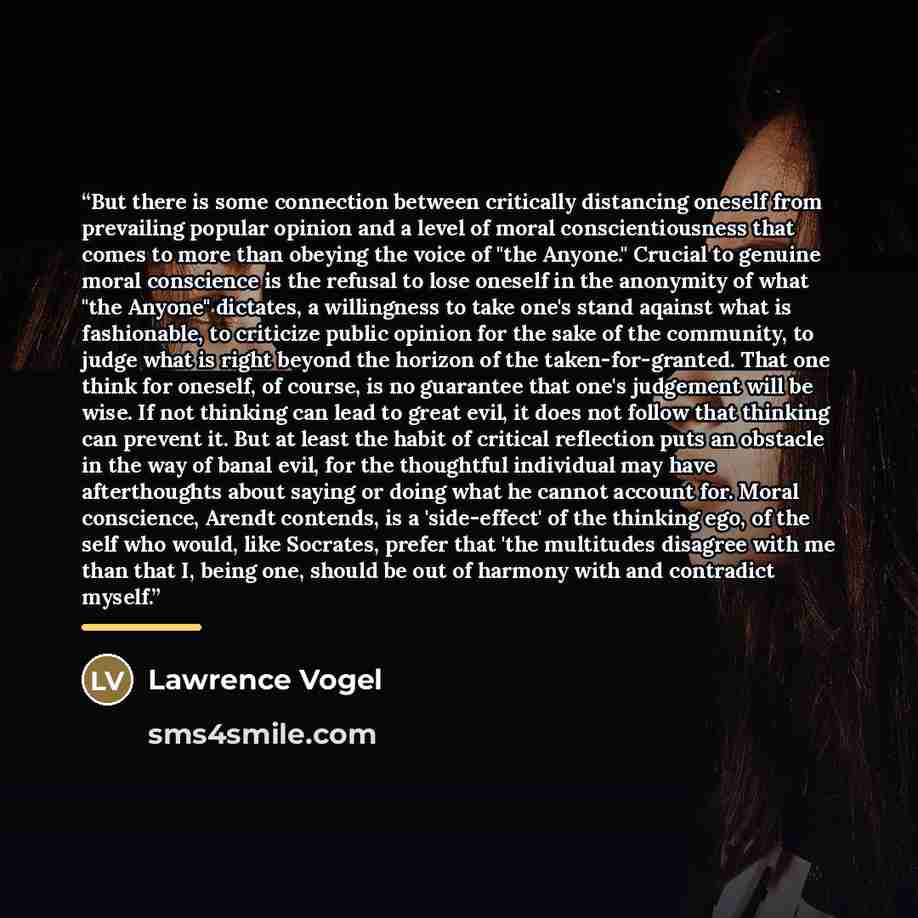
““But there is some connection between critically distancing oneself from prevailing popular opinion and a level of moral conscientiousness that comes to more than obeying the voice of "the Anyone." Crucial to genuine moral conscience is the refusal to lose oneself in the anonymity of what "the Anyone" dictates, a willingness to take one's stand aqainst what is fashionable, to criticize public opinion for the sake of the community, to judge what is right beyond the horizon of the taken-for-granted. That one think for oneself, of course, is no guarantee that one's judgement will be wise. If not thinking can lead to great evil, it does not follow that thinking can prevent it. But at least the habit of critical reflection puts an obstacle in the way of banal evil, for the thoughtful individual may have afterthoughts about saying or doing what he cannot account for. Moral conscience, Arendt contends, is a 'side-effect' of the thinking ego, of the self who would, like Socrates, prefer that 'the multitudes disagree with me than that I, being one, should be out of harmony with and contradict myself.””
About This Quote
Source Book: The Human Condition by Hannah Arendt, 1958
Critical reflection creates moral conscience by resisting popular opinion and preventing banal evil.
In simple terms: Thinking against the crowd builds moral awareness.
Key Takeaway
Cultivate independent, reflective thinking.
Themes
morality
critical thinking
individualism
conscience
social responsibility
Mood
thoughtful
provocative
Type
philosophical
ethical
When to use this quote
- political activism
- ethical decision making
- community leadership
- education
- media criticism
Key Concepts
Socratic doubt
ethical autonomy
public discourse
Questions to Reflect On
- How do you balance independent thought with humility?
- When might conformity be ethically justified?
A Different Perspective
Thinking alone does not guarantee wisdom; reflection can be misdirected.


![“[I]t struck me how easy it is to bamboozle an uneducated audience if you have prepared beforehand a set of repartees with which to evade awkward questions." . . . "You can go on and on telling lies, and the most palpable lies at that, and even if they are not actually believed, there is no strong…” quote by George Orwell](https://sms4smile.com/quotes/img-quotes/098/george-orwell-57_intellectual-honesty_i-t-struck-me-how-easy-it-is-to-bamboozl_2148389.jpg)