Creation science Quote by Ken Ham
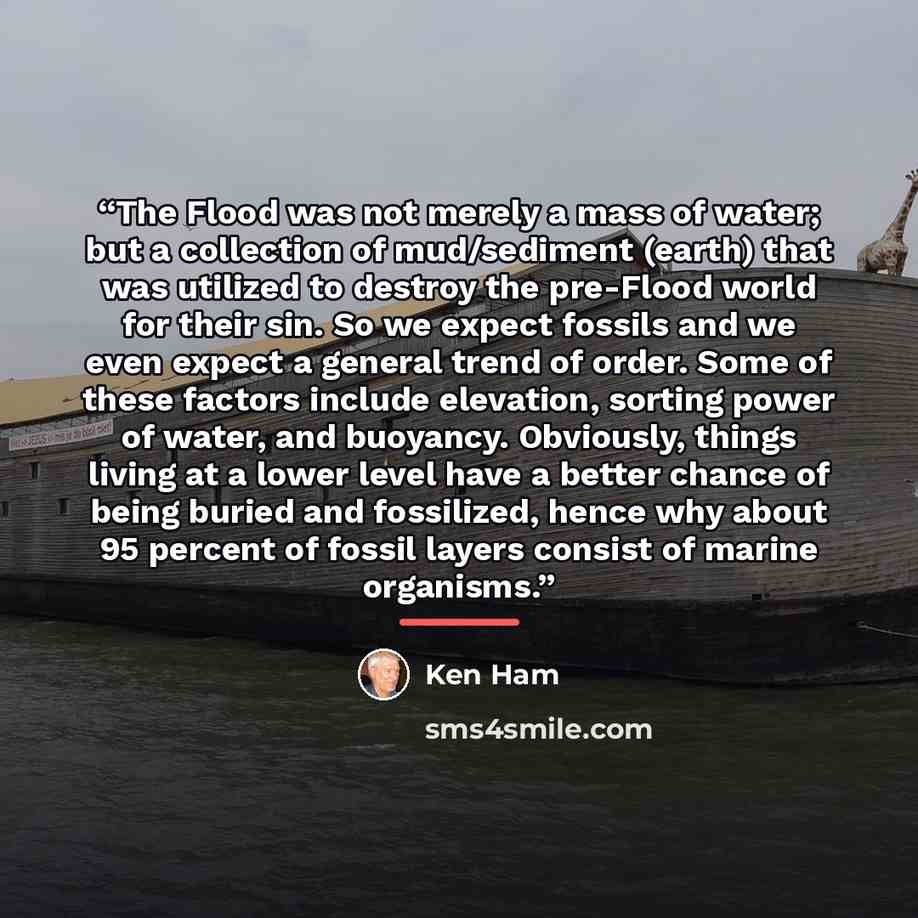
““As the floodwaters advanced during the global Flood, humans would have fled to higher ground, swam, or held on to floating debris for as long as possible. Also, human corpses tend to bloat and therefore float on the water’s surface. Hence, it makes sense that very few, if any, humans would be buried by sediment. Instead, they would have rotted and decayed without fossilization. It is expected that marine creatures and plants were the first things buried and fossilized, since they are at a lower elevation and couldn’t escape the sediment and water. When we look at the fossil record, statistically we find: 95% of all fossils were marine organisms. 95% of the remaining 5% were algae, plants/trees. 95% of the remaining 0.25% were invertebrates, including insects. The remaining 0.0125% were vertebrates, mostly fish.””
About This Quote
Source Lecture: Creation Science Seminar, 2015
Fossil records show most fossils are marine because marine organisms are more likely to be buried and preserved than terrestrial ones.
In simple terms: Most fossils are from sea life because they fossil easier to preserve.
Key Takeaway
Consider preservation bias in paleontology.
Themes
science
fossils
preservation
bias
geology
Mood
analytical
inquisitive
Type
educational
scientific
When to use this quote
- museum exhibits
- academic research
- educational videos
Key Concepts
taphonomy
sedimentology
fossilization processes
Questions to Reflect On
- What does the fossil record tell us about ancient ecosystems?
- How might preservation bias affect our understanding of history?
A Different Perspective
Fossil record is incomplete and biased toward certain environments.