Bourgeois Quote by Karl Marx
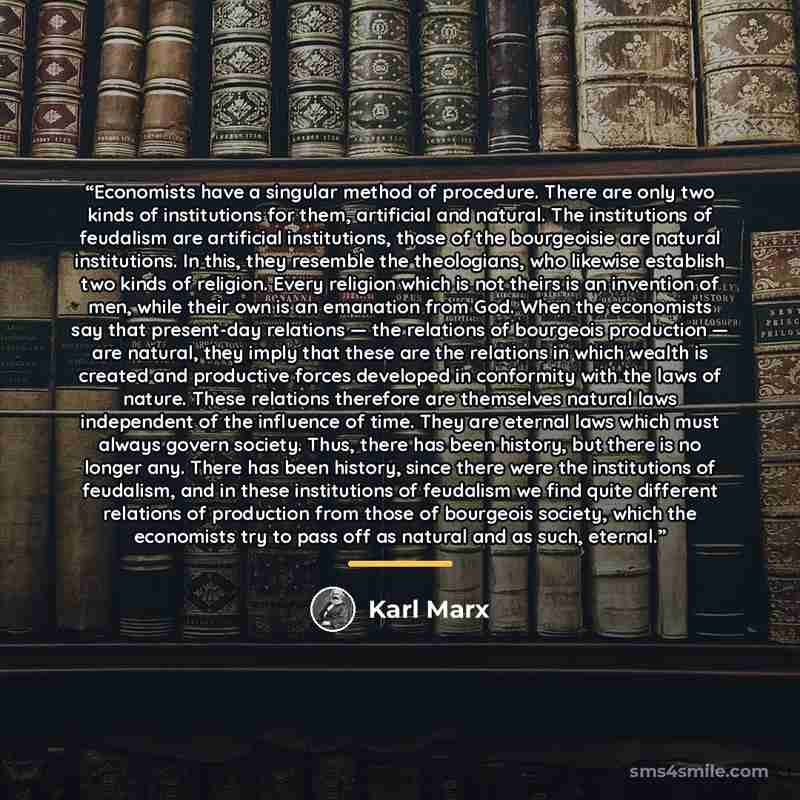
““Economists have a singular method of procedure. There are only two kinds of institutions for them, artificial and natural. The institutions of feudalism are artificial institutions, those of the bourgeoisie are natural institutions. In this, they resemble the theologians, who likewise establish two kinds of religion. Every religion which is not theirs is an invention of men, while their own is an emanation from God. When the economists say that present-day relations — the relations of bourgeois production — are natural, they imply that these are the relations in which wealth is created and productive forces developed in conformity with the laws of nature. These relations therefore are themselves natural laws independent of the influence of time. They are eternal laws which must always govern society. Thus, there has been history, but there is no longer any. There has been history, since there were the institutions of feudalism, and in these institutions of feudalism we find quite different relations of production from those of bourgeois society, which the economists try to pass off as natural and as such, eternal.””
About This Quote
Marx critiques economists for treating bourgeois economic structures as timeless natural laws, ignoring their historical emergence and the artificial nature of earlier feudal institutions.
In simple terms: Economists present capitalism as a natural, unchanging order.
Key Takeaway
Historical context is essential to understand economic institutions.
Themes
historical materialism
ideology critique
economic determinism
social construction
class analysis
institutional change
Mood
critical
analytical
skeptical
Type
philosophical
political
theoretical
When to use this quote
- academic critique of economic theory
- political debates on market regulation
- educational curricula on economic history
- media analysis of capitalist narratives
- policy discussions on institutional reform
Key Concepts
natural vs. artificial institutions
bourgeois production
feudalism
economic laws
historical continuity
Practical Applications
- teaching Marxist theory in university courses
- informing policy makers about the contingent nature of economic systems
Questions to Reflect On
- How does labeling a system as 'natural' affect its perceived legitimacy?
- What evidence shows that current economic relations are historically contingent?

![“The rule of the bourgeois democrats [in pre-federal Germany], from the very first, will carry within it the seeds of its own destruction” quote by Karl Marx](https://sms4smile.com/quotes/img-quotes/067/karl-marx-399_bourgeois_the-rule-of-the-bourgeois-democrats-in-p_2823277.jpg)



![“Avant-garde theatre, with its distrust of the individual (that bourgeois invention), tends to go beyond [character] and the psychological approach in search of a syntax of types and characters which are "deconstructed and post-individual.” quote by Patrice Pavis](https://sms4smile.com/quotes/img-quotes/c22/patrice-pavis-72351_approach_avant-garde-theatre-with-its-distrust-of_59690.jpg)