History-repeating-itself Quote by John R. Mulkern
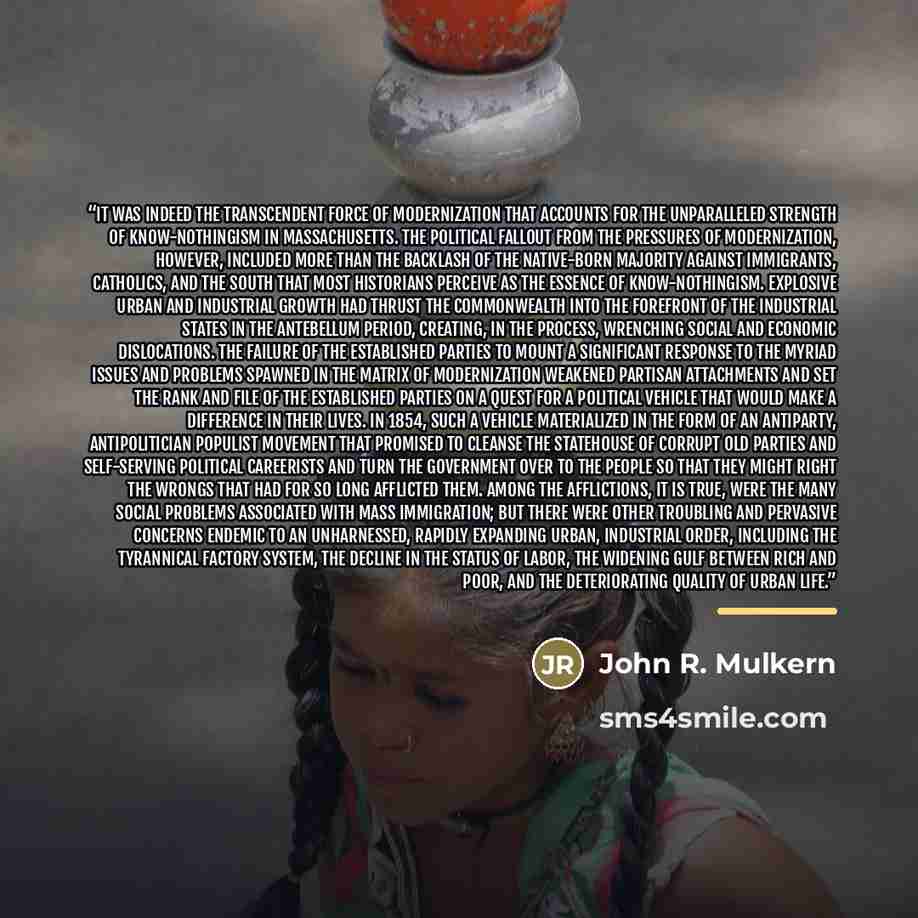
““It was indeed the transcendent force of modernization that accounts for the unparalleled strength of Know-Nothingism in Massachusetts. The political fallout from the pressures of modernization, however, included more than the backlash of the native-born majority against immigrants, Catholics, and the South that most historians perceive as the essence of Know-Nothingism. Explosive urban and industrial growth had thrust the Commonwealth into the forefront of the industrial states in the antebellum period, creating, in the process, wrenching social and economic dislocations. The failure of the established parties to mount a significant response to the myriad issues and problems spawned in the matrix of modernization weakened partisan attachments and set the rank and file of the established parties on a quest for a political vehicle that would make a difference in their lives. In 1854, such a vehicle materialized in the form of an antiparty, antipolitician populist movement that promised to cleanse the statehouse of corrupt old parties and self-serving political careerists and turn the government over to the people so that they might right the wrongs that had for so long afflicted them. Among the afflictions, it is true, were the many social problems associated with mass immigration; but there were other troubling and pervasive concerns endemic to an unharnessed, rapidly expanding urban, industrial order, including the tyrannical factory system, the decline in the status of labor, the widening gulf between rich and poor, and the deteriorating quality of urban life.””
About This Quote
Source Book: The Rise of the Know-Nothings, John R. Mulkern, 1995
Modernization created economic upheaval and social dislocation, fueling a nativist movement that promised reform but also reflected deeper class tensions.
In simple terms: Rapid change sparked a populist backlash against elites and immigrants.
Key Takeaway
Recognize how economic disruption can breed political extremism.
Themes
industrialization
populism
nativism
class conflict
urbanization
Mood
anxious
critical
historical
Type
analytical
contextual
When to use this quote
- urban labor unrest
- immigration debates
- political party collapse
- grassroots reform movements
Key Concepts
industrial capitalism
social displacement
political realignment
Questions to Reflect On
- How do economic shocks shape political identities?
- Can reform movements avoid scapegoating minorities?
A Different Perspective
The movement also exploited xenophobia, limiting its reformist potential.




![“You have driven me from the East to this place, and I have been here two thousand years or more. [...] My friends, if you took me away from this land it would be very hard for me. I wish to die in this land, I wish to be an old man here. [...] I have not wished to give even a part of it to the…” quote by Standing Bear](https://sms4smile.com/quotes/img-quotes/d35/standing-bear-40971_aboriginals_you-have-driven-me-from-the-east-to-this_1644739.jpg)