Israel Quote by John R. Bradley
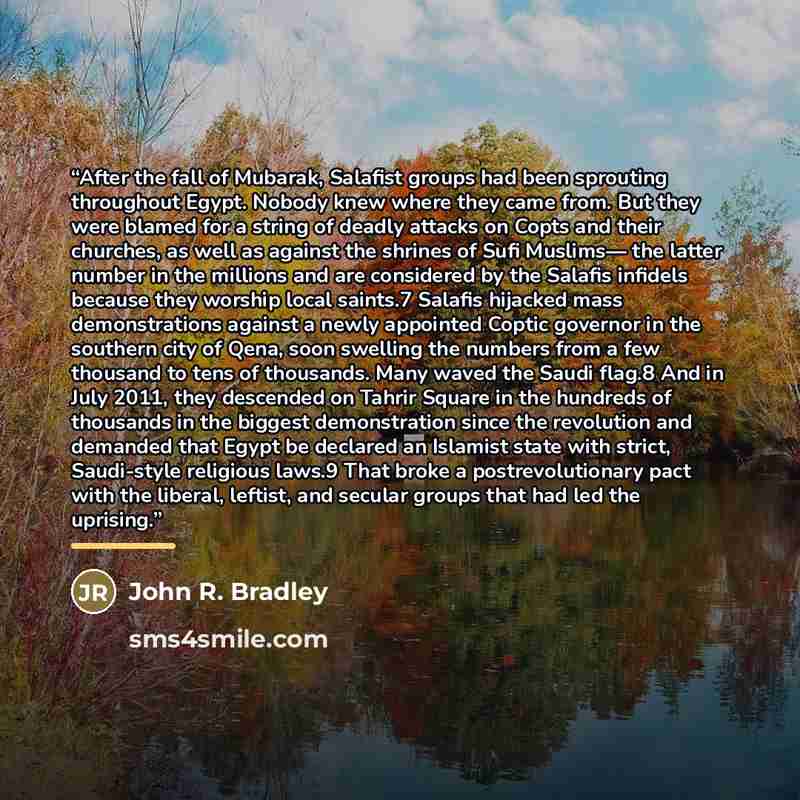
““After the fall of Mubarak, Salafist groups had been sprouting throughout Egypt. Nobody knew where they came from. But they were blamed for a string of deadly attacks on Copts and their churches, as well as against the shrines of Sufi Muslims— the latter number in the millions and are considered by the Salafis infidels because they worship local saints.7 Salafis hijacked mass demonstrations against a newly appointed Coptic governor in the southern city of Qena, soon swelling the numbers from a few thousand to tens of thousands. Many waved the Saudi flag.8 And in July 2011, they descended on Tahrir Square in the hundreds of thousands in the biggest demonstration since the revolution and demanded that Egypt be declared an Islamist state with strict, Saudi-style religious laws.9 That broke a postrevolutionary pact with the liberal, leftist, and secular groups that had led the uprising.””
About This Quote
Source Book: Egypt After the Arab Spring, John R. Bradley, 2013
The rise of Salafist groups after Mubarak’s fall led to violent attacks on religious minorities and massive protests demanding strict Islamist rule, breaking earlier alliances with secular forces.
In simple terms: Salafists grew powerful, attacked minorities, and pushed for strict Islamist laws, ending earlier secular alliances.
Key Takeaway
Recognize how power vacuums can empower extremist groups and threaten pluralism.
Themes
extremism
political upheaval
religious conflict
social fragmentation
Mood
tense
urgent
reflective
Type
political
historical
analytical
When to use this quote
- post‑revolution Egypt
- minority protection
- policy making
- community dialogue
Key Concepts
Sectarianism
radicalization
mass mobilization
Questions to Reflect On
- How can societies rebuild inclusive governance after a revolution?
- What safeguards prevent extremist dominance in transitional periods?
A Different Perspective
Extremist groups may also provide social services, complicating simple condemnation.

![“[Islam] Leaves no room of human legislation in an Islamic state, because herein all legislative functions vest in God and the only function left for Muslims lies in their observance of the God-made law.” quote by Abul A'la Maududi](https://sms4smile.com/quotes/img-quotes/704/abul-a-la-maududi-51903_function_islam-leaves-no-room-of-human-legislatio_886.jpg)