Barbarity Quote by Jeffrey Tayler

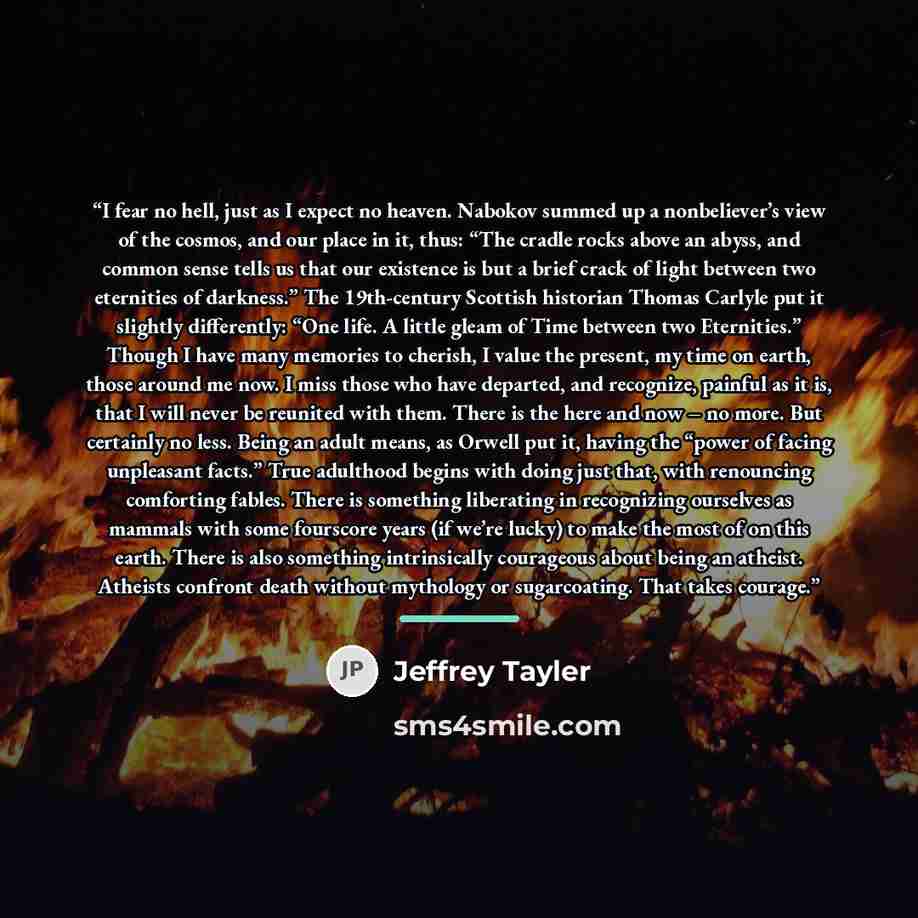
““Killing, raping and looting have been common practices in religious societies, and often carried out with clerical sanction. The catalogue of notorious barbarities – wars and massacres, acts of terrorism, the Inquisition, the Crusades, the chopping off of thieves’ hands, the slicing off of clitorises and labia majora, the use of gang rape as punishment, and manifold other savageries committed in the name of one faith or another — attests to religion’s longstanding propensity to induce barbarity, or at the very least to give it free rein. The Bible and the Quran have served to justify these atrocities and more, with women and gay people suffering disproportionately. There is a reason the Middle Ages in Europe were long referred to as the Dark Ages; the millennium of theocratic rule that ended only with the Renaissance (that is, with Europe’s turn away from God toward humankind) was a violent time. Morality arises out of our innate desire for safety, stability and order, without which no society can function; basic moral precepts (that murder and theft are wrong, for example) antedated religion. Those who abstain from crime solely because they fear divine wrath, and not because they recognize the difference between right and wrong, are not to be lauded, much less trusted. Just which practices are moral at a given time must be a matter of rational debate. The 'master-slave' ethos – obligatory obeisance to a deity — pervading the revealed religions is inimical to such debate. We need to chart our moral course as equals, or there can be no justice.””
About This Quote
The quote argues that religious institutions have historically justified violence and oppression, and that morality should be based on rational debate rather than divine authority.
In simple terms: Religion has often enabled cruelty; morality should be rational, not divine.
Key Takeaway
Question authority and base ethics on reason.
Themes
religion
morality
history
violence
justice
Mood
critical
thoughtful
serious
Type
analytical
philosophical
When to use this quote
- academic debate
- policy making
- education reform
- interfaith dialogue
Key Concepts
theodicy
secular ethics
human rights
Questions to Reflect On
- How can societies develop shared moral standards without religious foundations?
- What role should historical context play in evaluating past religious actions?
A Different Perspective
Religious texts are complex and interpreted differently, limiting a single narrative.
![“The African specialist Nahid Toubia puts it plain [when speaking of female genital mutilation]: In a man it would range from amoutation of most of the penis, to "removal of all the penis, its roots of soft tissue and part of the scrotal skin.” quote by Eve Ensler](https://sms4smile.com/quotes/img-quotes/59c/eve-ensler-1402_genital_the-african-specialist-nahid-toubia-puts_384212.jpg)