Mathematics Quote by James Gleick
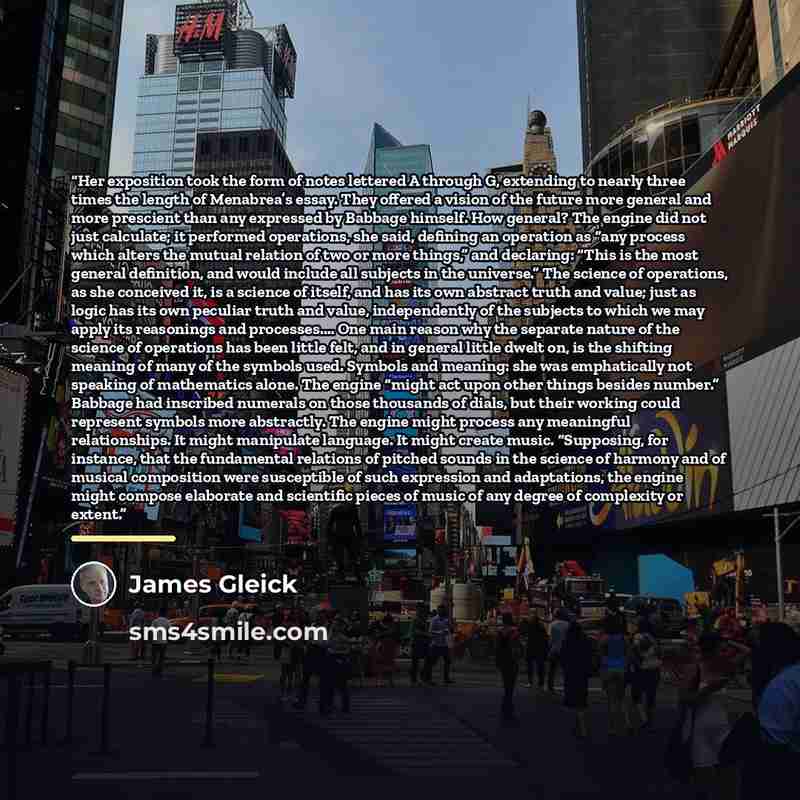
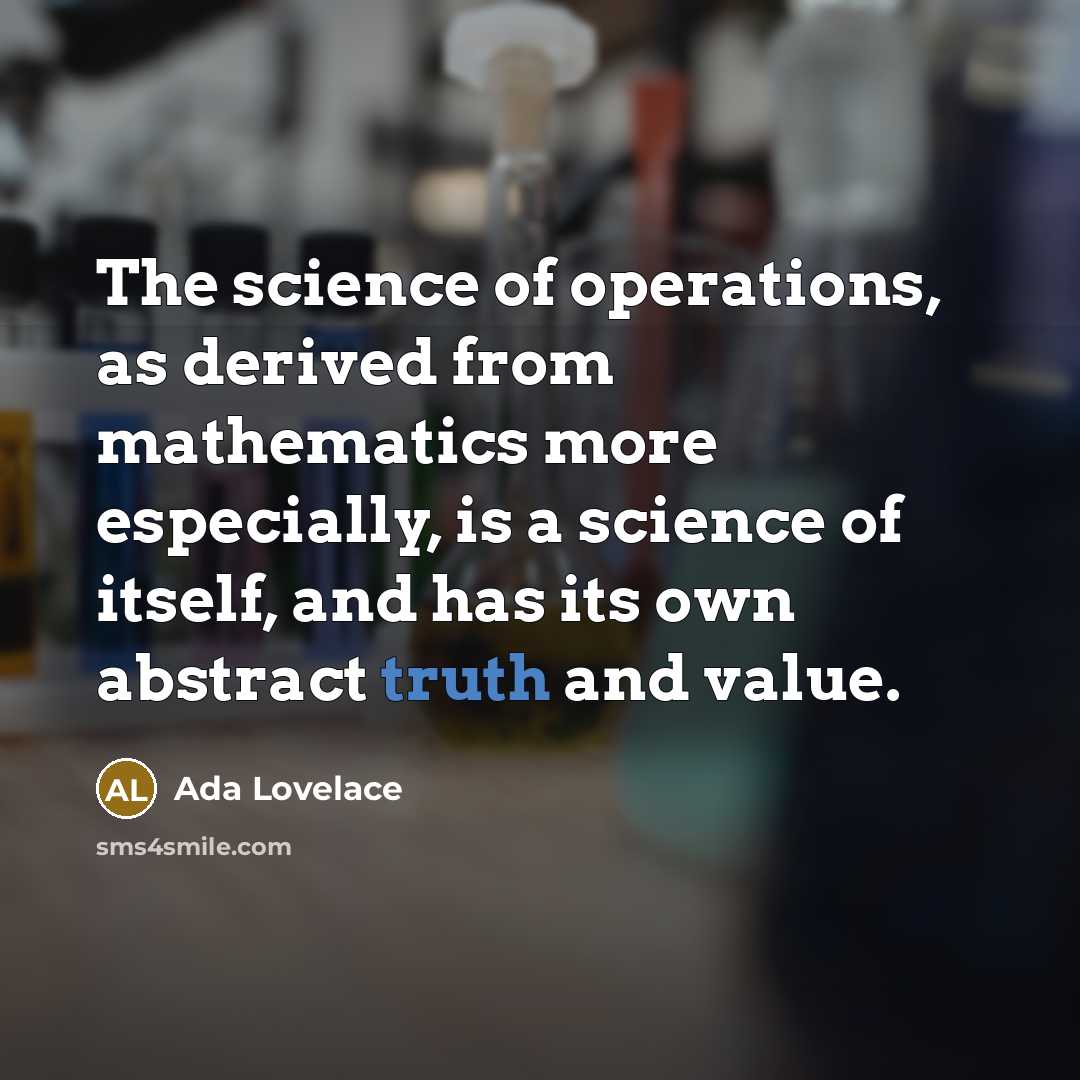
““Her exposition took the form of notes lettered A through G, extending to nearly three times the length of Menabrea’s essay. They offered a vision of the future more general and more prescient than any expressed by Babbage himself. How general? The engine did not just calculate; it performed operations, she said, defining an operation as “any process which alters the mutual relation of two or more things,” and declaring: “This is the most general definition, and would include all subjects in the universe.” The science of operations, as she conceived it, is a science of itself, and has its own abstract truth and value; just as logic has its own peculiar truth and value, independently of the subjects to which we may apply its reasonings and processes.… One main reason why the separate nature of the science of operations has been little felt, and in general little dwelt on, is the shifting meaning of many of the symbols used. Symbols and meaning: she was emphatically not speaking of mathematics alone. The engine “might act upon other things besides number.” Babbage had inscribed numerals on those thousands of dials, but their working could represent symbols more abstractly. The engine might process any meaningful relationships. It might manipulate language. It might create music. “Supposing, for instance, that the fundamental relations of pitched sounds in the science of harmony and of musical composition were susceptible of such expression and adaptations, the engine might compose elaborate and scientific pieces of music of any degree of complexity or extent.””
About This Quote
Source Book: The Information, James Gleick, 2011
Ada Lovelace envisioned computing as a universal operation engine, far beyond numbers, capable of manipulating any relational data, including language and music.
In simple terms: She saw computing as a general process for transforming relationships, not just arithmetic.
Key Takeaway
Embrace computing as a tool for all kinds of symbolic manipulation.
Themes
technology
innovation
abstraction
creativity
future studies
Mood
inquisitive
optimistic
Type
philosophical
inspirational
When to use this quote
- software development
- AI research
- digital art
- education
- music composition
Key Concepts
general-purpose computing
symbolic manipulation
interdisciplinary systems
Questions to Reflect On
- How can we design systems that truly handle diverse symbolic relations?
- What limits exist when extending computation beyond numbers?
A Different Perspective
Her vision assumes abstract symbols can be uniformly processed, which may overlook domain‑specific constraints.

![“Geometry, which should only obey Physics, when united with it sometimes commands it. If it happens that the question which we wish to examine is too complicated for all the elements to be able to enter into the analytical comparison we wish to make, we separate the more inconvenient [elements], we…” quote by Jean le Rond d'Alembert](https://sms4smile.com/quotes/img-quotes/0d9/jean-le-rond-d-alembert-26487_able_geometry-which-should-only-obey-physics_6945.jpg)