Freedom Quote by Immanuel Kant
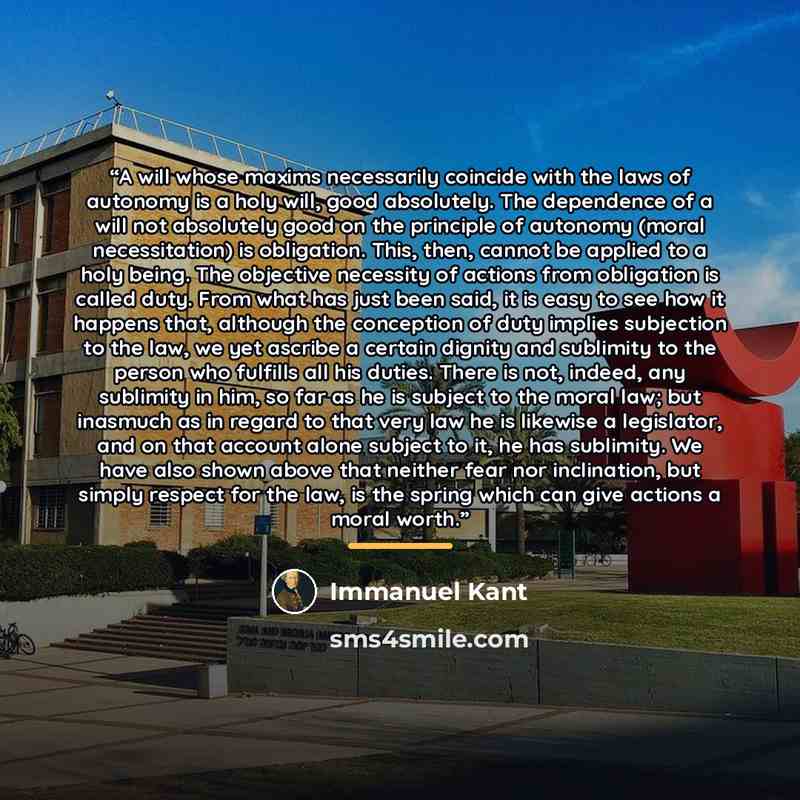
““A will whose maxims necessarily coincide with the laws of autonomy is a holy will, good absolutely. The dependence of a will not absolutely good on the principle of autonomy (moral necessitation) is obligation. This, then, cannot be applied to a holy being. The objective necessity of actions from obligation is called duty. From what has just been said, it is easy to see how it happens that, although the conception of duty implies subjection to the law, we yet ascribe a certain dignity and sublimity to the person who fulfills all his duties. There is not, indeed, any sublimity in him, so far as he is subject to the moral law; but inasmuch as in regard to that very law he is likewise a legislator, and on that account alone subject to it, he has sublimity. We have also shown above that neither fear nor inclination, but simply respect for the law, is the spring which can give actions a moral worth.””
About This Quote
Source Book: Groundwork of the Metaphysics of Morals, 1785
Moral worth comes from acting out of respect for law, not from fear or desire; duty confers dignity.
In simple terms: Good actions respect moral law, giving dignity.
Key Takeaway
Act from respect for moral law.
Themes
ethics
duty
autonomy
Mood
reflective
instructive
Type
philosophical
ethical
When to use this quote
- legal decisions
- personal integrity
- leadership
- education
Key Concepts
philosophy
morality
Questions to Reflect On
- What duties feel most dignified?
- How does respect differ from fear?
A Different Perspective
Respect for law may conflict with personal inclinations.

![“...[T]he sublimity and intrinsic dignity of the command in duty are so much the more evident, the less the subjective impulses favor it and the more they oppose it, without being able in the slightest degree to weaken the obligation of the law or to diminish its validity.” quote by Immanuel Kant](https://sms4smile.com/quotes/img-quotes/dd8/immanuel-kant-532_commandments_t-he-sublimity-and-intrinsic-dignity-of_1171020.jpg)