Human mind Quote by Ilia Delio
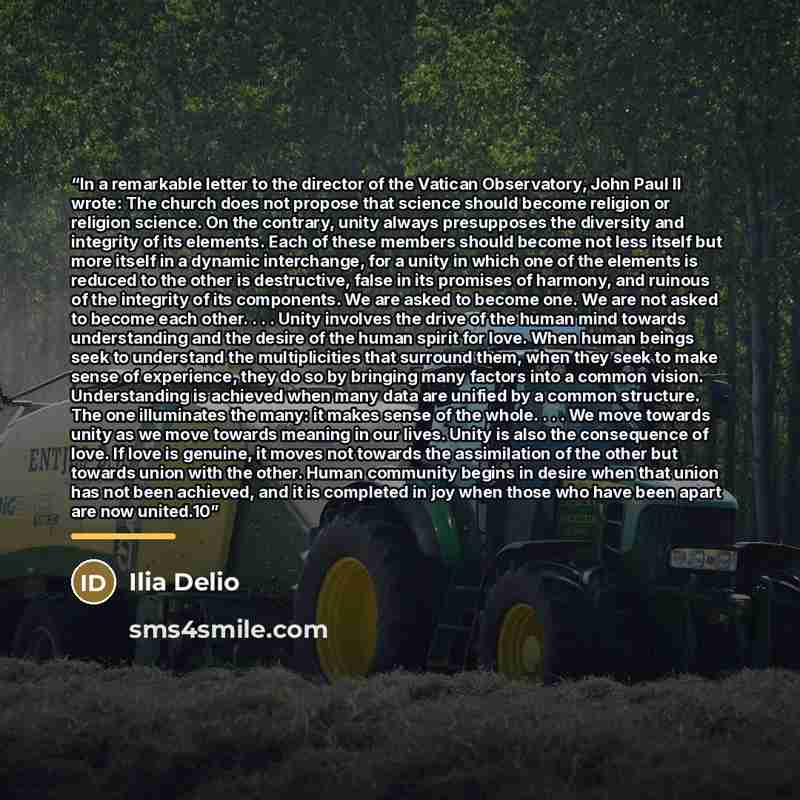
““In a remarkable letter to the director of the Vatican Observatory, John Paul II wrote: The church does not propose that science should become religion or religion science. On the contrary, unity always presupposes the diversity and integrity of its elements. Each of these members should become not less itself but more itself in a dynamic interchange, for a unity in which one of the elements is reduced to the other is destructive, false in its promises of harmony, and ruinous of the integrity of its components. We are asked to become one. We are not asked to become each other. . . . Unity involves the drive of the human mind towards understanding and the desire of the human spirit for love. When human beings seek to understand the multiplicities that surround them, when they seek to make sense of experience, they do so by bringing many factors into a common vision. Understanding is achieved when many data are unified by a common structure. The one illuminates the many: it makes sense of the whole. . . . We move towards unity as we move towards meaning in our lives. Unity is also the consequence of love. If love is genuine, it moves not towards the assimilation of the other but towards union with the other. Human community begins in desire when that union has not been achieved, and it is completed in joy when those who have been apart are now united.10””
About This Quote
Source Letter: Vatican Observatory correspondence, John Paul II, 1990s
The quote argues that true unity respects diversity, allowing each element to retain its identity while contributing to a shared purpose, and that love and understanding foster this harmonious integration.
In simple terms: Unity respects diversity and is built through love and understanding.
Key Takeaway
Preserve individuality while seeking common purpose.
Themes
unity
diversity
love
understanding
community
Mood
hopeful
reflective
Type
philosophical
inspirational
When to use this quote
- interfaith dialogue
- team collaboration
- education curriculum design
- community building
Key Concepts
philosophy
theology
systems thinking
Questions to Reflect On
- How can we protect distinct identities while building shared goals?
- What practices nurture love‑based unity?
A Different Perspective
It may be idealistic, as power dynamics can force assimilation rather than genuine integration.

![“Teaching might even be the greatest of the arts since the medium is the human mind and spirit. My three [great teachers] did not tell - they catalyzed a burning desire to know. Under their influence, the horizons sprung wide and fear went away and the unknown became knowable. But most important of…” quote by John Steinbeck](https://sms4smile.com/quotes/img-quotes/84c/john-steinbeck-71_art_teaching-might-even-be-the-greatest-of-t_1738.jpg)
![“It is certain that every class is interested in [educational] establishments which give to the human mind its highest improvements, and to every Country its truest and most durable celebrity.” quote by James Madison](https://sms4smile.com/quotes/img-quotes/964/james-madison-373_certain_it-is-certain-that-every-class-is-intere_22217.jpg)