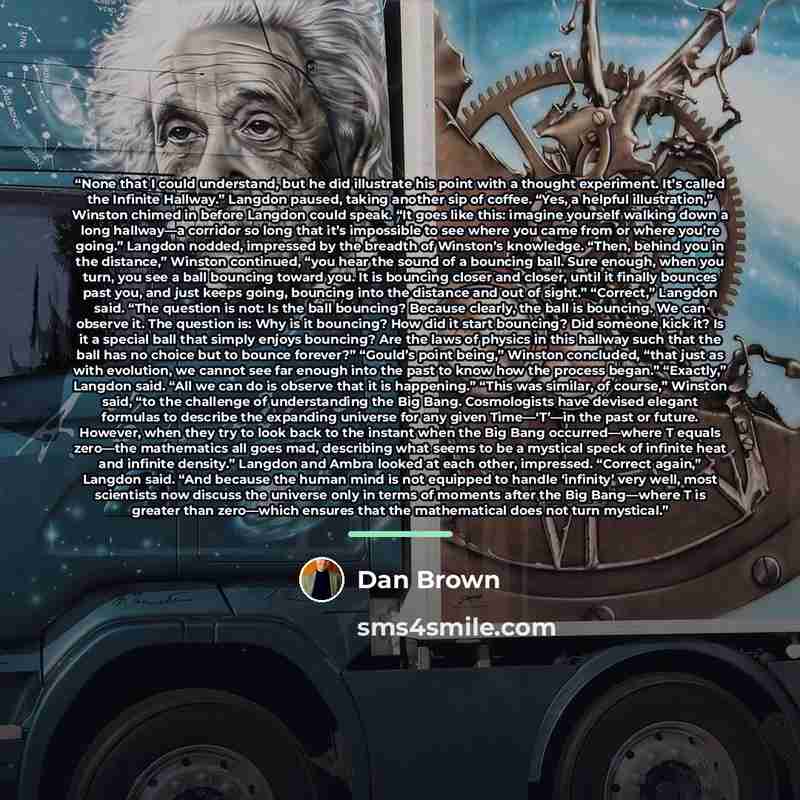
““To illustrate this relation, think of a game of table tennis. As the ball hits the table, it will bounce up and down. When we restrain the upward bounce by holding the paddle parallel to the table at a small height, the ball will bounce up and down at a faster rate between paddle and table. If the paddle, the table, and the ball were perfectly elastic, the ball would not lose any energy in the process. The closer to the table we hold the paddle, the more precisely we fix the location of the ball-but at the expense of having it move faster and faster. If we removed both paddle and table in one instant, we would not be able to predict the direction in which the ball moves-up or down. We simply don't know in which direction the very rapidly bouncing ball was moving at the very instant of removal. Consequently, we might say that this process just prior to the removal of table and paddle fixes the location while failing to give us any good information on the velocity; it makes the velocity uncertain. What distinguishes this macroscopic process from the quantum mechanical uncertainty relation is that in principle we can calculate the velocity of the ball at every instant from the initial conditions (how the bounce started) and the boundary conditions (the relative positions of table and paddle). In principle, macroscopic motion is free of uncertainties.””
![“Anybody who is not shocked by this subject has failed to understand it. [of quantum mechanics]” quote by Niels Bohr](https://sms4smile.com/quotes/img-quotes/9da/niels-bohr-4542_mechanic_anybody-who-is-not-shocked-by-this-subje_276713.jpg)




![“[Boxed] Multiple bouncing balls in a box are a metaphor for community. Notice how the escaping balls explode. This is what happens to people who move from Perl to Ruby.” quote by Larry Wall](https://sms4smile.com/quotes/img-quotes/df5/larry-wall-1576_balls_boxed-multiple-bouncing-balls-in-a-box-a_640682.jpg)