Justice Quote by Guy Standing
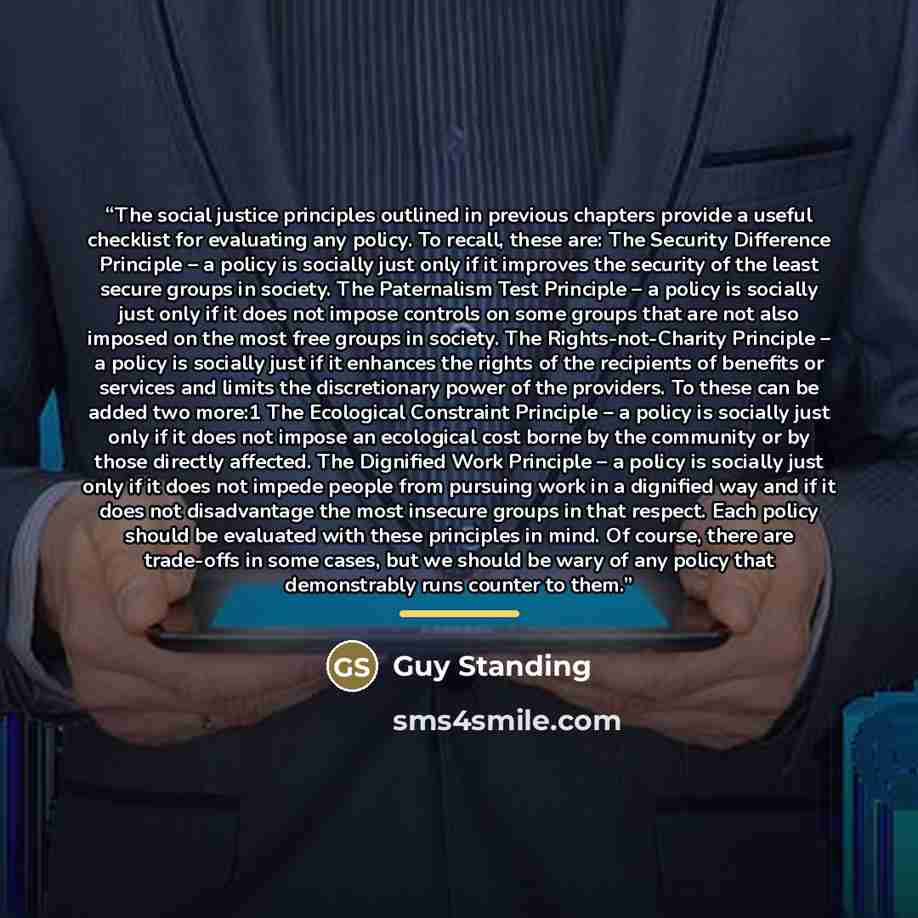
““The social justice principles outlined in previous chapters provide a useful checklist for evaluating any policy. To recall, these are: The Security Difference Principle – a policy is socially just only if it improves the security of the least secure groups in society. The Paternalism Test Principle – a policy is socially just only if it does not impose controls on some groups that are not also imposed on the most free groups in society. The Rights-not-Charity Principle – a policy is socially just if it enhances the rights of the recipients of benefits or services and limits the discretionary power of the providers. To these can be added two more:1 The Ecological Constraint Principle – a policy is socially just only if it does not impose an ecological cost borne by the community or by those directly affected. The Dignified Work Principle – a policy is socially just only if it does not impede people from pursuing work in a dignified way and if it does not disadvantage the most insecure groups in that respect. Each policy should be evaluated with these principles in mind. Of course, there are trade-offs in some cases, but we should be wary of any policy that demonstrably runs counter to them.””
About This Quote
Source Book: The Precariat: The New Dangerous Class, Guy Standing, 2011
A framework of five principles to assess whether policies promote fairness, security, rights, ecological health, and dignified work.
In simple terms: Check policies against security, rights, ecology, dignity, and paternalism.
Key Takeaway
Use these criteria to evaluate and improve policy fairness.
Themes
social justice
policy analysis
equity
rights
ecology
dignity
Mood
analytical
critical
thoughtful
Type
philosophical
policy
educational
When to use this quote
- government legislation
- corporate social responsibility
- community development
- environmental regulation
- labor standards
Key Concepts
Security Difference
Paternalism Test
Rights-not-Charity
Ecological Constraint
Dignified Work
Questions to Reflect On
- Which principle is most critical in your context?
- How to balance ecological constraints with economic growth?
A Different Perspective
Principles may conflict, requiring trade‑offs and prioritization.



![“This cold weather has set all the young Folks to providing Bedfellows. I have signed two or three Licences every Day [as a Fairfax Justice of the Peace] since I have been at Home. I wish I knew where to get a good one myself; for I find cold Sheets extreamly disagreeable.” quote by George Mason](https://sms4smile.com/quotes/img-quotes/b92/george-mason-8435_bedfellows_this-cold-weather-has-set-all-the-young_3953.jpg)