Blessedness Quote by George MacDonald
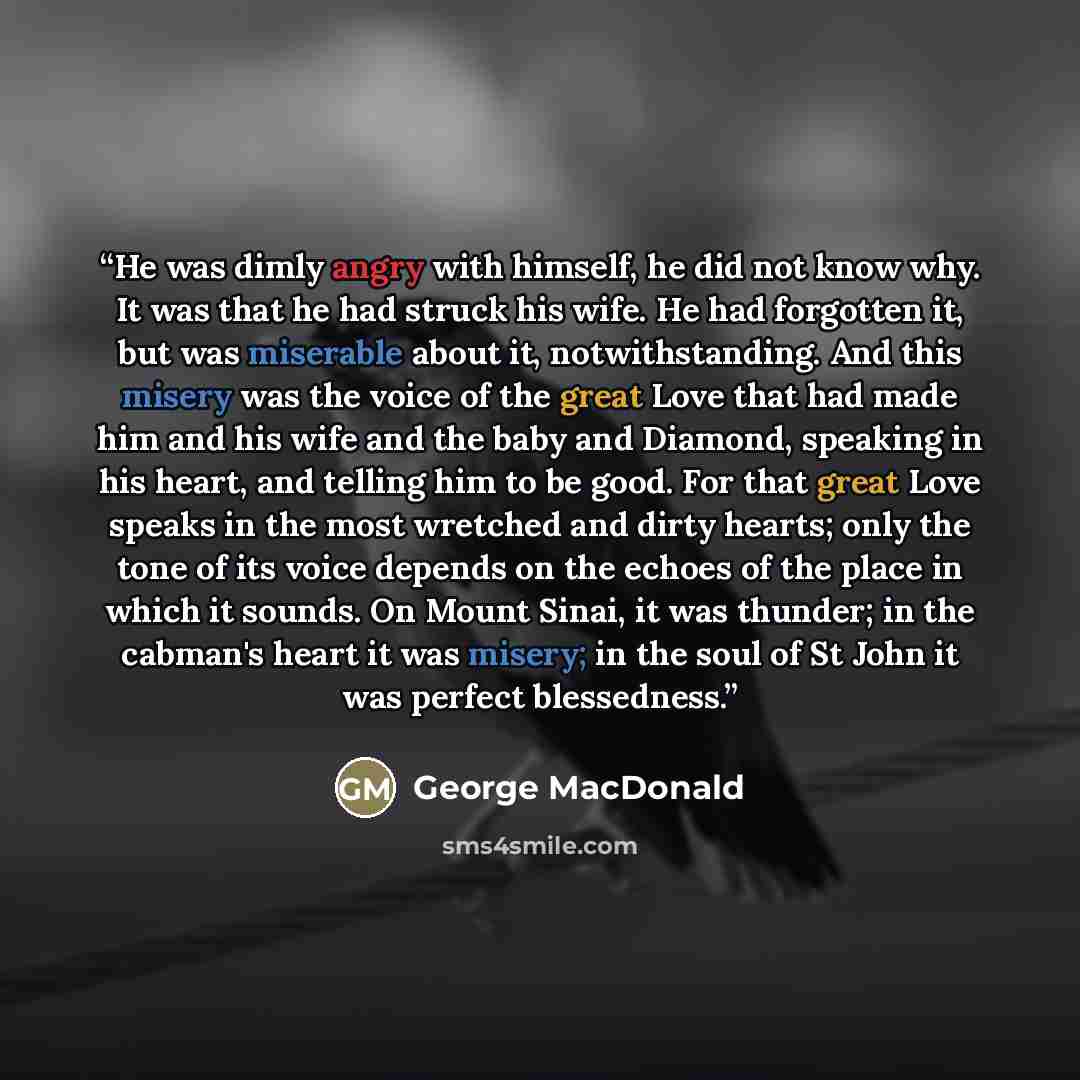
““He was dimly angry with himself, he did not know why. It was that he had struck his wife. He had forgotten it, but was miserable about it, notwithstanding. And this misery was the voice of the great Love that had made him and his wife and the baby and Diamond, speaking in his heart, and telling him to be good. For that great Love speaks in the most wretched and dirty hearts; only the tone of its voice depends on the echoes of the place in which it sounds. On Mount Sinai, it was thunder; in the cabman's heart it was misery; in the soul of St John it was perfect blessedness.””
About This Quote
A man's hidden guilt over harming his wife becomes a voice of love, urging him toward goodness; love's expression varies with the heart's condition.
In simple terms: Guilt transforms into a loving conscience that guides him.
Key Takeaway
Love can manifest as conscience, even in troubled hearts.
Themes
guilt
love
conscience
redemption
Mood
somber
introspective
Type
moral tale
philosophical
When to use this quote
- a person confronting past abuse
- a therapist exploring inner moral voices
Key Concepts
moral psychology
spiritual metaphor
Practical Applications
- use guilt as a catalyst for moral change
- recognize love's voice in self‑reflection
Questions to Reflect On
- When does guilt become constructive?
- How can love be distinguished from self‑justification?
A Different Perspective
Equating guilt with love may romanticize harmful behavior rather than demand accountability.





![“I wish I had [made that song]. No, I don't That would be to take it from somebody else. But it's mine for all that.' 'What makes it yours?' 'I love it so.' 'Does loving a thing make it yours?' 'I think so, Mother -- at least more than anything else can. . . . Love makes the only myness,' said…” quote by George MacDonald](https://sms4smile.com/quotes/img-quotes/722/george-macdonald-295_love_i-wish-i-had-made-that-song-no-i-don-t-t_35103.jpg)

![“The purpose of the whole [the Comedy] and of this portion [the Paradiso] is to remove those who are living in this life from the state of wretchedness, and to lead them to the state of blessedness.” quote by Dante Alighieri](https://sms4smile.com/quotes/img-quotes/e05/dante-alighieri-590_blessedness_the-purpose-of-the-whole-the-comedy-and_145640.jpg)