Cruelty Quote by Fyodor Dostoyevsky
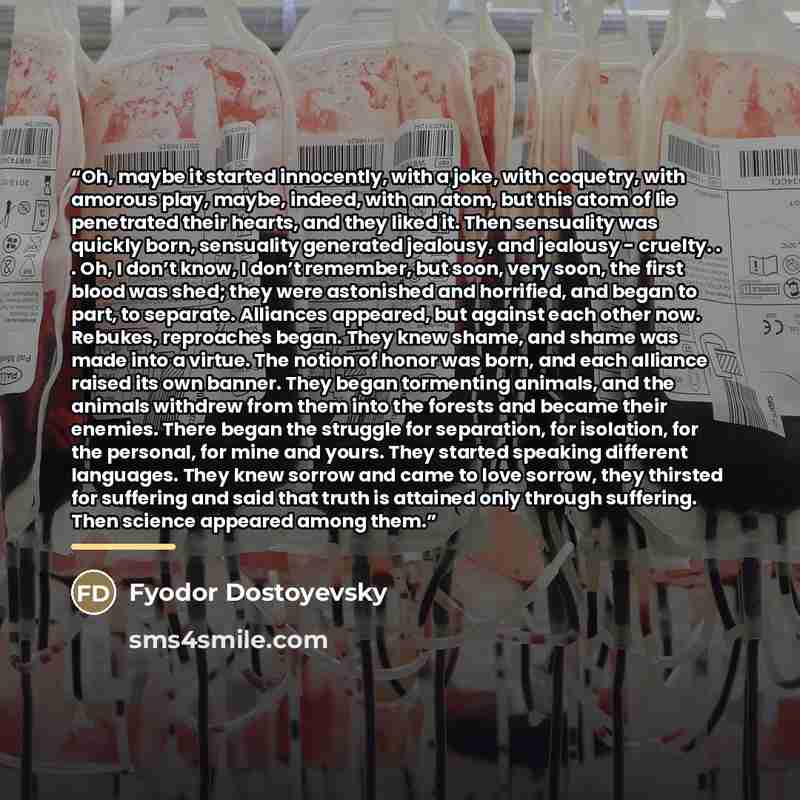
““Oh, maybe it started innocently, with a joke, with coquetry, with amorous play, maybe, indeed, with an atom, but this atom of lie penetrated their hearts, and they liked it. Then sensuality was quickly born, sensuality generated jealousy, and jealousy - cruelty. . . Oh, I don’t know, I don’t remember, but soon, very soon, the first blood was shed; they were astonished and horrified, and began to part, to separate. Alliances appeared, but against each other now. Rebukes, reproaches began. They knew shame, and shame was made into a virtue. The notion of honor was born, and each alliance raised its own banner. They began tormenting animals, and the animals withdrew from them into the forests and became their enemies. There began the struggle for separation, for isolation, for the personal, for mine and yours. They started speaking different languages. They knew sorrow and came to love sorrow, they thirsted for suffering and said that truth is attained only through suffering. Then science appeared among them.””
About This Quote
A mythic recounting of how a simple deception escalates into complex social structures, jealousy, cruelty, and the emergence of honor, language, and suffering as cultural foundations, culminating in the birth of science.
In simple terms: Origins of civilization from deceit to structured societies.
Key Takeaway
Small lies can spawn massive social systems.
Themes
Deception
Power dynamics
Cultural evolution
Suffering
Science emergence
Mood
Reflective
Somber
Philosophical
Type
Historical
Philosophical
When to use this quote
- Early tribal conflicts
- Formation of nation‑states
- Religious or ideological schisms
- Scientific revolutions
Key Concepts
Moral decay
Social stratification
Language formation
Human suffering
Practical Applications
- Analyzing the roots of societal conflict
- Designing interventions to curb escalation of mistrust
Questions to Reflect On
- What mechanisms transform personal betrayal into collective institutions?
- Can societies thrive without the glorification of suffering?
A Different Perspective
Some argue that cooperation, not conflict, is the primary driver of cultural development, suggesting that shared goals can arise without preceding betrayal.

















![“if [God] doesn't exist, man is the chief of the earth, of the universe. Magnificent! Only how is he going to be good without God?” quote by Fyodor Dostoyevsky](https://sms4smile.com/quotes/img-quotes/09b/fyodor-dostoyevsky-94_ethics_if-god-doesn-t-exist-man-is-the-chief-of_16023.jpg)